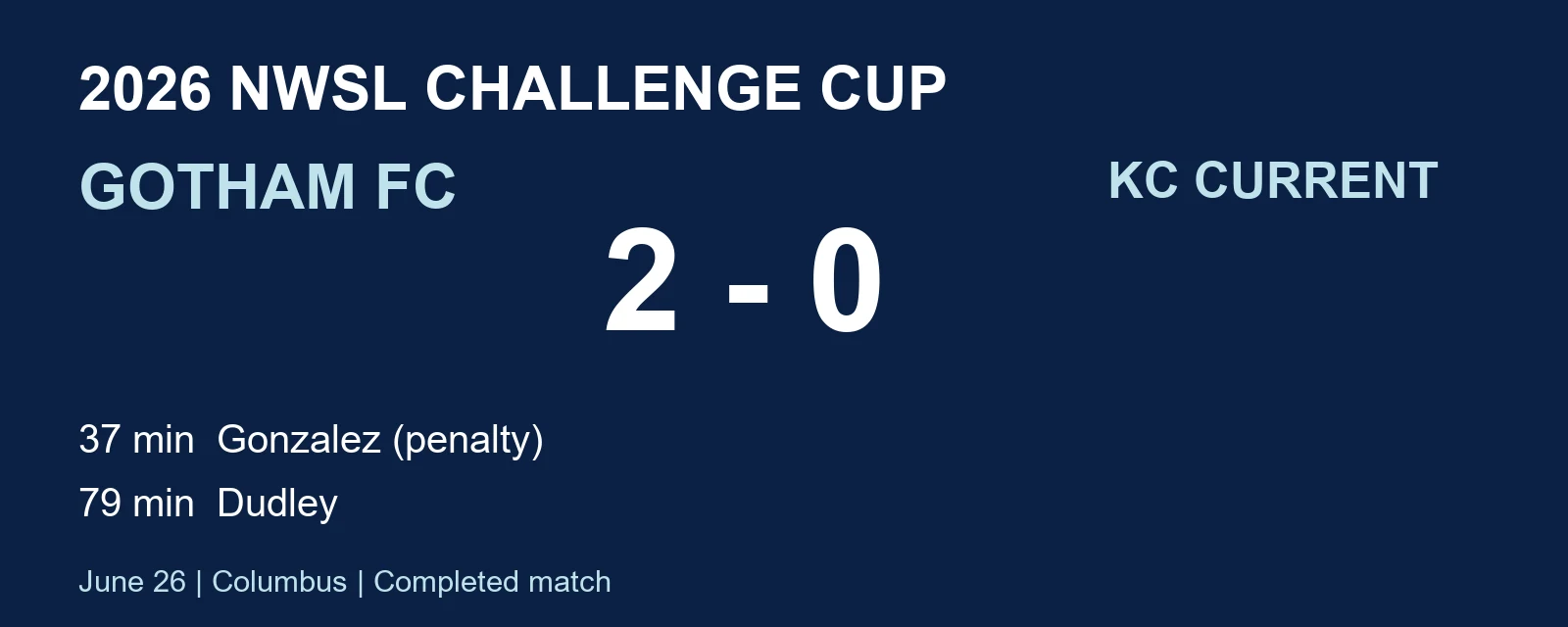
Gotham won the 2026 Challenge Cup in Columbus
Gotham FC beat the Kansas City Current 2-0 to win the 2026 NWSL Challenge Cup on June 26 at ScottsMiracle-Gro Field in Columbus, Ohio. Esther González scored a first-half penalty and Jordynn Dudley added the second goal after the interval. It was Gotham's first Challenge Cup title, secured with a clean sheet against the previous season's Shield winner.
The final score is straightforward, but the match was more interesting than a list of its two scorers. Ann-Katrin Berger had important work to do before Gotham went ahead. Kansas City then spent much of the second half within one goal of changing the contest, before Dudley's run supplied the cushion. Those are different contributions to the same trophy: keeping the game level, taking the lead and making that lead safer.
| Result | Scorers | Venue and date |
|---|---|---|
| Gotham FC 2-0 Kansas City Current | González 37' penalty; Dudley 79' | Columbus, June 26, 2026 |
This is a review of that completed cup match. Its qualification reflected the clubs' achievements in 2025, while the trophy was awarded during the 2026 season. The Gotham match report and Kansas City's account provide complementary views of how the evening unfolded; neither makes this result the conclusion of the league season.
The first half: Berger kept the game level before the penalty
Kansas City created the first clear openings
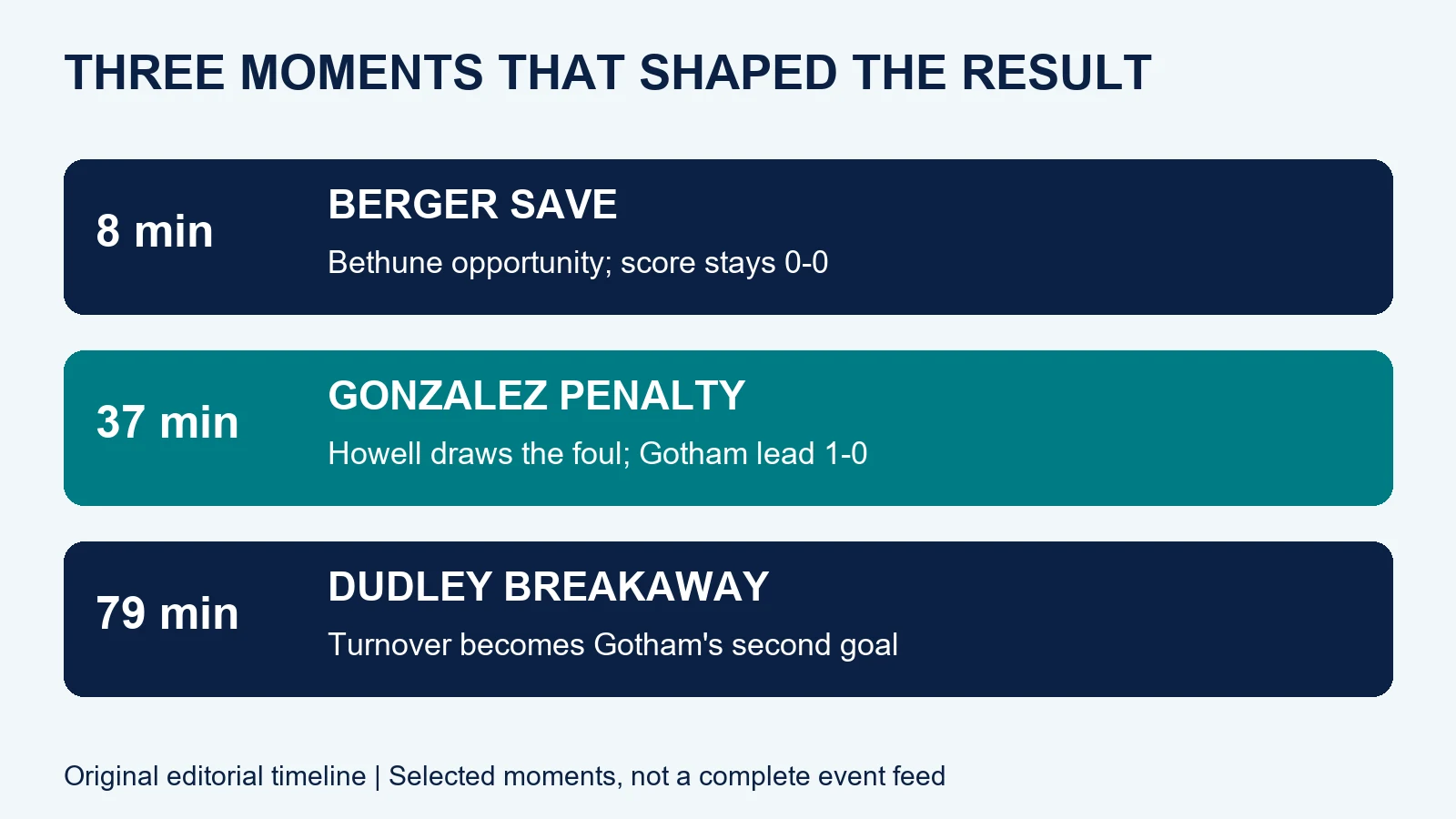
The first important intervention belonged to Berger. Croix Bethune forced an early turnover and reached a shooting opportunity in the eighth minute; Berger got a foot to the effort, which also touched the crossbar before being cleared. Later, a Bethune pass released Temwa Chawinga, with Berger saving again and Michelle Cooper unable to put the subsequent volley on target. Kansas City's official account identifies those opportunities before the opening goal.
That sequence changes how to read the clean sheet. A score of zero can describe an attack that created little, or an attack that found openings and met decisive resistance. Here there is evidence of the latter. Berger's work mattered at a time when one successful finish would have put Gotham behind, rather than merely reducing a comfortable advantage. The saves therefore belong near the beginning of any explanation of the win.
It also helps separate creating an opportunity from converting it. Bethune's ability to disrupt possession and find a teammate gave Kansas City routes toward goal. The final score cannot erase those routes, but neither can promising approach play be recorded as a goal. Gotham survived those tests with the score unchanged.
Howell won the penalty and Gonzalez finished it
The breakthrough followed a Gotham corner sequence. Jaelin Howell drew the foul in the penalty area, and González converted the resulting kick in the 37th minute. The significance of the goal was its timing as much as its method: Gotham reached halftime ahead after Kansas City had already produced threatening moments.
Howell's involvement is easy to lose when the scoring line names only the taker. Winning the decision and finishing the kick are separate actions, and the reports identify both. This was a regulation penalty, taken while the match was still being played, rather than part of a tie-breaking shootout. Gotham then had a one-goal lead to defend, which left the contest open and gave the second half a clear question: could Kansas City turn another promising attack into an equalizer?
The second half: a disallowed equalizer and Dudley's decisive run
Kansas City threatened the one-goal lead
Kansas City's search for a response continued after halftime. A delivery across the goal area required a Gotham intervention, while Chawinga later finished a move that was ruled offside. The cancelled effort did not change the score: Gotham still led 1-0. It nevertheless belongs in a review because it shows how different the match might have looked had a Kansas City attack produced a valid finish.
There is a useful distinction between recording pressure and awarding it a result. The Current's attacking sequences explain why the lead still required care, but an offside goal cannot be added to the scoreboard or treated as proof that the defending side had conceded. Likewise, a blocked delivery inside the area is evidence of an intervention, rather than evidence that a finish was inevitable.
At this stage a single equalizer would have restored parity. That makes the period between González's penalty and Gotham's second goal central to the match. It was the part of the evening in which a narrow advantage had to survive repeated attempts to remove it, rather than a period played with the outcome already settled.
Dudley turned a turnover into the second goal
Dudley supplied the decisive second score in the 79th minute. The league's report describes her forcing a turnover near midfield, carrying the attack herself and finishing low. It was a different route to goal from the first-half penalty: the scorer was also the player who converted a change of possession into a direct attacking opportunity.
The second goal changed the arithmetic. Kansas City now needed two goals to reach level terms, with far less regulation time remaining. Calling it insurance captures that practical effect, although the finish still required Dudley to make the opportunity count. Gotham had converted two distinct moments into a lead that held to the final whistle.
What the starting teams and substitutions show
Gotham's published starting structure was a four-three-three, with Berger in goal, a midfield including Howell and Rose Lavelle, and González, Dudley and Jaedyn Shaw in the attacking line. Kansas City was listed in a four-three-two-one, with Marisa Jordan starting in goal and Chawinga at the front. These details help locate the main participants in the match rather than leaving the scorers detached from the team around them.
For Gotham, the central defensive names included Tierna Davidson and Emily Sonnett. Their presence, alongside Jess Carter, supplies context for the defensive work recognized in the league's report. It does not mean every Kansas City chance was prevented before reaching the goalkeeper: Berger's interventions are part of the same defensive outcome. A clean sheet can require both an organized group and individual action when that group is tested.
Read these as the June 26 selections
A formation in a match report is the listed starting arrangement. It cannot, by itself, establish where every player stood during a particular turnover, who received an instruction to press, or how far a defender advanced in possession. The reports support describing Dudley's direct transition attack; they do not support inventing a detailed coaching plan from the formation numbers alone.
The substitutions also need their own scope. Mandy Freeman replaced Carter, and Sarah Schupansky came on for Lavelle. Kansas City introduced Rocky Rodríguez and Amelia White for Bayley Feist and Bethune, with Penelope Hocking and Ellie Bravo-Young also entering later. Those are changes in personnel. Without further evidence, they should not be presented as injury diagnoses or as a proven explanation for the next goal.
The two clubs' reports differ by a minute on the change involving González and Katie Lampson. The identity of the players is consistent, and that is enough for this review; attaching a falsely precise timestamp would add little. The broader point is that a substitution record tells us who participated and when the selection changed, while the reported chances explain what happened with the ball.
These are historical selections for one cup final. A player who appeared in June is not automatically a confirmed starter or contracted squad member for a later fixture. For a broader player reference, the site's Gotham FC roster guide provides the separate squad context. Keeping the match lineup and the roster question distinct makes both resources easier to use.
Why the statistics tell more than the score alone
The final match card presents a useful contrast: Gotham led the total-shot count, while Kansas City had more shots on target. The winner also had more possession. Those facts can coexist because they measure different parts of a match. None is a substitute for recording which chances became valid goals.
| Measure | Gotham | Kansas City |
|---|---|---|
| Shots | 10 | 6 |
| Shots on target | 2 | 3 |
| Possession | 55% | 45% |
| Corners | 3 | 5 |
Shot totals describe how often a side attempted to finish. Shots on target narrow the count, but still do not tell the whole story of the goalkeeper's response, the quality of the opening or the importance of the moment. Kansas City's advantage in that second measure is consistent with Berger having meaningful saves to make. It is not a reason to change the recorded result or discount Gotham's finishing.
At the other end, two shots on target and two goals describe what Gotham achieved that evening. They do not establish a sustainable conversion rate for future matches. One finish was a penalty and the other followed a turnover and run; treating both as evidence that any future shot would score would ignore the circumstances that produced them. A single final is a small sample, especially when each goal has an outsized effect on the result.
Possession has a similar limitation. A modest majority of the ball provides context for Gotham's involvement, but it cannot prove that Kansas City never threatened. The documented early saves and the second-half offside sequence are more specific evidence about those moments. Reading the numbers alongside the chronology prevents a broad percentage from flattening the contest into a story of uninterrupted control.
The most useful statistical reading therefore keeps several truths together. Gotham attempted more shots and scored twice; Kansas City put more attempts on target and finished without a goal; Berger and the defense preserved the advantage. The contrast is part of what makes this final worth revisiting. It explains why a two-goal margin can be deserved through decisive actions while still containing periods when the eventual winner was under pressure.
Why this cup was played in June in a neutral city
The qualification came from the 2025 season
The matchup was built from the preceding season's two title routes. Gotham qualified as the 2025 NWSL Champion, while Kansas City qualified as the 2025 Shield winner. The host's announcement describes the event as an annual super cup featuring the previous year's title winners. That explains the participants even though the match itself belonged to the following calendar year.
The June date made this an event during the regular-season calendar rather than a final deciding that season's league champion. The clubs' reports subsequently pointed toward their return to regular-season fixtures. Winning in Columbus added a separate honor to Gotham's season; losing did not eliminate Kansas City from the league competition. That distinction is particularly useful when an archived article describes the Challenge Cup as the first trophy of the year.
The public event information confirms the June placement, but does not establish a specific explanation for every scheduling change implied by older announcements. The useful record here is the final date and completed result. A theory about why an earlier plan changed would need its own evidence.
A completed Columbus showcase, with old preview details still online
ScottsMiracle-Gro Field supplied a neutral setting, bringing the clubs to a city outside either team's usual home venue. The Crew's announcement emphasized the chance to introduce NWSL play to Columbus. Gotham appearing first in the fixture listing should therefore not be read as evidence that the match took place at its ordinary home stadium.
This setting also explains why the host's promotional material is part of the event record. It documents the city, venue and original viewing arrangements, while the two clubs' reports document what happened on the field. Each source answers a different question. Using the preview as the final report would miss the score; using only the score would miss why the venue was notable.
Some old pages still contain ticket buttons or future-tense language. The venue now explicitly marks the event as passed, and Gotham's match card says final. Prime Video was the announced live outlet for that June match; a historical broadcast listing does not by itself confirm present replay access. Readers following the competition now can use the site's current schedule for upcoming fixtures rather than treating this archived showcase as an event still awaiting kickoff.
The 2026 format and where this result belongs
The 2026 Challenge Cup was a single match between the reigning NWSL Champion and the previous season's Shield winner. The league's format explanation also covers the contingency in which one club holds both honors: the Championship runner-up takes the other berth. Gotham and Kansas City qualified through different titles, so that contingency was not required for this edition.
The match rules provided two halves of regulation play and, if the teams remained level, a direct penalty shootout without extra time. That matters when comparing the cup with other knockout events, but the tie-break provision was not needed in Columbus. Gotham won in regulation. González's first-half spot kick was an incident within the match, not a shootout that decided a drawn final.
Older Challenge Cup results can describe a different competition structure. A group-stage table or a multi-round route in an earlier archive should not be applied to this one-game edition. For the longer background and the separate record of league finals, see the site's NWSL championship history guide. This result belongs under the 2026 Challenge Cup, with the previous season explaining qualification rather than changing the event's year.
That classification also keeps its sporting meaning clear. The cup awarded a trophy; it did not supply regular-season points or decide the eventual playoff bracket. A reader can recognize its value without using one June match as a prediction of everything that followed.
Revisiting the final through its sequence gives a fuller appreciation of Gotham's win. Berger helped protect parity before the breakthrough, Howell and González combined to turn a penalty decision into the lead, and Dudley's later run made that lead more secure. Kansas City created genuine openings but finished without a valid goal. Together, those details explain the completed result more precisely than either an isolated scoreline or a general history of the trophy.
Loading comments…