Where the race stands on September 27
There are three different brackets worth keeping apart: the matchups created by the table right now, a forecast of where the clubs could finish on November 1, and the official bracket that will exist only after Decision Day. This article uses the NWSL Schedule standings snapshot last updated September 26, 2026, at 6:00 p.m. ET. The games still to be played on September 27 are not included. Every seed below can move.
Gotham FC has the clearest numerical lead: 54 points from 26 matches, six ahead of San Diego Wave FC. Washington Spirit has 46 from 25, leaving it close to San Diego on points pace. The middle of the playoff field is compressed. Utah Royals and Portland Thorns FC each have 42, Kansas City Current has 41, Seattle Reign FC has 40, and Angel City FC and North Carolina Courage each have 39. The league's 2026 competition rules award playoff places to the top eight after the 30-game regular season; this is still a race, not a finalized field.
The provisional bracket if the season ended today
Apply the official 1-versus-8, 2-versus-7, 3-versus-6 and 4-versus-5 bracket formula to the current table and these would be the quarterfinals. This is a snapshot exercise, not a published playoff schedule.
| Current seeds | Hypothetical matchup | Points |
|---|---|---|
| 1 vs. 8 | Gotham FC vs. Angel City FC | 54 vs. 39 |
| 2 vs. 7 | San Diego Wave FC vs. Seattle Reign FC | 48 vs. 40 |
| 3 vs. 6 | Washington Spirit vs. Kansas City Current | 46 vs. 41 |
| 4 vs. 5 | Utah Royals vs. Portland Thorns FC | 42 vs. 42 |
At this instant Angel City takes eighth ahead of North Carolina on goal difference, +15 to +11, despite equal points. Utah and Portland also share 42 points and +8 goal difference; Utah is listed fourth because it has more wins, 13 to 12. The higher seed normally hosts a quarterfinal, although the rules allow the lower seed to host if the higher seed's venue is unavailable. The playoffs schedule guide explains the bracket and confirmed round windows in more detail.
The narrow race for the last places
A glance at points alone hides an important imbalance. Seattle has 40 points but has already played 26 matches. Angel City and North Carolina each have 39 from 25. They have one more scheduled opportunity to collect points than Seattle does. That game in hand is an opportunity, not three points already won: a loss adds nothing, a draw adds one, and a win adds three.
Denver Summit FC is next on 35 from 26. Four points behind eighth is a meaningful gap with four games remaining, but it is not by itself proof of elimination. The September 27 North Carolina visit to Utah could change both the playoff cutoff and the No. 4 hosting race. North Carolina then visits Seattle on October 2, a particularly direct test for two clubs competing near the line. Check the upcoming fixtures and current match statuses before using any of these projected pairings to plan a trip.
The projection method and its limits
Our forecast begins with one simple, reproducible question: where would every club finish if it kept earning points at exactly the rate it has earned them so far? The league schedules 30 regular-season matches per team. Divide a team's current points by its games played, then multiply by 30. That gives a points-pace estimate for the final table. It is an editorial baseline, not an NWSL prediction or a probability of qualifying.
Projected points = current points ÷ games played × 30
Example: Angel City has 39 points from 25 games. Its 1.56 points per game pace produces 46.8 projected final points. Seattle has 40 from 26, a 1.54 pace and 46.2 projected points. The decimal is an average across possible outcomes, not a score a team can actually finish with.
This calculation gives each club credit for its remaining opportunities without silently awarding wins for games in hand. It also makes the assumptions easy to challenge. A team may face stronger opponents in October than it faced earlier, rotate players, lose someone to injury, or simply draw when its earlier results suggest a win. We have not assigned made-up weights for those unknowns or treated a five-game streak as proof of what will happen next. The schedule is especially important where rivals meet: North Carolina's September 27 game at Utah and October 2 trip to Seattle can move two parts of the bracket at once.
On this baseline, Gotham reaches about 62.3 points, San Diego 55.4 and Washington 55.2. The two-tenths gap between second and third is too small to present as a secure finish. Utah and Portland both project to 50.4, while Kansas City projects to 47.3. Angel City and North Carolina each project to 46.8, followed by Seattle at 46.2 and Denver at 40.4. The spread from seventh through ninth is smaller than the value of one win, which is why our last two predicted places are deliberately low confidence.
Where this arithmetic produces an exact tie, we use current goal difference, then current wins, only to give readers a tentative order. Angel City currently has a +15 goal difference to North Carolina's +11. Utah and Portland are both +8, but Utah currently has 13 wins to Portland's 12. Those are today's values, not forecasts of November's tiebreakers. The official rules apply the final goal difference first, then final wins, goals scored, head-to-head measures and later criteria. Once new scores arrive, the live table will be more useful than this frozen arithmetic.
Projected eight-team field and quarterfinals
Apply the points-pace method to the September 26 snapshot and one club changes between today's provisional top eight and our projected final field: North Carolina comes in and Seattle drops to ninth. That is a narrow editorial call, not a claim that either club has secured or lost a playoff place. There are still games to play, and the forecast is particularly fragile at the seventh and eighth seeds.
Projected seeds 1–8
| Projected seed | Club | Current position | Projected points |
|---|---|---|---|
| 1 | Gotham FC | 1 | 62.3 |
| 2 | San Diego Wave FC | 2 | 55.4 |
| 3 | Washington Spirit | 3 | 55.2 |
| 4 | Utah Royals | 4 | 50.4 |
| 5 | Portland Thorns FC | 5 | 50.4 |
| 6 | Kansas City Current | 6 | 47.3 |
| 7 | Angel City FC | 8 | 46.8 |
| 8 | North Carolina Courage | 9 | 46.8 |
The decimals are a way to rank current scoring pace, not possible final point totals. Utah's No. 4 over Portland and Angel City's No. 7 over North Carolina are especially tentative: the projected points are identical within each pair. We use the current tiebreak indicators as placeholders, while the league will use the final statistics after Decision Day. Washington is only 0.2 projected points behind San Diego, so No. 2 versus No. 3 is also a near toss-up on this simple measure.
Four possible quarterfinals
The competition rules lock in the seed pairings, but none of these club matchups is official. Our projected first round is Gotham FC vs. North Carolina Courage (1–8), San Diego Wave FC vs. Angel City FC (2–7), Washington Spirit vs. Kansas City Current (3–6), and Utah Royals vs. Portland Thorns FC (4–5). The higher seed would ordinarily host, subject to the rules' venue-availability exception. Dates and exact venues for individual games remain TBA.
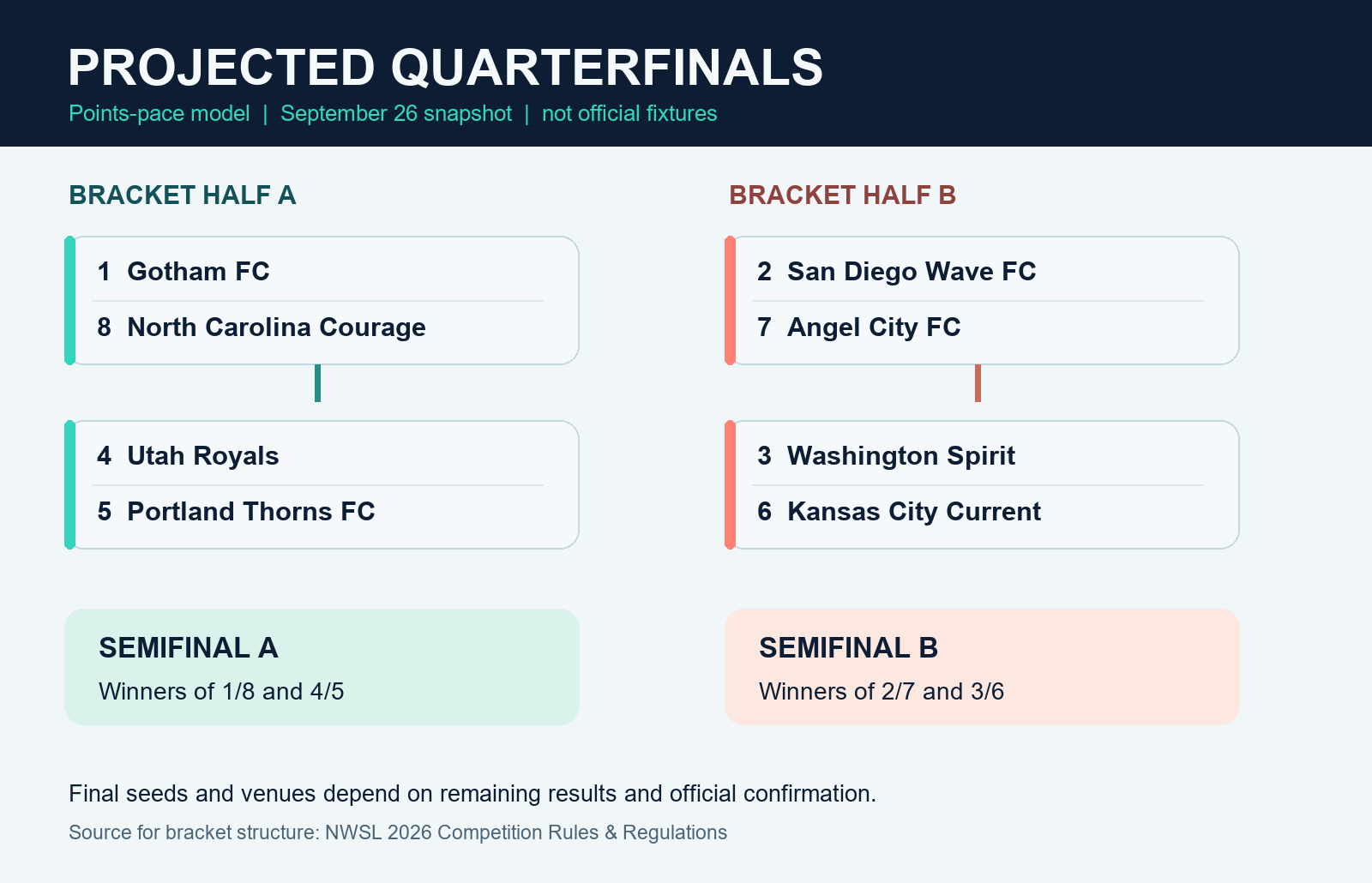
The bracket does not reshuffle after the quarterfinals. The winner of Gotham–North Carolina would meet the winner of Utah–Portland. San Diego–Angel City and Washington–Kansas City feed the other semifinal. That fixed route makes the difference between seventh, eighth and ninth consequential: if Seattle replaces Angel City or North Carolina in the final field, its opponent and the opponents' preparation change too. Follow the current table for seeds and the playoffs guide for the confirmed round windows.
How each bracket half could unfold
Projecting eight seeds is one judgment; picking the winners of seven knockout games is a much bigger one. The choices below describe a possible path through our forecast bracket. They use the table's points, scoring and defensive records as evidence, then make an explicit editorial call where the data cannot decide a single match. Every round would be one game, and a level score after 90 minutes would lead to two complete 15-minute extra-time periods and, if needed, penalties.
Gotham's half: North Carolina, Utah and Portland
Our first lean is Gotham over North Carolina in the projected 1–8 quarterfinal. Gotham's 54 points are 15 above the Courage's 39, and its 20 goals conceded in 26 games are the fewest in the league's current table. That defensive record is a reasonable reason to favor Gotham over one match. It is not a shutout forecast. North Carolina has scored 48 goals in 25 games, the highest total on the September 26 table, so this would be a real test of Gotham's most compelling strength.
The projected Utah–Portland quarterfinal is the closest call in this half. Both clubs have 42 points from 25 games and a +8 goal difference. Utah has scored 41 and allowed 33; Portland has scored 42 and allowed 34. Those totals are almost mirror images. We give Utah a very slight edge because its 13 wins currently put it ahead of Portland's 12 in the live standings. That is a thin tiebreak-based argument, not evidence that Utah will win a head-to-head playoff game. Portland advancing would hardly contradict the season statistics.
That leaves Gotham–Utah as our projected semifinal, with Gotham advancing to the title match. If Portland takes the 4–5 game, it would meet Gotham instead. If North Carolina's attack breaks through against Gotham, either Utah or Portland would face a very different semifinal opponent. The fixed bracket gives Gotham a path on paper, but it does not protect the No. 1 seed from one decisive bad night.
San Diego's half: Angel City, Washington and Kansas City
We narrowly favor San Diego over Angel City in the projected 2–7 game. The Wave have 48 points from 26 matches; Angel City has 39 from 25. San Diego's points pace is stronger, but Angel City's +15 goal difference actually exceeds the Wave's +11, and Angel City has a game in hand. That combination makes the predicted seed gap look larger than the difference between the sides may be on the field. This pick rests on San Diego's full-season points record, not on an invented matchup win probability.
Washington is our pick over Kansas City in the projected 3–6 game. The Spirit have 46 points in 25 games, five more than the Current have collected in 26. Washington has conceded 23; Kansas City has conceded 37. Kansas City has scored 43 to Washington's 36, so it has a visible attacking counterargument, but the Spirit's stronger points pace and lower goals-against total tip our call. The fixed bracket would then create a San Diego–Washington semifinal.
That semifinal is where our model gives the least separation among its upper seeds. San Diego projects to 55.4 final points and Washington to 55.2. We select San Diego by the slimmest margin because it is currently second, while recognizing that Washington has played one fewer match and could reverse the order well before Decision Day. Either club would be a credible finalist from this half. If Angel City or Kansas City wins a quarterfinal, the entire route changes without any reseeding.
Our Championship lean
Our full speculative path ends with Gotham FC over San Diego Wave FC. Gotham's six-point current lead over the Wave and league-low 20 goals conceded make it the most defensible single-club lean from this snapshot. This pick does not decide the Shield, final seed, match venue or title; official standings and knockout results determine those outcomes. In a single-match final, San Diego, Washington or another qualifier could win regardless of the regular-season point spread.
The NWSL has set the Championship for November 21 at Audi Field in Washington, D.C. That venue is fixed, so our projected No. 1 seed would not host the final as a regular home match. The playoff schedule guide has the round dates and bracket rules; use it alongside the live table as the real field takes shape.
The teams most likely to spoil this forecast
The clearest way to judge this forecast is to watch the small group of results that would change the eighth-place line or the first home quarterfinal. A projected point total is an average, while the table changes in jumps of zero, one or three points after each match. There is still enough schedule left for a club just outside our eight to replace one of our picks.
Angel City, North Carolina and Seattle at the cutoff
Our pace model favors Angel City and North Carolina over Seattle by less than one projected point. The actual table, however, has Seattle seventh on 40 points and Angel City eighth on 39, with North Carolina ninth on 39. Seattle's immediate case is straightforward: it already holds a point lead over both. Its problem in the model is that it has played 26 games to their 25. Strong results from its last four games would overturn our forecast quickly.
Angel City's current +15 goal difference is a useful cushion over North Carolina's +11 only if they finish level on points. It is not four bonus points, and a future run of results could change both goal differences. North Carolina has a direct route to improve its place: its scheduled trip to Utah on September 27 affects both its points and a projected No. 4 seed, while its October 2 visit to Seattle is a direct contest with another cutoff rival. If the Courage take three points in Seattle, they gain three while Seattle takes none from that game; the reverse result would strengthen Seattle's case. Check the match schedule for live status and rescheduling before treating either as a completed result.
Denver is further back at 35 points from 26 games. It can still reach 47 by winning all four remaining games, whereas Angel City and North Carolina can each reach 54 and Seattle 52. Those numbers are mathematical ceilings, not estimates of likely finishes or a complete elimination calculation. The order of teams between Denver and the cutoff matters too, so we do not label any club out of contention from one maximum-points comparison.
Utah, Portland and Kansas City in the hosting race
Our Utah–Portland quarterfinal depends on those teams retaining fourth and fifth. Both are on 42 points through 25 matches. Utah is ahead in today's table because the clubs are also level at +8 goal difference and Utah has one more win. Kansas City is just one point back on 41, although it has played 26 games. Two good results by the Current and dropped points by either rival would change the seed order, perhaps changing the opponent as well as which club has normal hosting priority.
Finishing fourth matters because the higher seed ordinarily hosts its quarterfinal, but the league's rules make venue availability an exception. Even a final No. 4 finish is therefore not a confirmed stadium announcement. Utah's pending North Carolina game makes this race unusually connected: the same score can move a potential host and a potential eighth seed. Our table and pairings should be refreshed after that match, then again after the Seattle–North Carolina game and every subsequent result. The live standings are the starting point; the format guide explains how each revised seed feeds the bracket.
Dates, decision points and how to follow changes
The NWSL's later, full 2026 schedule announcement places Decision Day on Sunday, November 1, with all 16 clubs playing simultaneously. The eight playoff teams, their final seeds and the club names in each quarterfinal can be settled only after the relevant regular-season results are final and the league applies its tiebreakers. Our September projection is meant to help readers understand the race before that point; it should not be mistaken for a ticket listing or an official fixture.
| Milestone | Confirmed window | What remains to be decided |
|---|---|---|
| Decision Day | November 1 | Final table and seeds |
| Quarterfinals | November 6–8 | Club pairings, individual kickoff details |
| Semifinals | November 13–15 | Advancing clubs and individual fixtures |
| Championship | November 21, 8 p.m. ET | Finalists; Audi Field is confirmed |
These windows come from the league's full schedule release. The league's September Championship update reconfirmed the final's Audi Field venue and 8 p.m. ET kickoff. For the first two rounds, a projected higher seed and date window do not establish a venue or precise kickoff; wait for the individual official match listing before making travel plans.
To update this forecast after a result, start with the current table and check that the game is marked final on the schedule. Recalculate points pace from the new points and games-played totals, then compare any close projected totals with the live goal difference and wins. Next, insert the revised seeds into the fixed 1–8, 2–7, 3–6 and 4–5 positions. Finally, separate that revised editorial view from the league's own confirmed qualification or fixture announcements. This routine is especially useful after North Carolina's scheduled matches at Utah and Seattle, where one result can move two clubs in the forecast.
Once Decision Day is complete, the forecast's job ends. The final standings and official playoff schedule should replace it for opponents, hosts, kickoffs and broadcast choices. Until then, the strongest takeaway from this snapshot is the shape of the race: Gotham leads, San Diego and Washington are close on projected pace, and the last places are sufficiently tight that one weekend can redraw the bracket.
Loading comments…