What the Washington win changed, and what it did not
Angel City FC took a substantial step in the 2026 NWSL playoff race on Saturday, September 26. Maiara Niehues scored in the 88th minute at Audi Field to beat the Washington Spirit 1–0. It was a late winner in a difficult road match, not a mathematical ticket to the postseason. The league awards three points for a win, and Angel City still has four regular-season games to play.
The club's September 26 match report said the result moved Angel City into fourth place at the time of that report. That is a valuable snapshot of the immediate effect, but it is not a promise that fourth would remain the team's position after the rest of the weekend. Portland's later draw with Houston and Sunday's remaining games can change positions around a crowded middle of the table. The safest reading is that the Washington win improved Angel City's position and gave it more control over its own finish; the exact seed must be checked again as other scores arrive.
There is also a data-timing issue for readers using this site's standings page. The table shown when this article was checked early on September 27 still had Angel City eighth on 39 points through 25 games, with the Washington game awaiting an update. Three points from the confirmed win imply 42 points through 26 games. The older table and the club's postmatch fourth-place statement refer to different moments; they should never be treated as conflicting results from the same completed set of games. Reopen the table after it refreshes, and compare the games-played column before making a claim about today's rank.
The 2026 rules provide the larger frame. Sixteen clubs play 30 regular-season games apiece, and the top eight at the end advance to a single-elimination postseason. A finish in fourth would carry a different first-round matchup from a finish in eighth, but neither the September 26 result nor a temporary top-four rank locks in either seed. Four remaining fixtures offer up to 12 more points, while teams near Angel City will have their own chances to move. For now, the clearest answer to “Are Angel City in the playoffs?” is not yet clinched on the evidence available here. Their recent surge has made the run-in more promising, and the race remains live.
The four remaining games on Angel City's schedule
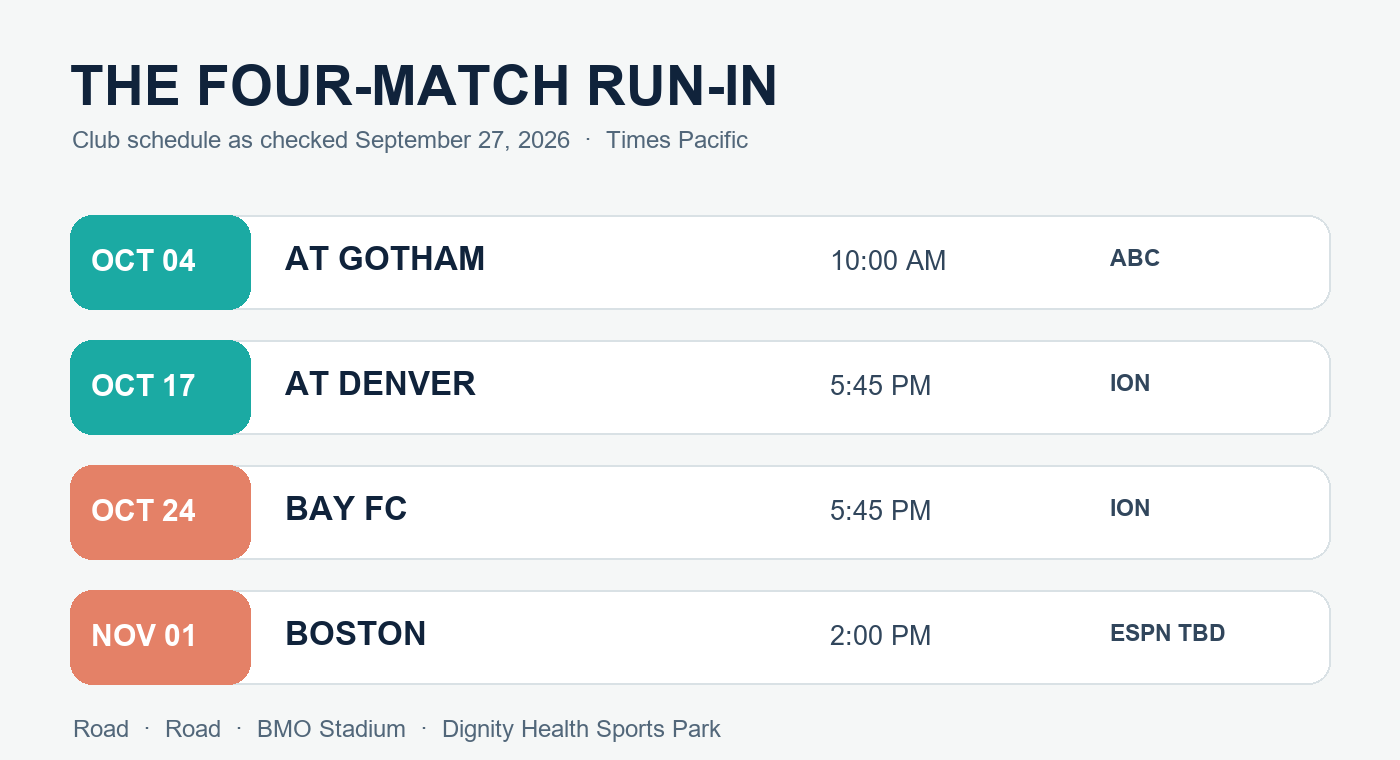
The run-in has a clear shape: two trips, then two matches in Southern California. After the win in Washington, Angel City's official schedule shows four remaining regular-season fixtures. All four can affect qualification; they may also separate teams tied on points or change which club hosts a quarterfinal. Times below are the club's listed kickoff times as checked September 27, and fans should check the fixture again before traveling or tuning in.
| Date | Opponent and site | Kickoff | Club broadcast listing |
|---|---|---|---|
| Sun, Oct. 4 | At Gotham FC, Sports Illustrated Stadium | 10 a.m. PT / 1 p.m. ET | ABC |
| Sat, Oct. 17 | At Denver Summit FC, Centennial Stadium | 5:45 p.m. PT / 8:45 p.m. ET | ION |
| Sat, Oct. 24 | Vs. Bay FC, BMO Stadium | 5:45 p.m. PT / 8:45 p.m. ET | ION |
| Sun, Nov. 1 | Vs. Boston Legacy FC, Dignity Health Sports Park | 2 p.m. PT / 5 p.m. ET | ESPN listing; details to confirm |
The two away trips: Gotham and Denver
First comes Gotham on Sunday, October 4. Gotham announced a kickoff change in September: the match is now at 1 p.m. Eastern, which is 10 a.m. Pacific, and ABC will show it nationally. That correction matters because an older listing may still show noon Eastern. Gotham was at the top of the standings display checked September 27, though a table position several days before the match is context, not a prediction. A road point there could be useful; three would be a major step. The match itself will decide which possibility materializes.
Angel City next travels to Denver on Saturday, October 17. The club lists a 5:45 p.m. Pacific kickoff at Centennial Stadium and ION as broadcaster. A longer gap between those two games gives fans a chance to reassess the standings after the Gotham weekend, but it does not reduce the value of Denver's three available points. Denver's position in one older table does not make this a scheduled win. Compare opponent form and the latest team news closer to kickoff, and use the TV schedule for any updated carriage details.
The home finish: Bay FC and Boston
Bay FC visits BMO Stadium on Saturday, October 24. The club lists 5:45 p.m. Pacific and ION. A week later, Boston Legacy FC visits on Sunday, November 1 at 2 p.m. Pacific. That last match is a home-designated fixture, but its venue is Dignity Health Sports Park in Carson, not BMO Stadium. The venue's event page confirms the location and identifies it as Angel City's regular-season finale. Anyone buying a ticket, arranging transit or making a meet-up plan should use the November 1 venue rather than assuming every Angel City home game uses the same stadium.
The club's Boston broadcast card currently lists ESPN with further details pending. That is a reason to recheck the full schedule near game day, not a basis for naming a specific ESPN channel or claiming a free stream. These four dates are the planning framework as of September 27. Results elsewhere, television listings and kickoff information can move independently; the fixture itself is the thing to refresh before each match.
How to read Angel City's playoff position
The basic target is straightforward: finish in the top eight of the 16-team table after every club has played its 30 regular-season games. The NWSL's 2026 competition rules set that cutoff and make the playoffs a single-elimination bracket. Eighth is enough to enter, while fourth and fifth are paired in a quarterfinal; those placements can matter for the route through the bracket and which team normally hosts. A temporary fourth-place reading in September and a final fourth seed are very different things.
For Angel City, the September 26 win should be read alongside the four remaining matches and everybody else's results. A table is a snapshot after a particular set of completed games. The same club can move several places without playing again if nearby teams have fixtures later in the weekend. That is exactly why the Washington postmatch position cannot be described as a permanent current ranking. The standings page is the place to check the updated table, but its data must first show the relevant completed games.
The top-eight line and games in hand
The “playoff line” is the boundary between eighth and ninth, not a published points target. It moves as matches are completed. A club a point behind with a game in hand may have a better route than a club a point ahead that has already played its extra fixture; neither fact alone guarantees where either will finish. Check points and games played for Angel City and the teams immediately above and below it. Then see whether any of those clubs meet one another, since head-to-head games distribute a limited set of points among direct rivals.
Four remaining Angel City matches mean 12 points are still available at most: three for each win, one for each draw, none for a loss. That ceiling is arithmetic, not a forecast. The 1–0 win over Washington brought the club three real points; the next four outcomes are unknown. A fan checking a scenario should start with the latest synchronized table, add a proposed Angel City result, and then allow nearby clubs their remaining opportunities. Declaring a magic number from an incomplete weekend would falsely imply those other schedules were settled.
Why goal difference matters before head-to-head
Points are the first ranking measure. If teams finish level on points, the 2026 rules break the tie by goal difference first, then total wins and goals scored. Head-to-head points come fourth, followed by head-to-head goals, disciplinary points and, if needed, a draw of lots or coin flip. That sequence matters to Angel City because a tight race can produce several clubs on the same point total. A win by more than one goal can help beyond the three points; conceding several goals in a loss can hurt beyond missing the points.
For a simple example, if Angel City and another club both finish on 48 points, the club with the better season-long goal difference ranks higher before their direct meetings are considered. The number 48 is only an illustration, not a projected qualifying line. Angel City's Washington clean sheet improved its own goal difference by one versus the earlier site snapshot, but the complete table also needs later matches. This is a useful reason to follow the final score, not merely the win-draw-loss label, through the last four games.
What the recent six-match run says about the team
Angel City's 1–0 victory in Washington extended an unbeaten run to six matches, according to the club's September 26 recap. That is the strongest simple description of its current form. The streak contains results earned in different ways: a multi-goal home win over Seattle, a road shutout against Utah and a late, narrow road win over the Spirit. For a playoff chase, that variety is encouraging because the next four opponents will ask different questions. It is still a short sample, and no streak by itself supplies the points from October games.
The standings can move faster than the narrative around a team. Angel City was described as sixth after beating Utah on September 20 and fourth immediately after beating Washington on September 26; each club report reflected its own postgame moment. A fan assessing the form should focus first on the completed performances and then return to the newly synchronized table for the position. That avoids mistaking a headline from last week for a live seed.
The Seattle and Utah wins built the platform
On September 16, Angel City beat Seattle Reign FC 3–1 at BMO Stadium. The club's match report recorded goals from Ally Sentnor, Ary Borges and substitute Taylor Suarez, as well as the first 10-win season in Angel City history. The three scorers matter more to the playoff argument than any one highlight: they show that the result did not depend on a single finisher. Interim head coach Leif Smerud described how the team handled the pressure of a significant match, but his reaction is evidence of that evening's response, not proof that future pressure will always be handled the same way.
Four days later, Angel City won 3–0 at Utah. Its official Utah recap reported the team's eighth clean sheet of the season, then a club record, and goals by Sentnor, Suarez and Sveindís Jónsdóttir. The context matters: Utah was reduced to nine players after two early red cards. Angel City still had to turn that advantage into a win and clean sheet, which it did. Yet that scoreline should not be treated as evidence that another road opponent will offer similar space or a comparable numerical advantage.
The Washington finish was another kind of test
The Washington game supplied a counterexample to any notion that Angel City can only win when it scores early or has an extra player. It remained 0–0 deep into a rain-soaked match at Audi Field. The club recap says Niehues came on in the 86th minute and scored two minutes later from outside the box after receiving the ball from Carina Lageyre. It was her ninth league goal of the season, a club single-season record. The goal gave immediate value to Smerud's late substitution, while Angelina Anderson's saves and Sarah Gorden's defensive work helped preserve the result.
This does not mean Angel City should plan to wait until the final minutes in Gotham or Denver. A late winner is a demonstrated solution to one close match, not a repeatable guarantee. It does show that the club has recently collected points through both attack-heavy and defense-heavy games. The practical question now is whether those performances continue when the schedule turns to the final two away trips and then the home-designated finish. The October results, rather than the six-match label alone, will answer it.
Practical paths through the run-in
There is no defensible single-number “Angel City must reach X points” answer while the September 27 table is still absorbing games. The club can add up to 12 points in four matches, while nearby teams have their own fixtures. The examples below start from 42 points after the confirmed Washington win, calculated by adding that win's three points to the 39 points shown on the earlier standings display. They are illustrations of arithmetic, not forecasts, official clinch scenarios or claims about a live seed.
| Four-game example | Added points | Illustrative final total | What remains unknown |
|---|---|---|---|
| Four wins | 12 | 54 | Other clubs' totals and final tiebreakers |
| Two wins, two draws | 8 | 50 | Whether it is enough for a desired seed |
| One win, one draw, two losses | 4 | 46 | Where the eighth-place line finally lands |
This is why a playoff race is more than a list of Angel City results. A win over a club near it in the table both adds three to Angel City's account and denies that opponent points in the same game. A draw splits the available points one apiece. A loss gives the direct rival all three. The effect depends on whether the opponent is still near the relevant cutoff when the match is played, so check the table at that time. Gotham, Denver, Bay and Boston are each scheduled opponents, but their September positions cannot be projected unchanged into October.
A strong finish can improve seeding
A string of wins can do more than clear the eighth-place line: it can move a qualifying club into a higher seed. Under the 2026 competition rules, fourth faces fifth in the quarterfinals, while eighth faces first. The higher seed normally hosts the quarterfinal, although the rules allow an exception when venue availability prevents it. Higher placement can therefore change the opponent and the usual hosting situation. A 54-point Angel City finish in the four-win example would be a strong total, but the exact seed still depends on everybody else's results and tiebreakers.
The first assignment is a difficult one: Gotham away on October 4. A result there would alter the available paths before Angel City goes to Denver, and it could change how urgent the two home-designated dates feel. Fans wanting the wider postseason bracket can consult the site's 2026 playoff schedule guide, then return to current results to see which seeds have actually been earned.
Dropped points leave more work to rivals
If Angel City draws repeatedly or loses, the points left on the table give other clubs more room to move above it. Four draws would add only four points, producing the same illustrative 46-point total as one win, one draw and two losses. Even those two paths are not identical under the rules: total wins are a tiebreaker after goal difference, and the scorelines also affect goal difference itself. Looking only at the final points column can conceal that difference.
A 46-point example cannot be declared either safe or eliminated from the partial September 27 evidence. The league determines the top eight after the last regular-season games, and the remaining matches of other clubs are part of that calculation. Angel City can make its task easier by winning its own fixtures; it cannot freeze the rest of the table. Recalculate only after every relevant final whistle, especially on weekends when opponents near the cutoff play later than Angel City.
Follow the race without losing the time context
The quickest way to keep this article useful as the table changes is to separate three questions: What has Angel City already done? What is next? What has the rest of the league done since then? The confirmed starting point for this guide is the September 26 win at Washington, followed by Gotham away on October 4. Angel City's official fixture list supplies the next four dates. A current table should supply the rank only after all relevant completed scores have entered it.
- Check the match status. A scheduled or in-progress result must not be counted as final. Confirm whether Angel City's latest match and the games around the playoff line have ended.
- Compare points and games played. A one-point lead between clubs with different games remaining is not a final margin. Make sure each row represents the same weekend of results before comparing ranks.
- Check the tiebreaker. If clubs share points, start with goal difference, then wins and goals scored under the 2026 rules. Head-to-head appears later in that sequence.
- Recheck the fixture and broadcaster. Use the schedule and TV listings near kickoff. Gotham's October 4 start was already changed to 1 p.m. Eastern, a reminder that an old calendar entry can be wrong.
If the question is whether Angel City has clinched, look for an official league or club clinching announcement or calculate every remaining rival outcome from a fully updated table. A single postmatch fourth-place headline does not do that work. If the question is whether Angel City can still improve its seed, the answer is yes: four matches remain and the rules reward higher places with different opponents and usually home field. The exact destination will be decided by the results, not by the September 27 snapshot.
As of this guide's September 27 check, the reliable facts are the Washington victory, the six-match unbeaten stretch reported by the club, the four listed run-in fixtures and the league's top-eight rule. Position and points gaps are the facts most likely to change next. Check them after the remaining weekend games and again after each Angel City match, particularly after Gotham. That gives the race its proper rhythm: confirmed result, updated table, next assignment.
Loading comments…