What San Diego confirmed about Macario's 2026 season
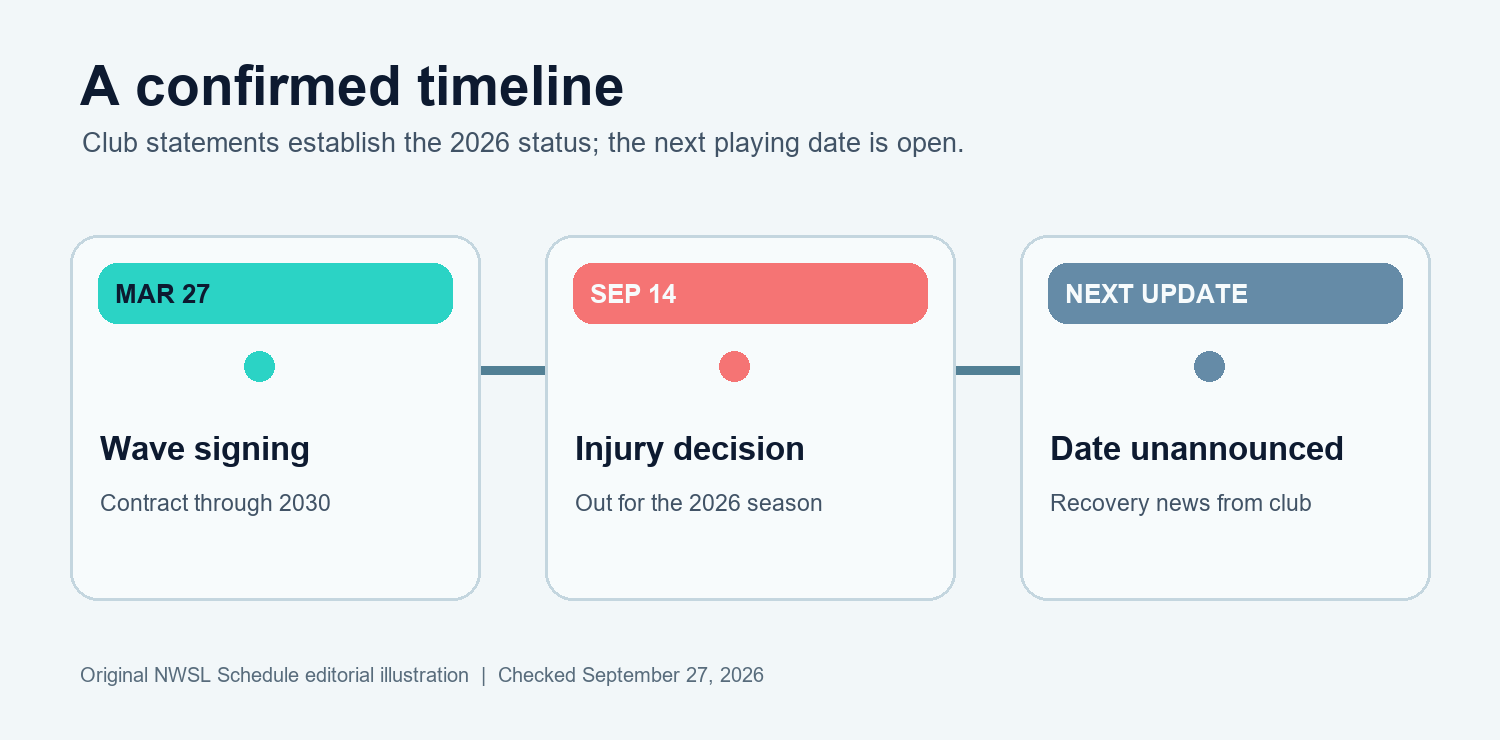
The central update is definitive for this year. On September 14, San Diego Wave FC announced that forward Catarina Macario had been placed on the NWSL Season-Ending Injury List while rehabilitating an ongoing knee issue. General manager and sporting director Camille Ashton said the club was disappointed that Macario would not be available this season. Macario's own statement said she would not get to represent San Diego on the field this season. The club announcement is the primary source for both the status and the wording of the injury update.
For anyone checking a future Wave match, that means Macario is not a player to anticipate in a 2026 lineup. The decision does not end the Wave's campaign or change the results they have already earned. It settles one question within a continuing playoff race: the team must finish its regular season and any postseason games with the players available to it.
Why the season-ending designation settles the playoff question
Supporters sometimes ask whether a late recovery could allow a surprise appearance in a playoff game. Here the most reliable answer comes from San Diego itself. The club did not merely describe a short absence or say it would reassess Macario before the quarterfinals. Ashton used the season-wide phrase “will not be available this season,” and Macario likewise referred to missing the chance to play for the club this season. There is no club-announced playoff return to plan around.
The 2026 competition rules describe the playoffs as the concluding knockout phase of the league season, with eight teams qualifying from the regular-season table. The rules help explain why the postseason is part of the same 2026 campaign. They do not need to be stretched into a medical or administrative prediction about one player. San Diego's own statement supplies the individual answer. The standings supply the separate team question of qualification and seeding.
Those distinctions matter as the Wave pursue a high seed. A club can keep winning while one planned contributor is absent, and an injured player's status does not itself award or remove standings points. It also means a match preview should not tease a Macario debut to attract readers when the latest direct club statement rules it out for the year.
What the club has and has not said about recovery
San Diego's release names an ongoing knee issue, but it gives no specific diagnosis, rehabilitation milestone, return-to-training date, or first-match target. It says further updates will be provided when appropriate. That is a narrow statement of public facts. A long contract or a player's optimism about eventually returning should not be converted into a forecast for opening day 2027, the next U.S. national-team window, or any other specific event.
Some supporters have noticed that earlier availability coverage used a heel label while the September club statement says knee. Contemporaneous reporting documents the earlier label, but neither the label nor the newer announcement explains how those matters are related. It would be irresponsible to join them into a diagnosis, infer a setback, or describe a treatment plan the club has not released. The safest account is simply to name each source and privilege the latest club wording for current status.
Macario acknowledged disappointment and emphasized focusing on her recovery and the larger commitment to the club. Those are her expressed priorities, not a schedule. Fans can follow the Wave's actual fixtures while waiting for the club to announce a new health update on its own terms.
Why the homecoming signing raised expectations
Macario's unavailable status has an unusual emotional weight in San Diego. On March 27, the Wave announced that they had acquired the U.S. national-team forward from Chelsea and signed her through the 2030 season. The club presented her as a major addition under the NWSL's High Impact Player Rule. Its welcome campaign invited fans to picture a hometown star in the Wave's attack during 2026. The September announcement now says that debut will not happen this year.
That change explains disappointment without requiring speculation about either the club's decision to sign her or her medical care. The March transaction was a long-term move. A season-ending injury in its first year is a major lost opportunity for supporters and player, but it does not tell us how the remaining years of the deal will unfold.
The contract and San Diego connection
The official signing announcement says Macario moved from Brazil to San Diego at age 12, played with San Diego Surf, starred at Stanford, and then won trophies in Europe with Lyon and Chelsea. She was scheduled for a formal welcome at Snapdragon Stadium on March 28 and was assigned No. 20. Those details are why “homecoming” was more than a convenient headline. San Diego was inviting the player back to a community central to her early soccer life.
The club also announced a contract through 2030. Its transaction line called the transfer fee undisclosed. Publicly reported estimates of the deal's value may attract attention, but they do not explain when an injured player will be able to compete, and the official release does not disclose a fee. For this season's planning, the supported facts are the contract term and the club's later statement that she is unavailable for 2026. Neither establishes an appointment on a 2027 match calendar.
The attacking role the Wave had hoped to add
San Diego's sporting director characterized Macario as an intelligent and creative attacker with vision and composure in the final third. In practical soccer terms, a player with that profile could help connect passes through a crowded central area, find a runner behind the defense, or make a different choice when an attack stalls. This describes the intended fit and its appeal to supporters. It is not a report of an NWSL partnership the Wave got to see in a 2026 match.
Macario brought a record that made the expectation credible. The March release credits her with eight goals in ten U.S. national-team appearances in 2025. The date matters. Those were performances for a different team in the previous year, not projected goals for San Diego in the current season. Her arrival offered the possibility of another high-end option alongside the attackers already on the roster, but that potential remained untested in Wave competition.
There is evidence of what the current attack actually did. In the September 18 win over Kansas City, the club's recap describes contributions from Kenza Dali, Trinity Byars, Melanie Barcenas and Gia Corley. A cross from Barcenas helped force the opener, while Dali delivered the late free kick that Kennedy Wesley headed in. Those plays do not answer how Macario would have meshed with them, but they show that the Wave have functioning attacking combinations without her. For a playoff preview, those observed combinations should carry more weight than an imagined Macario scoring line.
How the Wave reached September without a Macario debut
San Diego's late-season story is easy to distort if the injury news is treated as though a regular starter suddenly disappeared from the lineup. Macario did not make a competitive Wave debut in 2026. The club's results were accumulated with a different set of players from March onward. That does not lessen the disappointment of the homecoming that never reached the pitch, but it changes the analysis of what the team must do next: the Wave are continuing combinations that already exist, rather than rebuilding a system around a player who had been central to its recent match plans.
Three successive September wins illustrate how much of the work was done by the available squad:
- September 12, North Carolina Courage, 2-1: Gia Corley scored in the first half and Melanie Barcenas added what became the winning goal after halftime. Sandra Paños made an important double save while the match was still tight, according to the Wave's match report.
- September 18, Kansas City Current, 2-0: an attacking move ending in a Barcenas cross forced an own goal. Kenza Dali later supplied the free kick headed in by Kennedy Wesley, and the defense kept Kansas City off the scoresheet. The club recap describes a win built from more than one phase of play.
- September 25, at Racing Louisville, 2-0: Corley finished a move involving Trinity Byars and Lia Godfrey; Ludmila came off the bench and scored from Dali's pass. Barbara Bonansea also made a late Wave debut, another sign that the available attacking group can change within a match.
The Louisville club report put San Diego at 15 wins, eight losses, three draws and 48 points after 26 games. The site's September 26 standings snapshot agreed on the 48 points and placed the Wave second. That is evidence of a strong season so far, not a final-seed forecast. Four scheduled matches remain, and the sides immediately behind San Diego have not all played the same number of games.
These wins also suggest a more precise question than “How many goals did the injury cost?” There is no reliable way to assign a number to matches Macario never played. The Wave's recent goals came through wide delivery, midfield connections, a set piece and a substitution; their two latest clean sheets depended on Paños and the back line. In a knockout tournament, another creative attacker might have offered a different solution, but the evidence for the current playoff push is the squad that has actually competed. Supporters can follow that group's next test on the remaining schedule.
What her absence means for the playoff run
The practical cost of Macario's injury is a missing option, not a subtraction from San Diego's league points. Coach Jonas Eidevall cannot introduce the attacking player the club hoped to integrate this year, including as a late change in a knockout match. At the same time, the September wins show that the Wave have developed other ways to score and defend. How far they go will depend on the fixtures still ahead and the available squad's performance, not on a projected contribution from someone who has not played for them.
The current seed and remaining fixtures
At the site's September 26 standings update, the Wave occupied second place with 48 points through 26 games and Gotham led with 54 from 26. Washington's displayed 46 points from 25 games predated its September 26 home loss to Angel City; after that 1-0 defeat, its points remained 46 and its games played became 26. San Diego therefore held a strong but unfinished position, and the older table should not be read as a live game-in-hand advantage for Washington. The four Wave games below were still scheduled when this article was checked.
| Date | San Diego opponent | Venue position |
|---|---|---|
| October 2 | Orlando Pride | Away |
| October 17 | North Carolina Courage | Away |
| October 25 | Boston Legacy FC | Home |
| November 1 | Bay FC | Away |
These dates agree with the club schedule and the site's game records; check the live schedule for any later change. The October 17 meeting with North Carolina is particularly relevant because the Courage were immediately outside the top eight in the September 26 table. That dated observation is not a prediction of the match result or a guarantee that the same rank will hold in October. The October 25 game is San Diego's one listed home fixture in this closing four-game run. November 1 is Decision Day, when the league says all clubs finish regular-season play.
Under the 2026 competition rules, eight teams advance. Seeds one through four meet seeds eight through five in the quarterfinals; the second seed would meet the seventh. The higher seed is designated to host a quarterfinal or semifinal unless venue availability prevents it. The Wave's second-place position at the cited standings update therefore has a tangible possible benefit, but it is not yet an awarded home playoff game. The league has set November 6–8 for quarterfinals, November 13–15 for semifinals and November 21 for the championship. None of those dates is a Macario return target.
The actual roster and tactical questions
What can the existing side carry into those games? Against Kansas City, San Diego's opening score came from wide service that forced an own goal; the second was a set piece finished by a defender. Against Louisville, Corley finished a move created through teammates in open play, and Ludmila scored quickly after entering from the bench. Sandra Paños and her defenders then protected a pair of 2-0 outcomes. This spread of contributions is a more useful scouting picture than simply counting the forwards on a roster sheet.
Single-elimination play often asks a team to find an answer to a specific opponent rather than repeat its preferred pattern without resistance. Macario's creative profile might have given San Diego one more answer, which is why her unavailability is meaningful. That is an interpretation of the signing and the competition format, not a claim about how any particular future game will unfold. Before kickoff, watch who is actually named to the squad, whether Dali and the wide attackers can connect chances, and whether a substitute can change the tempo. Those observations can be made on the field; a hypothetical Macario performance cannot.
What supporters should watch for next
A fan following this story needs to keep two questions separate. “What is the Wave's next game?” has a public answer on the match calendar. “When will Macario play for San Diego?” does not yet have a dated answer. The first question will change as fixtures are completed and the postseason bracket forms; the second requires a new statement from the player, the club or an official squad update. A win at Orlando, for example, would affect league points but would not itself change the September 14 injury announcement.
For the remaining regular season, check the fixture date and opponent, then look at the updated table after the final whistle. Once the club releases a matchday squad, that list will show who can contribute in that game. The NWSL also maintains an availability-report page for clubs across the league. A report can help answer a near-term absence question, while a direct club statement is the stronger source for the season-wide decision already announced for Macario. Readers should check the displayed update date rather than assume any injury page is permanent.
This matters for how the late season is presented. San Diego's October 25 home match against Boston Legacy FC is the club's one remaining scheduled regular-season fixture at Snapdragon Stadium. It has real significance for supporters because it can affect playoff position and may be the last local chance to see this particular team before the bracket is set. It should be described on those terms. No responsible match preview or ticket guide should suggest a surprise 2026 Macario appearance after the club has said she will not be available this season.
Official updates and the 2027 question
The Wave signed Macario through 2030, so the relationship continues beyond the current campaign. That is a contract fact, not a recovery timetable. Neither the March signing release nor the September injury statement announces a first match in 2027. The latter says more recovery information will be shared when appropriate. Even a report that she is training again would need to be read for exactly what it says; training, roster availability and minutes in an NWSL game are distinct steps.
Supporters' disappointment is understandable: this was a return-home signing with a great deal of anticipation. It is also possible to support a patient recovery while appreciating the players who have carried San Diego's 2026 season. The verifiable present is clear: Macario is out for this season, the Wave have four listed regular-season fixtures after their 48-point snapshot, and the final seed remains to be decided. Everything about a future debut awaits an official update. That approach leaves room for optimism without inventing a date or a medical explanation.
Loading comments…