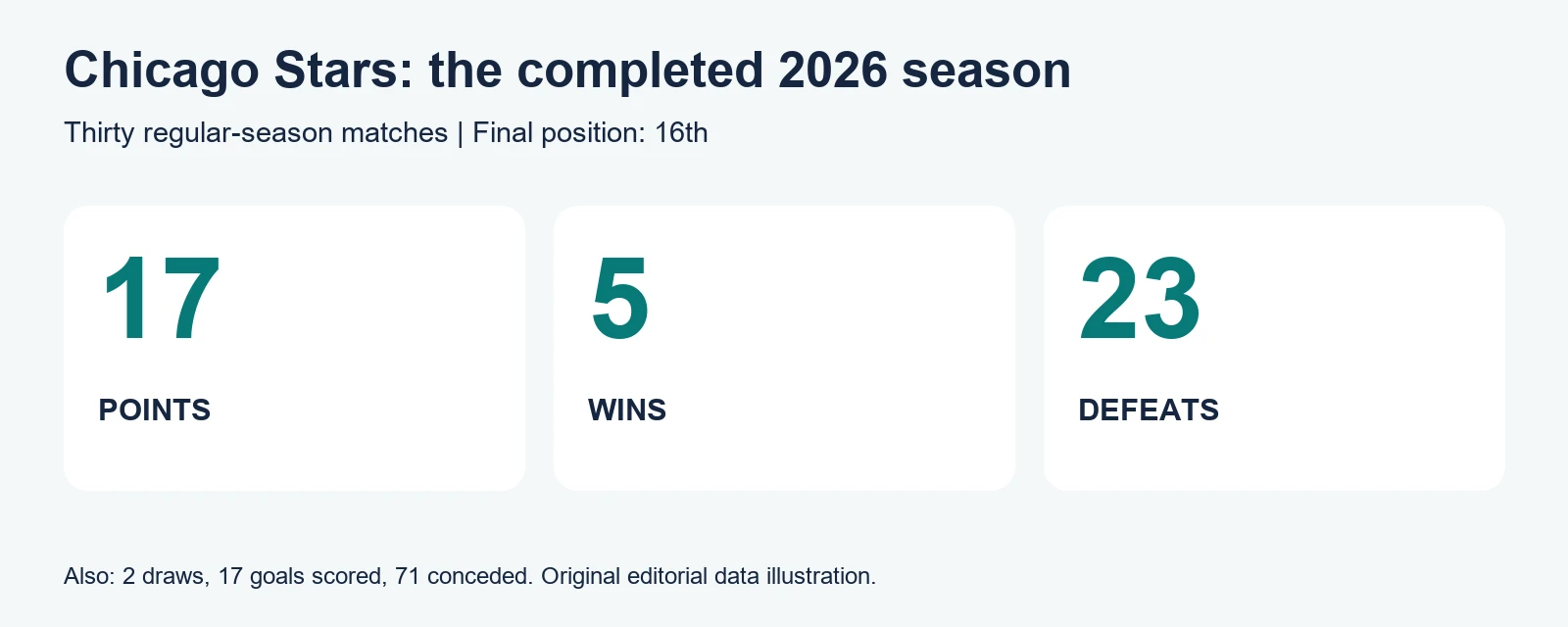
Chicago finished last after a thirty-match season
Chicago Stars FC finished the 2026 NWSL regular season in sixteenth place with five wins, two draws and twenty-three defeats. The club earned seventeen points from thirty matches, scoring seventeen goals and conceding seventy-one. Its season ended on November 1 with a 2-0 defeat away to Washington Spirit; Chicago did not qualify for the playoffs.
That is the starting point for reading the Chicago Stars 2026 schedule now. These fixtures are completed results, including the home slate at Martin Stadium. Readers looking for the next confirmed game should use the Chicago Stars schedule and results page, where each fixture can be checked in its own season. A past match list should not be used as a promise about next year's opponents, dates or broadcast arrangements.
The final record is especially stark because the problems appeared at both ends of the field. Seventeen goals across thirty games meant Chicago averaged well below one goal per match. Seventy-one conceded left a goal difference of minus fifty-four. The arithmetic explains the league position without requiring a claim that every defeat followed the same pattern: a narrow away loss, a high-scoring home win and a heavy defeat are different football experiences even when the table records each as a single result.
There were meaningful wins within that campaign. Chicago beat Kansas City in its home opener, defeated Boston in April, won at Bay FC in May and later edged Utah and Racing Louisville at home. Those five victories deserve to be remembered accurately. They also remained isolated: the Stars never put together consecutive league wins. The central feature of the season was the distance between individual positive days and sustained points collection.
This review follows that progression through the spring, the uneven summer and the closing run. The home and away splits are calculated from the completed regular-season results. Selected club match reports add detail where they establish what happened on the pitch; the scoreline alone cannot establish the team's tactical intentions or explain an individual player's form.
Spring brought three wins and an early scoring warning
The first twelve fixtures produced three wins and nine defeats. Chicago took nine points before the midseason break, scoring five goals and conceding twenty-four. Those numbers established a difficult baseline well before the heavy losses that would attract attention later in the year. The scoring shortage was already visible in March, April and May.
The home opener offered an immediate response
After losing 4-0 at Angel City on March 15, the Stars beat Kansas City Current 2-1 in their March 22 home opener. Rookie Tessa Dellarose scored on her first professional start, and Jordyn Huitema added a header after the interval. Kansas City pulled a goal back, but Chicago protected the lead to earn its first three points. It was a substantial result against the previous season's Shield winner, rather than simply a ceremonial first afternoon by the lake.
It also introduced players who would be part of the season's story. Dellarose supplied an immediate contribution, while Huitema opened her Chicago account. The value of that afternoon is clearest when kept within its actual context: it was a successful match with identifiable contributions, followed three days later by a 3-0 home defeat to Orlando. The win did not begin an unbeaten stretch.
The first twelve matches set a difficult baseline
April brought a second home win, 2-0 against Boston Legacy on April 25. Huitema scored early and Nádia Gomes added the second after halftime. Katie Atkinson made eight saves, an important detail behind the clean sheet. Emma Egizii and Aaliyah Farmer also reached starting milestones. A comfortable-looking final margin therefore contained both attacking contributions and significant goalkeeping work.
Chicago's third spring win came away to Bay FC on May 24, a 1-0 result that would remain its only road victory. A 2-0 home loss to San Diego followed on May 31. Across the opening ten matches, the Stars had scored in only two games: the wins over Kansas City and Boston. Eight scoreless outings made the early difficulty broader than a bad opening-night result. By the break, the challenge was to make scoring and points collection repeatable across different opponents, rather than waiting for another isolated success.
Home games supplied most of the points
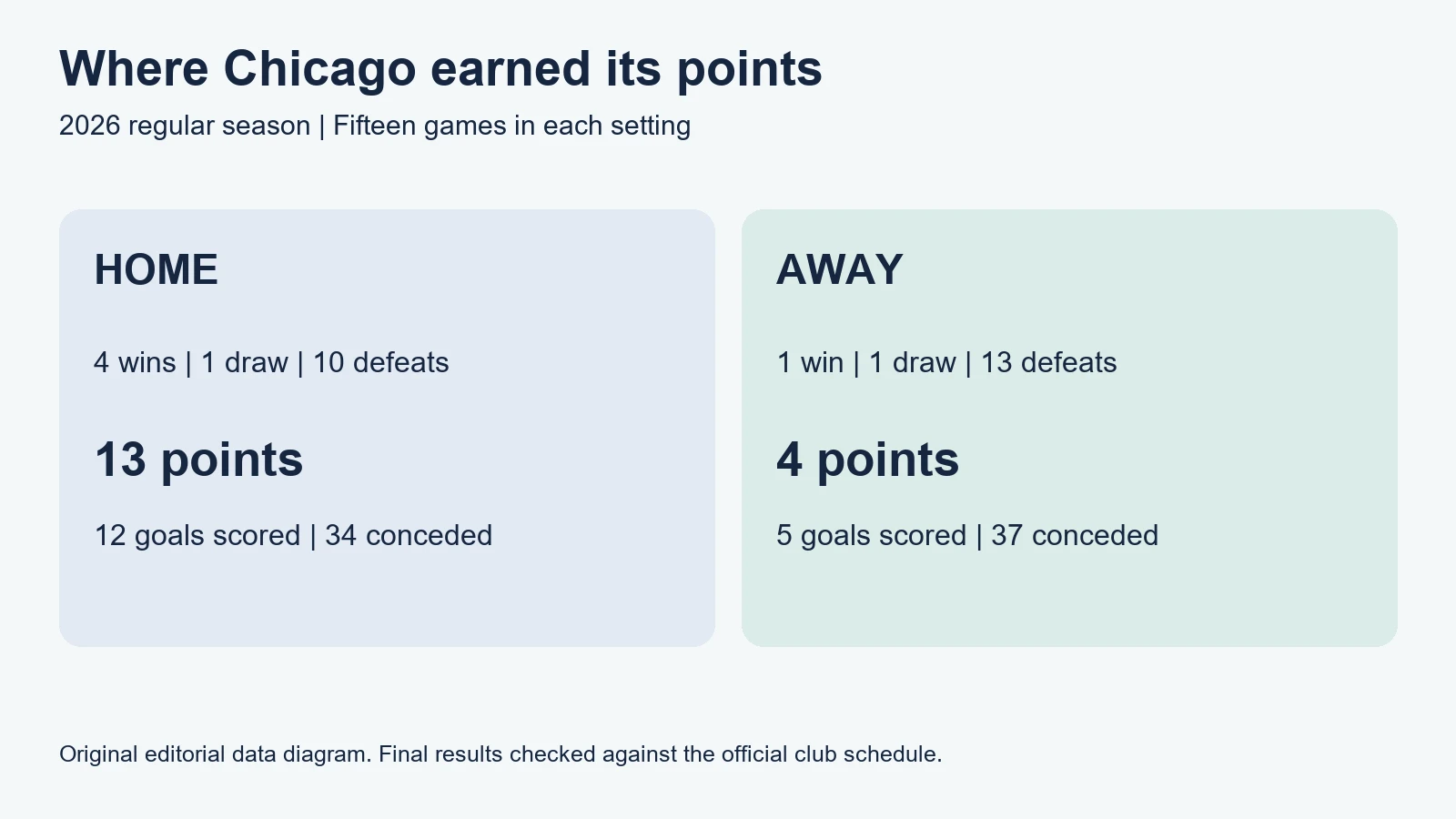
Chicago collected thirteen of its seventeen points at home. The fifteen home matches ended with four wins, one draw and ten defeats, with twelve goals scored and thirty-four conceded. That was the more productive half of the schedule, although it still left the Stars without a result in two-thirds of their home games.
The four home victories were against Kansas City, Boston, Utah and Racing Louisville. Chicago scored ten goals across those four matches. Its other eleven home fixtures produced only two goals, both in late-season 3-1 defeats. The distribution matters as much as the overall tally: the successful afternoons accounted for most of the attacking output at Martin Stadium. A home average on its own would conceal that concentration.
The remaining home point came in the 0-0 draw against Bay FC on August 9. Together with the April win over Boston, that result provided a home clean sheet, but the list also included defeats by Orlando, Gotham, Portland and San Diego. There was no extended home sequence that could consistently offset the away results. Remembering the four victories should therefore sit alongside an honest account of how rarely Chicago found the net in the other fixtures.
The road record left little margin
Away from home, Chicago finished with one win, one draw and thirteen defeats. It scored five goals in fifteen matches and conceded thirty-seven. The win at Bay and the later draw at Portland supplied all four road points. Even a modest improvement in the home record would have faced a substantial burden if that away pattern had continued.
These splits describe where the results happened. They do not establish that the stadium, travel or a particular playing surface caused them. What they do establish is a practical benchmark for the next campaign: improvement needs to survive outside Chicago as well as inside it. A few memorable home wins cannot support a competitive league position when the road schedule supplies so few points.
July and August brought brief recoveries
The return from the midseason break produced one of Chicago's most eventful wins. Against Utah on July 5, Huitema put the Stars ahead, but the Royals equalized before halftime and then took the lead through a second-half penalty. Sam Staab answered with a direct free kick before Huitema completed her brace with the late winner. Chicago had recovered from a deficit to win 3-2.
That match offered more than a result to add to the table. It combined a forward's two goals with a defender's set-piece contribution, and it required Chicago to score again after surrendering the lead. The club's report also recorded four first-half chances created by Mallory Swanson. Those are specific pieces of attacking evidence from a successful afternoon, rather than a general claim that the team had solved its scoring problem.
The following sequence showed why the distinction matters. Chicago lost its next four fixtures, to Boston, Angel City, Orlando and Racing Louisville. The 0-0 draw against Bay ended that run of defeats but did not bring a goal. Losses at Seattle and Houston followed. The July victory had supplied three valuable points; it had not changed the broader pattern of results.
The next win arrived on August 23, when Chicago beat Louisville 3-2 at Martin Stadium. This time the Stars never trailed, but they had to restore their lead twice. Jameese Joseph opened the scoring, Swanson put Chicago back ahead after Louisville's first equalizer, and Julia Grosso supplied the winner after the visitors had levelled again. The club recorded that afternoon as interim head coach Karina Báez's first victory.
These two summer wins should not be collapsed into a single comeback story. Utah required Chicago to overturn a deficit; Louisville required a third lead after two equalizers. Both demonstrated the value of having several routes to a goal. They also remained separated by seven fixtures without a victory. The August result would prove to be Chicago's last win of the season, leaving the successful details of that afternoon as useful examples to build on rather than evidence of an established recovery.
The final nine matches exposed the size of the gap
Chicago took only one point from the nine fixtures after the Louisville win. The sequence contained eight defeats and a draw, with five goals scored and thirty conceded. It was a decisive closing stretch because neither the attacking output nor the points return recovered over a sustained period.
Two heavy defeats preceded a point in Portland
The Stars lost 6-1 at Denver on August 29 and then 6-0 at home to North Carolina on September 6. The Courage scored twice before halftime and added four more goals after the interval. Conceding twelve across consecutive matches left an unmistakable mark on the season's final goal difference. The two results also show why the home and away question cannot explain the campaign by itself: one heavy defeat occurred in each setting.
The next match offered a different ending. At Portland on September 13, Taylor Wood headed in Emma Egizii's corner in stoppage time to secure a 1-1 draw. It was Wood's first professional goal, while Alyssa Naeher made seven saves. Chicago had earned a late point against a team that would reach the playoffs. The result interrupted the defeats without becoming the start of an unbeaten run.
The last six fixtures all ended in defeat
Washington, Gotham, Denver, Seattle, Houston and Washington again supplied the remaining six opponents. Chicago lost all six matches. Three of those fixtures were at home in October, so the finish cannot be described simply as an unusually long road trip. The Stars scored three goals across the sequence and conceded seventeen.
The closing home match was the 3-1 loss to Houston on October 23. The November 1 defeat at Audi Field then completed the season. By that stage, the question was no longer whether one dramatic late goal or one encouraging win could change the table. The results had established a longer problem of sustaining competitive outcomes from one match to the next.
Chicago finished scoreless in nineteen of its thirty league games. That measure places the heavy defeats within the wider season: several matches were lost by much smaller margins, but the Stars often had no goal with which to contest the result. Reducing the largest concessions and scoring more regularly are separate objectives, and the completed schedule gives concrete evidence for both.
Individual contributions still mattered at the finish
A season with seventeen points still contains individual work that deserves a precise account. Sam Staab's year is one example of continuity: the club's final match report recorded thirty appearances and twenty-nine starts. That is a substantial availability record across the entire league campaign. It should be recognized without treating one defender's presence as an explanation for everything the team conceded.
Staab also scored Chicago's final home goal, heading in Egizii's corner during stoppage time against Houston. The goal came after the Dash had built a three-goal lead, so it did not alter the result. It nevertheless added another identifiable set-piece connection to the season, following the late corner that had earned a point in Portland. Those moments give a more useful account than describing every defeat as entirely empty of contribution.
Simone Charley's late-season involvement supplied another distinction between a player's milestones and the team result. She made her first Chicago start against Houston, then came off the bench in the finale at Washington and led the Stars with five shots. In that last match, Chicago recorded nineteen shots to Washington's eighteen and four shots on target to the Spirit's three.
The club's finale report also explains the decisive sequence: the first half ended scoreless, an own goal put Washington ahead, and Trinity Rodman added the second late on. Chicago's shot totals did not prevent a 2-0 defeat. Volume therefore needs to be read alongside the outcome, rather than presented as proof that the Stars deserved to win.
These examples are selected contributions, not a ranking of the squad or a substitute for complete individual season statistics. Staab's appearances, Charley's involvement and Egizii's deliveries establish different things. Together they show why a review can acknowledge useful performances while still retaining the final record as its overall measure. The next step is to turn such contributions into a team that earns points more regularly.
What the completed season means for the next schedule
The next Chicago Stars campaign will be judged against clear evidence from 2026. More regular scoring would address the nineteen scoreless fixtures. A stronger road return would address the single away win. Fewer heavy concessions would help prevent a small number of matches from damaging the goal difference so severely. These are observations from the completed results, not a prediction that one signing or one appointment can resolve every issue.
There is also a useful distinction between sporting improvement and planning a visit. The club confirmed on August 25 that its 2027 home matches would remain at Martin Stadium in Evanston. Fans can use our Chicago Stars stadium guide for the practical venue context. That confirmation establishes a home location; it does not turn the dates on the 2026 schedule into next season's fixtures.
Separate confirmed changes from unfinished decisions
Another confirmed development was the September appointment of Vlatko Andonovski as chief soccer officer. His remit covers sporting and technical initiatives, including working with the head coach on areas such as recruitment and player development. The title matters: the announcement should not be read as a new head-coach appointment. Our guide to Andonovski's Chicago role explains that distinction in more detail.
As of November 11, the pages checked for this review do not establish a complete 2027 league fixture list or a final next-season squad. Older announcements can be particularly misleading here: a page labelled end-of-season roster updates may describe the previous winter. Readers should check the article's date and the season named in its opening paragraph before treating it as a current decision.
For future matches, return to the team schedule and check the season, opponent and match status. For assessing progress, keep the completed 2026 record in view. Chicago produced several good individual afternoons, including wins with multiple scorers and important contributions from new starters. The work ahead is to make those afternoons part of a reliable sequence across the whole schedule.
Loading comments…