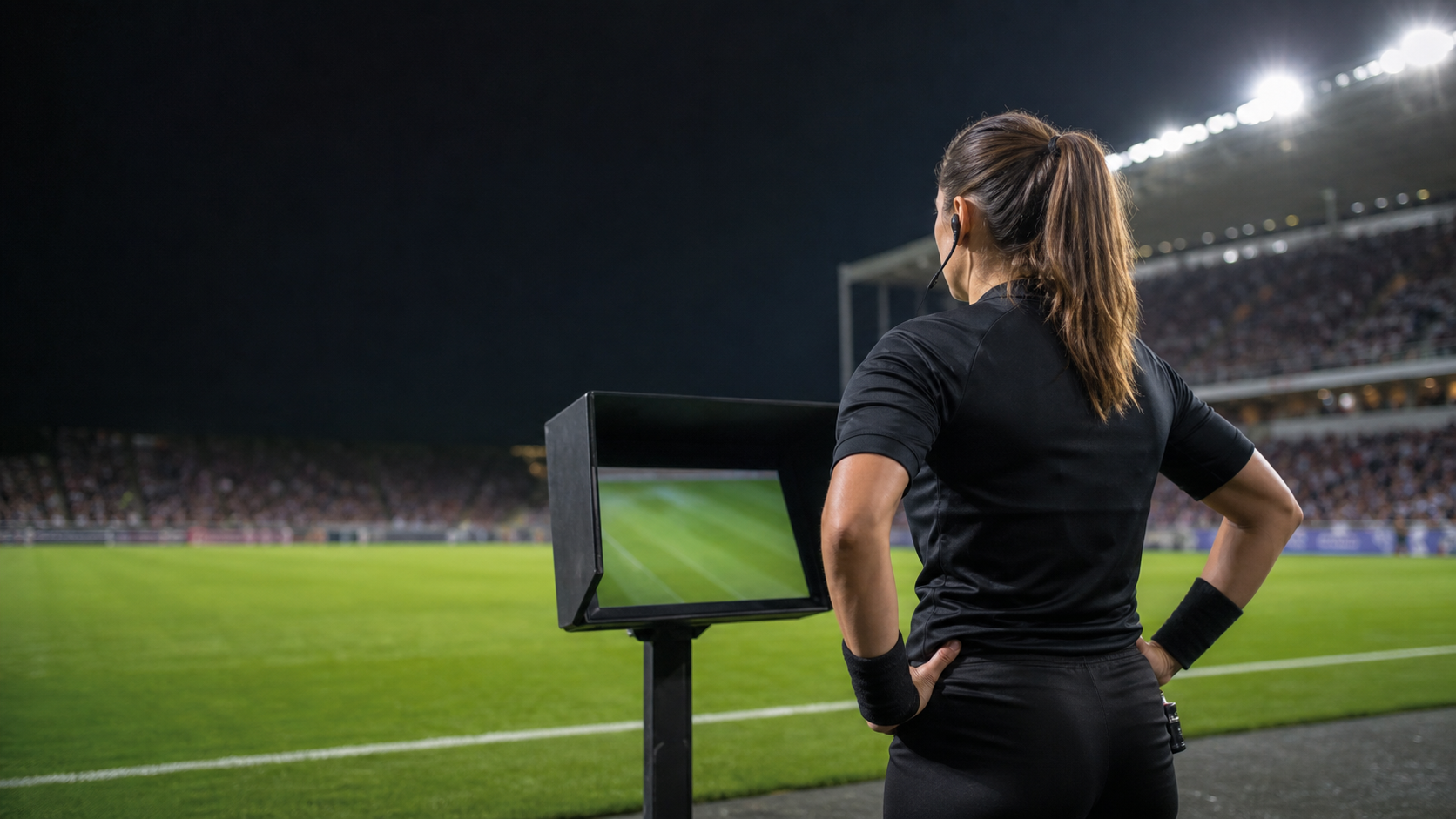
Short answer: VAR assists, the referee decides
Video review in the NWSL is best understood as a safety net for a narrow set of major incidents, not as a second referee with unlimited power. Under the IFAB VAR protocol, the video assistant can alert the referee to a clear and obvious error or a serious missed incident in an eligible category. The referee still makes the original decision and remains responsible for the final ruling. That distinction matters whenever a broadcast says that “VAR gave” a penalty or “VAR ruled out” a goal: the language is convenient, but the on-field referee owns the decision.
In an NWSL match, the video team watches eligible incidents while play continues whenever possible. Many checks are silent and finish without a stoppage. If the video assistant believes the required threshold may have been met, the referee can receive factual information or conduct an on-field review at the pitchside monitor, depending on the type of question. A replay that supports a different opinion is not automatically enough. The protocol is designed to correct an unmistakable error, not to replace one reasonable judgment with another.
The officials are part of the Professional Referee Organization system: the current 2026 NWSL Competition Rules and Regulations say PRO trains, assigns and evaluates the match officials. The league also introduced public referee announcements and explanations for VAR decisions in 2026. That change gives people in the stadium and viewers at home a clearer final answer, although it does not expose every conversation or camera angle used during the check.
The practical takeaway is simple. Watch the original call, identify whether the incident is reviewable, and then ask whether the evidence makes that call clearly wrong. Do not assume that a long delay guarantees an overturn or that the referee visiting the monitor means a decision has already been made. For the match and result surrounding a disputed call, use the NWSL schedule; the sections below explain how the review itself reaches its conclusion.
What VAR can and cannot review
VAR does not provide a general right of appeal for every whistle. Its authority begins with a defined category and then applies the clear-and-obvious or serious-missed-incident test. That two-part gate explains why a minor error can remain untouched while a match-changing incident receives several camera checks. It also explains why disagreement among supporters is not, by itself, evidence that the protocol was ignored.
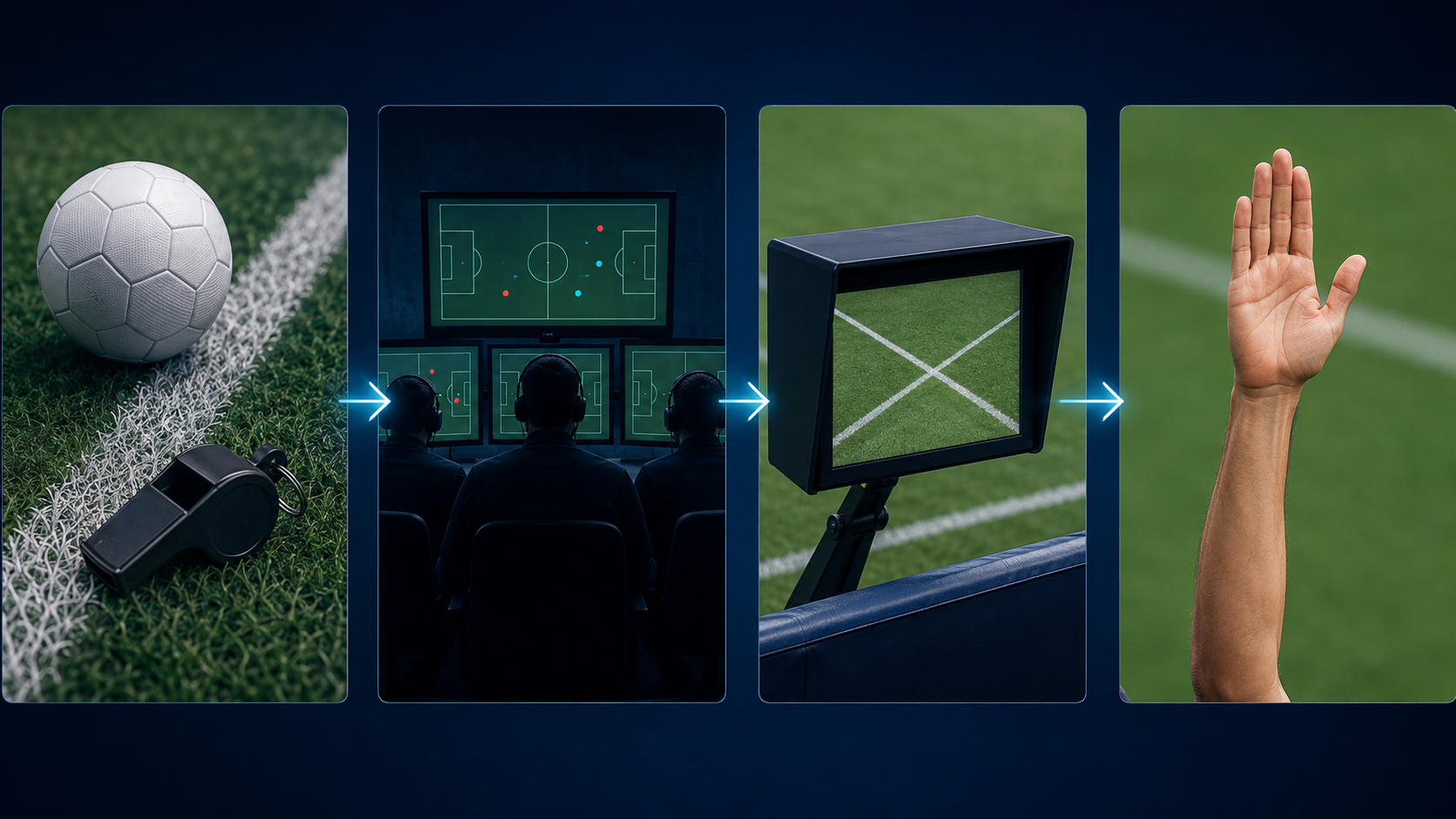
Core match-changing categories
The familiar core has four groups. A goal or no-goal review can include an offence in the attacking phase, such as offside, a foul or attacking handball before the ball enters the net. A penalty or no-penalty review can examine whether an offence occurred and whether its location was inside or outside the penalty area. A direct-red-card review covers matters such as denying an obvious goal-scoring opportunity, serious foul play or violent conduct; it is not a routine review of every possible yellow card. Mistaken identity allows officials to correct which player received a card.
These categories are connected to a consequential final decision, but the video team may need to look backward to establish it. For example, the decisive question on a goal may be an earlier touch in the attacking phase, while the decisive question on a penalty may be the precise point of contact. The category tells officials what they are allowed to examine; the threshold tells them whether the field decision should change.
Outside the core, and the 2026/27 caveat
The current IFAB protocol also lists a clearly incorrect second caution that leads to a sending-off. That is narrower than reviewing a missed possible second yellow: it concerns correcting a caution that was actually shown and was clearly wrong. The protocol also permits competitions to opt into immediate correction of a clearly wrong corner decision before play restarts.
That corner provision needs careful labeling in an NWSL guide. It is an IFAB competition option, not automatic proof of NWSL implementation. The official NWSL rules release reviewed for this article does not confirm that the league adopted the optional corner process. Accordingly, supporters should not expect every disputed corner, throw-in or free-kick direction to receive video intervention. Unless the league publishes an adoption notice, the safe NWSL reading is the established match-changing scope plus the specifically authorized current provisions—not an unlimited replay system.
From silent check to final announcement
The process begins before viewers see a monitor. The referee makes an original decision—sometimes a positive call, sometimes a decision to let play continue—and the video assistant automatically checks eligible incidents using the available broadcast and dedicated camera feeds. Players and coaches do not need to request a check. In fact, most checks finish in the background because the pictures support the field decision or do not show the kind of clear error that justifies formal intervention.
A check is not the same as a review
“Checking” on a broadcast graphic describes that routine video examination. A “review” is the next, less common stage after the VAR identifies evidence that the referee may have made a clear and obvious error or missed a serious incident. The video assistant can recommend that step and summarize what the replays show, but only the referee can initiate the review and make the final decision. This is why the appearance of a checking message should not be read as an expected overturn.
Play can continue during a check if it is safe and practical to do so. If the video team needs more time around a reviewable incident, the referee can delay the restart. Once play has validly restarted after being stopped, the protocol sharply limits when officials can go back, which is one reason the review team may ask the referee to hold the restart while it completes an initial look. Following the NWSL games today page alongside a live match supplies the fixture context; it cannot replace the referee's eventual ruling.
Information, monitor and announcement
Not every formal review looks identical. For a factual question—such as the location of an offence or an offside position—the referee may accept video information without visiting the pitchside screen. A subjective judgment, including the intensity of a foul or many handball questions, normally uses an on-field review so the referee can assess the replay personally. Normal speed helps show movement and intensity; slow motion can help identify a precise point of contact.
After the review, the referee signals and confirms the outcome. The NWSL's 2026 rules update added an announcement and explanation of VAR decisions, improving the information available inside the venue and on the broadcast. Check the NWSL TV schedule for viewing details, but remember that a broadcast may show more angles than the crowd sees while still carrying the same final explanation.
Why reviews take time
The IFAB protocol does not impose a countdown on a review; it explicitly puts accuracy ahead of speed. That does not make every delay efficient, but it means a referee cannot be forced to accept an uncertain result merely because a proposed time limit expired. The useful question is what officials are trying to establish and whether the elapsed time includes activity beyond replay analysis.
What officials must establish
A single incident can contain several linked questions. Officials may need to find the start of the attacking phase, choose the correct camera angle, identify the point and intensity of contact, decide whether an offence occurred inside the penalty area, and then determine the appropriate sanction. Normal speed is important for judging movement or force, while slow motion can locate a foot, hand or ball precisely. More zoom and more repetition do not necessarily make a subjective answer clearer.
PRO's NWSL Week 19 review shows the variety. One intervention examined a step on a heel, another moved a foul from inside the penalty area to a direct free kick outside it, and another looked back to an attacking handball before a possible penalty. Those are different evidence problems even though each appears to viewers under the same VAR label.
Published durations need context
PRO recorded the three Week 19 sequences at 3:30, 2:32 and 4:15. In Week 9, it listed a much longer 7:22 sequence, but its analysis says that interval included treatment for an injured player. Quoting “seven minutes for VAR” without that qualifier would wrongly treat the entire stoppage as officials staring at a screen. Conversely, noting the treatment does not erase the disruption supporters experienced.
The current competition rules allow the referee to add time for VAR checks and reviews as well as injury assessment and treatment. Added time is therefore a recovery mechanism, not proof that the rhythm of the match was unaffected. A credible critique can hold both ideas at once: complex reviews need enough time to get a major call right, while officials and competition organizers should still reduce avoidable searching, improve information and restore lost playing time as fairly as possible.
What PRO's 2026 decisions show
PRO's weekly Definitive Angle series is useful because it does more than repeat the referee's announcement. It explains selected incidents after the match and sometimes says that the crew reached the right result, intervened when it should not have, or finished with the wrong decision. Those different judgments disprove two easy narratives: video review is neither automatically correct nor automatically a failure whenever controversy remains.
A clear correction: Kansas City versus North Carolina
In the Week 19 match between Kansas City and North Carolina, Kansas City's Michelle Cooper tripped North Carolina's Ashley Sanchez near the penalty-area boundary. The referee initially awarded a penalty. Replays established that the offence occurred outside the area, so the decision became a direct free kick, and Cooper received a yellow card for stopping a promising attack. PRO supported that outcome.
This is the kind of boundary fact video handles especially well. The foul itself was not the central dispute; its location changed the restart and required a precise visual answer. The case also demonstrates that review is not simply a choice between “penalty” and “nothing.” Correcting the location can preserve the foul while changing the restart, and the disciplinary consequence can be assessed with the corrected facts. Readers can use the full NWSL schedule and results for the official match context.
Over-intervention and a wrong outcome
Week 8 offers the threshold problem. Bay FC goalkeeper Jordan Silkowitz collided with Boston forward Aissata Traoré after Traoré failed to connect cleanly with a shot. Review produced a penalty, but PRO's analysis said it would have preferred no review because the incident was subjective and the original no-penalty decision was not clearly and obviously wrong. An alternative call could be defensible without satisfying the intervention standard.
Week 9 shows a different failure. PRO concluded that a Bay FC goal against Chicago was wrongly disallowed and should have stood. Together, the cases separate three questions that often collapse into one: was review permitted, was intervention warranted, and was the final outcome correct? PRO's retrospective conclusion can improve accountability and future training, but it does not reopen the completed match or change the stored result. That limitation is part of the IFAB protocol's match-validity framework.
Why fans remain frustrated
Supporter frustration is not one complaint. It combines lost rhythm, uncertainty inside the stadium, distrust of subjective thresholds and the experience of seeing a replay that appears decisive without knowing which part officials are evaluating. Recent r/NWSL discussions about a possible time limit and perceived handball consistency illustrate those reactions, but they are conversation samples rather than representative polling. Their comments also include fans who defend taking time for accuracy or disagree about how the law applies.
Delay creates an information gap
During a long stoppage, the officials may be comparing angles, locating an offence or waiting for medical treatment, while spectators often receive only a “check” message. That gap invites people to count seconds and speculate about the problem. The referee's 2026 post-review announcement is a meaningful improvement because it supplies the decision and a reason at the end. It does not narrate each stage in real time or tell the crowd which camera view has become decisive.
PRO's public review clips help later, but its Week 19 page expressly notes that the recordings do not include audio. They show the screen seen by the video assistant, not a complete transcript of the crew's communication. Broadcast commentary can bridge some of the gap, yet viewers watching different services or attending in person may still receive different levels of explanation. The NWSL TV schedule identifies where to watch; it cannot guarantee identical replay access or commentary across presentations.
Similar replay, different threshold
Apparent inconsistency is the harder complaint. Two handballs or goalkeeper collisions can look similar in short clips but differ in arm position, movement, contact, the original field decision or what the available angles prove. Because intervention tests whether the original decision is clearly wrong, identical final preferences do not necessarily produce identical review outcomes. A no-call that remains reasonably supportable should survive even if another referee could have called the offence live.
PRO's Bay-Boston analysis makes that tension concrete: it accepted that a penalty argument existed but still preferred no intervention because the original no-penalty judgment was not clearly erroneous. That threshold can feel unsatisfying to anyone seeking perfectly uniform outcomes from replay. It is also what prevents the video booth from re-refereeing every subjective incident. Fans are justified in asking officials to apply and explain it consistently; a disputed outcome alone does not establish team bias, technological failure or bad faith.
How to evaluate a disputed review
A replay clip is easier to assess when the debate is broken into five questions. This checklist cannot reproduce the officials' complete evidence or communication, but it can separate a rules argument from frustration about the result.
- What was the original decision? “No penalty” is a decision just as surely as a whistle is. The intervention threshold is measured against that starting point.
- Is the incident in a reviewable category? Identify a goal, penalty, direct red card, mistaken identity or another specifically authorized current provision. A plainly wrong throw-in normally remains outside VAR's reach.
- What exactly might be clearly wrong? Separate factual location or identity from subjective force, intent or arm position. An alternative reasonable interpretation is not automatically a clear error.
- Does the attacking phase matter? A goal or penalty sequence may require an earlier offside, foul or handball to be checked. The final contact shown in a viral clip may not be the only issue.
- What do the explanation and later review say? Start with the referee's match announcement, then look for a relevant PRO Definitive Angle entry. PRO covers selected cases, so silence is not an endorsement or rejection.
Camera speed also matters. Normal speed is usually more informative about motion, intensity and whether contact belongs to a natural football action; slow motion is useful for the precise contact point. A freeze-frame can clarify location while exaggerating how an incident developed. Ask what each view proves instead of assuming the most dramatic image is the most complete one.
Finally, preserve the difference between analysis and the official record. The NWSL schedule and results and today's match page provide that record. Later PRO criticism can explain an error and guide training, but it is not an appeal process. This framework makes criticism more specific: supporters can argue about scope, threshold, evidence, communication or delay without blending every concern into “VAR got it wrong.”
Transparency has improved, but the next steps are clear
The referee explanation is the most visible NWSL improvement in 2026. It tells the stadium and broadcast audience what changed and why, closing the worst version of the information gap. PRO's selected weekly analyses add a second layer by showing the video screen, recording review length and offering a technical judgment after the match. Neither layer is complete: the announcement is brief, and PRO says its public screen recordings contain no audio.
A useful next step would be more consistent post-match coverage. A simple incident record could identify the original decision, review category, final decision, elapsed review time and a short rules explanation for every formal review. Publishing it on a predictable schedule would help supporters compare like with like instead of relying on clipped broadcasts. When a delay includes injury treatment or another interruption, separating those components would make duration data more meaningful.
Better stadium communication also matters. The final announcement should be audible and paired with a clear visual summary where venue systems permit, while broadcasts can repeat the explanation after replays. That would not require releasing live official audio or turning a referee into a commentator during the check. It would simply ensure that people following on television—see the NWSL TV schedule—and people in the stands receive the same essential outcome.
Transparency must coexist with match control. The competition's Only the Captain approach limits who can confront the referee, reducing the crowd around an official after a difficult decision. That restriction does not prevent substantive criticism afterward. Clubs, analysts and supporters can challenge whether a review met its threshold, and PRO can acknowledge a mistake, without personal abuse or unsupported claims of corruption.
VAR will not eliminate debate because some football decisions remain subjective. A fair 2026 assessment is narrower: the system can correct important factual errors, sometimes intervenes too readily, sometimes still reaches the wrong result, and can take longer than supporters find acceptable. Public explanations and PRO reviews make those strengths and failures easier to see. The standard for progress should now be consistent intervention, efficient evidence gathering and an accessible account of what officials decided.
Loading comments…