Why charter flights are back in the NWSL conversation
NWSL executives are asking for better travel support, and the argument reaches beyond whether a player gets a more comfortable seat. In a league with repeated road trips and crowded stretches of matches, control over departure times and connections can influence how much usable time a team has between games. The debate is about working conditions and the quality of preparation as well as the flight itself.
Just Women's Sports reported on October 28, 2026 that executives in ESPN's anonymous GM survey wanted more charter flights and stronger travel support. That is a documented current concern from the reported survey, not a scientific finding that a particular journey caused a defeat or a poll proving every fan wants the same policy.
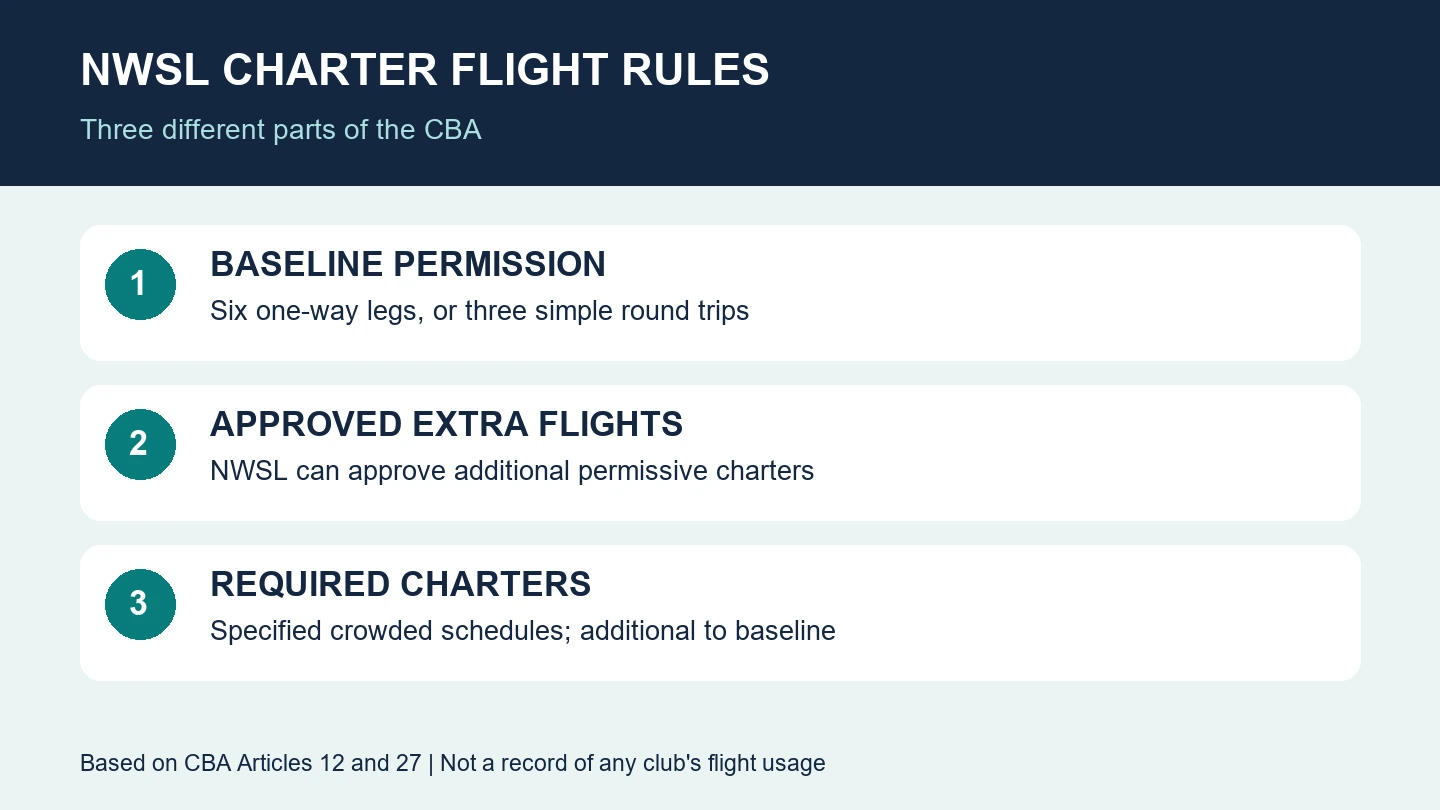
The phrase attracting attention is “six legs.” Read casually, it sounds like an absolute rule that a team can never take a seventh charter flight. The full collective bargaining agreement is more nuanced. It distinguishes a baseline permission, additional flights the league may approve and flights required under specified scheduling conditions.
Six permissive charter legs are not a universal ceiling on every charter a team may take. Approval-based extras and required flights are separate parts of the agreement.
The NWSL Players Association's CBA overview describes minimum charter standards alongside game frequency and time off. That context matters: a charter policy is one element of workload management, rather than a replacement for a sensible calendar, adequate breaks or good accommodation.
This guide uses the published agreement available on October 29, 2026 to explain the distinction. It does not claim access to every club's travel records or every approval the league has granted. Start with the rules, then use the NWSL schedule to understand the sequence of matches behind a particular complaint. Those two pieces provide a stronger basis for discussion than assuming any commercial journey is automatically a violation.
Six flight legs are a baseline permission, not an absolute ceiling
Article 12.1 of the union-hosted 2024–2030 CBA permits teams, beginning in 2025, to book three charter round trips or six legs in a league season. It also expressly allows NWSL to approve more. That second provision disappears when a summary calls six an unconditional maximum.
The union's description of six legs as a right and the agreement's permissive wording address the baseline access teams have. Neither establishes that every club must use all six, nor that any desired seventh flight is automatically approved. Those are different questions about actual use and league decisions.
What counts as a leg rather than a round trip
A leg is one one-way segment in the itinerary. In a simple illustrative trip, flying from the home city to the away city is one leg and flying home is another. Three such out-and-back journeys therefore account for six legs, rather than six round trips.
A multi-city road swing shows why the distinction matters. Imagine a fictional route from City A to City B, then City C, then back to City A. The diagram would contain three one-way movements. Calling it one road trip does not turn it into one flight leg, while calling it three legs does not mean it contains three return journeys. Actual contractual accounting still needs the team's real itinerary.
How approved extra flights differ from required charters
There are three useful categories to keep separate. Baseline permissive flights fall within the six-leg allowance. Extra permissive flights need league approval. Required charters arise under the agreement's specified scheduling provisions and are additional to the permissive number.
For example, a hypothetical club could use its baseline allowance and separately face a qualifying mandatory-flight situation. It would be misleading to tell supporters that the baseline automatically cancels the separate requirement. It would be equally misleading to claim that a club can add unlimited optional flights without any approval process.
These distinctions also improve the policy debate. Someone can argue the baseline should be broader while recognizing that exceptions already exist. Conversely, pointing to the possibility of an exception does not answer whether the process gives teams enough predictable planning flexibility. Both positions need more detail than a six-flight headline.
Which crowded schedules trigger mandatory charter travel
The mandatory provisions connect travel to particular scheduling pressures. They do not say that every match played between two weekends must involve a charter. To understand a real case, read Article 12 together with the season-schedule provisions in Article 27 of the agreement.
This is where a fan's calendar can be useful without being conclusive. It shows when matches are scheduled; it does not necessarily reveal the contractual classification of every competition or whether an itinerary received separate approval. Treat it as a way to identify the right questions.
The CBA's match-count and three-game-week provisions
One trigger concerns a team scheduled for more than 42 counted NWSL games in a league season. The agreement then requires charter flights into and out of midweek NWSL games. The qualifying count has its own definition: it is not simply every match a player might appear in anywhere. Article 27 excludes categories including official tournaments from that particular maximum calculation.
Another trigger addresses repeated three-game weeks and consecutive crowded weeks. Article 12 describes the additional charter requirement for qualifying sets beyond two, or the second consecutive midweek game. Its own example uses a weekend–Wednesday–weekend sequence to explain the calculation.
For a simplified illustration, imagine a fictional club with a third distinct qualifying weekend–midweek–weekend set. The relevant question is whether that set activates the agreement's additional charter provision. Counting only the midweek date would miss the reason the broader sequence matters. The example illustrates the contract's structure, not a claim about an actual club's flights.
Why an ordinary Wednesday match is not enough information
A Wednesday fixture alone does not establish that the team has crossed the counted-game threshold, reached the repeated-set condition or entered a qualifying rescheduling exception. You need the neighboring weekends and the previous crowded stretches, plus the applicable scheduling history.
Article 27.7 separately addresses a rescheduled regular-season game that produces consecutive midweek weeks under specified circumstances, such as stadium availability, cancellation or postponement. It requires charter travel for that rescheduled game. That is a targeted provision, not an unrestricted license to create any compressed calendar.
When checking the week's NWSL fixtures, look backward and forward as well as at the highlighted match. A reasonable assessment may still require information a public calendar does not provide. Describe that limit instead of announcing a breach from a single Wednesday listing.
What a charter can change between two matches
A charter can give a team more control over the itinerary, especially departure timing and the need for a connection. That control is the practical appeal. It may allow a journey to fit the team's preparation plan more closely, although the actual benefit depends on airports, availability, routing and the surrounding match schedule.
It does not shorten the geographical distance, remove a time-zone change or guarantee that weather will cooperate. Nor does it prove that a team will win, recover fully or avoid injury. Those are stronger claims than an itinerary comparison can establish.
FIFPRO's 2025 women's workload report considers match load, travel and rest together. Its wider finding is that demands vary sharply across the sport: some players face intense schedules while others lack enough competitive opportunities. That is a useful warning against treating every player, club or league as if it has the same workload problem.
Compare the whole itinerary, not just time in the air
A flight's scheduled duration is only one part of a work trip. Ground transfers, airport waiting, possible connections and the journey from the arrival airport to the hotel all occupy time. A shorter airborne segment can still belong to a longer door-to-door journey. The comparison should include when the team actually reaches its destination.
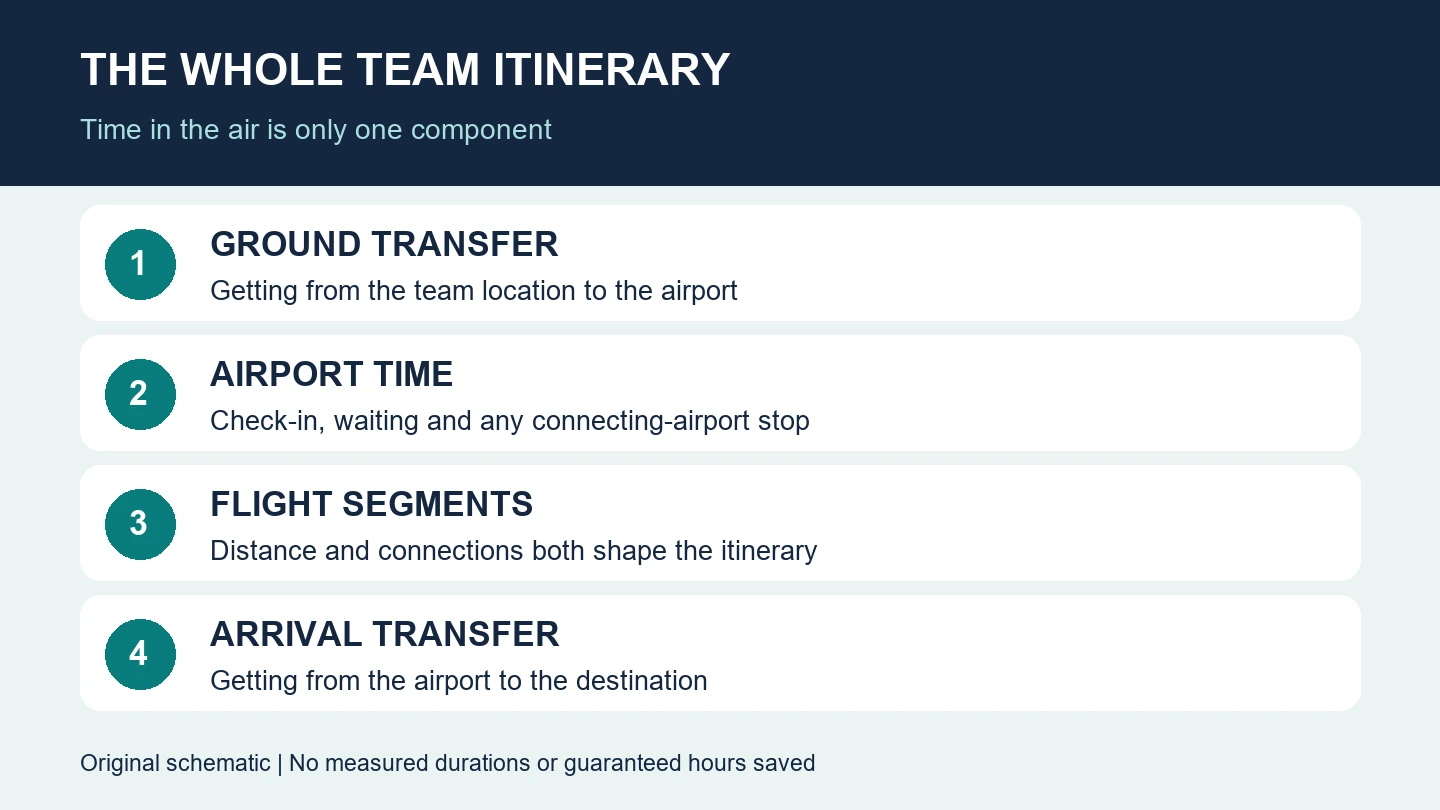
Imagine two fictional itineraries serving the same pair of matches. One has a direct flight with a convenient departure; the other involves a connection and a long wait. Even if the distance is identical, the team experiences different amounts of time in transit. That is a logistics observation, not a diagnosis of any player's readiness.
Fans following a busy stretch should therefore ask when the team traveled, whether the route connected and how the trip fitted between matches. The calendar subscription is useful for seeing fixture spacing, but a match calendar cannot reveal an entire travel day. Assess the route and the available time together before assigning a numerical competitive advantage.
Travel standards also apply when teams fly commercial
Commercial travel is contemplated by the agreement. Its existence does not, on its own, show a failure to follow the rules. The useful question is whether the relevant standards and any applicable charter requirement were met for that journey.
Article 12 includes reasonable-efforts provisions concerning seat selection, nonstop routing and aisle or window seating. It also addresses how staff seats relate to players assigned middle seats in the same class. These details show that the commercial-flight experience remains a negotiated working condition, rather than an area outside the CBA.
The qualifiers matter. A reasonable-efforts standard is different from an unconditional promise that an ideal seat or nonstop service will always be available. A photo of one player in a middle seat does not reveal every booking option, the staff seating allocation or the efforts made. It can prompt a question without proving the answer.
The agreement also distinguishes longer air journeys from ground transportation, with an exception when a ground trip is faster overall and the affected team's player representative agrees. The practical insight is that the preferred mode cannot always be identified from distance alone. Airport connections and transfers may change the comparison.
Imagine a fictional short regional journey for which reaching a distant airport, waiting for a connection and transferring back into the destination city takes longer than driving directly. Fans should compare the actual door-to-door options rather than assuming an airplane is automatically the more protective choice. Whether a specific arrangement meets the agreement depends on the applicable details and approvals.
Accommodation and meals are also part of the surrounding travel framework. A better plane cannot substitute for a workable arrival plan. For public discussion, that means asking about the whole trip while recognizing that teams do not publish every operational choice. Do not turn a general concern about professionalism into an unsupported claim that a particular club has violated a contractual clause.
Those distinctions leave room for criticism. A policy can be followed and still be a candidate for improvement. Supporters can ask for stronger, clearer or more predictable standards without first alleging misconduct that the available evidence does not establish.
How fans can assess a travel complaint fairly
A travel complaint can make several different claims: the itinerary was difficult, the current policy should improve, the journey affected performance or a contractual requirement was breached. Those claims need different evidence. Agreement with the first does not automatically prove the fourth.
Start by identifying what the speaker is asking to change. More baseline charter access, quicker decisions on extra flights, clearer scheduling protections and better commercial arrangements are distinct proposals. Lumping them together as “more spending” can hide the operational problem a player or executive is describing.
- Which matches surrounded the trip, and was the journey direct or connecting?
- Does the complaint concern the published baseline, an approval decision or a mandatory-flight condition?
- Is there a confirmed account of the itinerary, or only a public match calendar?
- Is the proposed improvement about predictable planning, total transit time or another working condition?
These questions allow supporters to take player welfare seriously without treating every frustrating road result as proof of the same cause. A team can play poorly after a convenient journey or perform well after an inconvenient one. The score alone cannot audit the travel policy.
What is confirmed and what remains private
The published agreement establishes the framework described here. Public schedules establish listed fixture times and locations. Neither supplies a complete club-by-club record of charter requests, approvals, actual departure times or last-minute disruptions. The absence of a public approval announcement is not proof that approval was denied.
The reported October GM concerns are useful evidence of the current debate. They do not provide a public audit of every journey. Likewise, FIFPRO's workload approach considers match exposure, travel and rest across competitions; it does not reduce an individual's workload to one club fixture list.
A precise fan discussion can therefore distinguish a confirmed itinerary problem from a broader policy judgment. It can also acknowledge an unanswered operational question without filling the gap with a guess about a club's finances, motives or medical decisions. That makes criticism more actionable: the proposed fix connects to an identified problem rather than an assumed one.
What better travel support would mean for the league
A stronger travel framework would be valuable if it made preparation more predictable and addressed the journeys creating the most pressure. That is an editorial way to evaluate a proposal, not an announcement that NWSL has adopted a new charter policy. The agreement itself requires discussion with the players' association before policy revisions and protects the existing baseline from more restrictive changes.
One useful test is predictability. Can a club plan its travel well before a crowded run, or does it depend on uncertain decisions close to departure? Another is coverage: does a proposed improvement reach the difficult itineraries and match sequences it is intended to address? A policy described only by its headline allowance may leave both questions unanswered.
A third test is whether the travel discussion remains connected to scheduling. More convenient flights do not create additional days between fixtures. Better transport, workable match spacing and protected time off address related but different parts of a player's work. The union's workload summary treats them together for that reason.
Finally, proposals should be judged with appropriate evidence. Actual route and arrival information can help compare transit demands; aggregated experience can show which recurring problems need attention. A single result, an anonymous complaint or an uncaptioned airport photo cannot supply the whole evaluation. Supporters can ask for better public explanation without demanding private player health information.
The current disagreement is therefore more precise than whether professional players deserve good travel conditions. It concerns what the existing agreement permits, what it requires and which improvements would most help teams prepare. Six permissive legs are the starting point, with league-approved extras and separate mandatory provisions already in the framework.
When the next travel debate appears, pair the fixture sequence with the reported itinerary and the relevant rule. Keep the case for a better policy separate from a claim that a specific rule was broken. That gives players' concerns a fair hearing and makes the discussion useful for the people trying to solve the problem.
Loading comments…