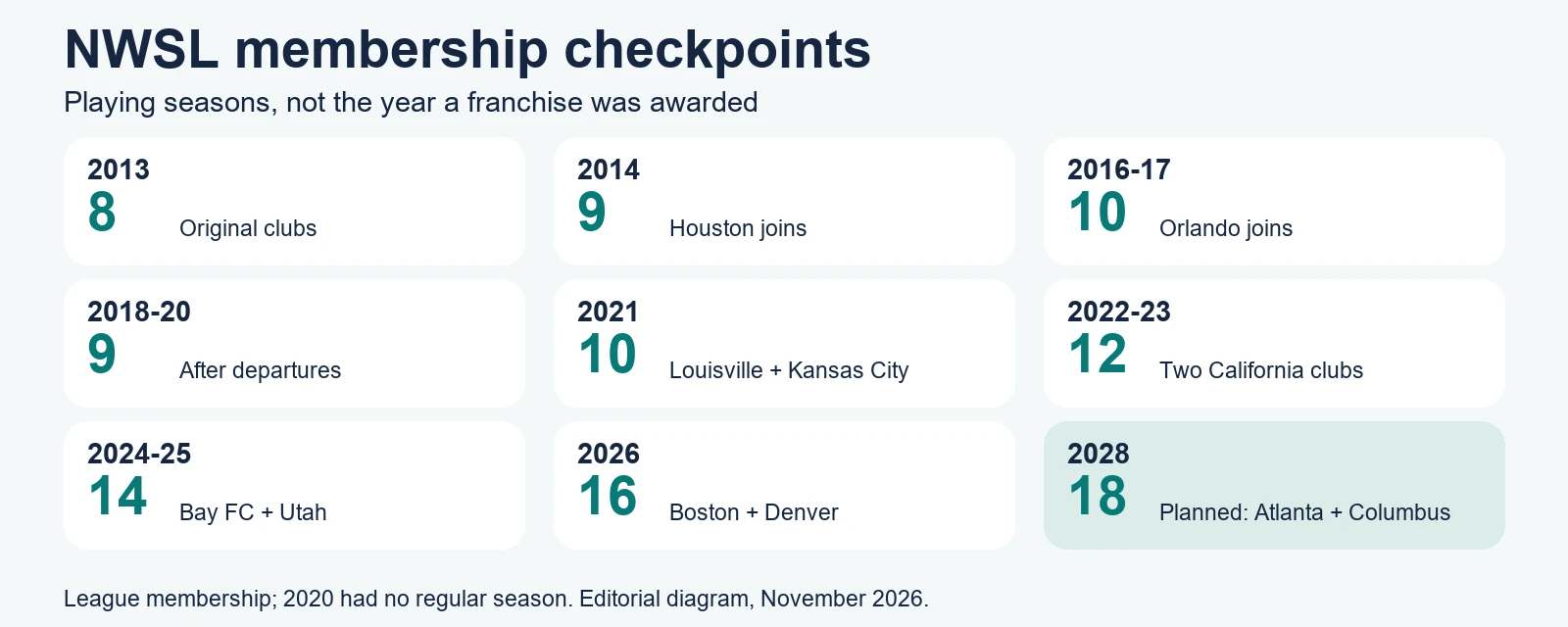
The league grew from eight clubs to sixteen
The NWSL began playing with eight clubs in 2013 and has sixteen in 2026. Atlanta and Columbus are scheduled to take the field to eighteen in 2028. Those numbers describe different playing seasons: a franchise announcement does not put another team into the current standings, and a new club name does not necessarily add another league place.
The history between those endpoints is less straightforward than a steadily rising line. Houston and Orlando expanded the early league. Other years brought market changes, transfers of player assets and a club closing. More recently, pairs of newcomers have enlarged the field. Understanding which kind of change occurred is the key to reading an old team list correctly.
| Playing-season checkpoint | League clubs | What to remember |
|---|---|---|
| 2013 | 8 | Original field |
| 2014 | 9 | Houston joins |
| 2016–17 | 10 | Orlando joins; later market change |
| 2018–20 | 9 | Boston departure changes membership |
| 2021 | 10 | Louisville arrives; Kansas City returns |
| 2022–23 | 12 | Angel City and San Diego enter |
| 2024–25 | 14 | Bay FC and Utah enter |
| 2026 | 16 | Boston and Denver enter |
| 2028, planned | 18 | Atlanta and Columbus debut |
Membership is also different from participation in a particular tournament. The canceled 2020 regular season and the competitions staged that year need their own context; counting entrants in one event would not provide a reliable list of the league's clubs. Similarly, an expansion award made during one season may be intended for a debut several years later.
For a historical comparison, start with the year you mean, then ask three questions: which clubs actually belonged to that field, which names they used then, and which markets they represented. This approach explains why a 2021 map cannot simply be produced by removing the newest clubs from a 2026 graphic. Some of the remaining labels and home locations have changed too.
The original eight established the first footprint
The first NWSL field consisted of Boston Breakers, Chicago Red Stars, FC Kansas City, Portland Thorns FC, Seattle Reign FC, Sky Blue FC, Washington Spirit and Western New York Flash. The league was founded in November 2012, with its first match played the following April. Keeping those two years separate avoids giving an announcement the status of an entire completed season.
The geographical pattern was distinctive. Boston, New Jersey, Western New York and Washington supplied an eastern concentration; Chicago and Kansas City represented the Midwest; Portland and Seattle provided a Pacific Northwest pairing. California did not have one of the original eight places. Neither did the Houston and Orlando markets that would join in the first expansion phase.
An original NWSL club was not necessarily a newly created soccer organization. Several names already carried women's professional soccer history. The start of this league and the origins of each individual organization are separate timelines, so a club's earlier existence should not be mistaken for an earlier NWSL playing season.
Read the 2013 names in their own era
A period team list should retain the identity used during that season. Calling the original New Jersey club Sky Blue FC is useful historical information, even though supporters now know its successor identity as Gotham. Likewise, a Chicago Red Stars result should remain recognizable when a reader reaches it through a modern Chicago Stars search.
That does not require treating every name change as another expansion. The task is to connect the labels without adding fictitious league places. An old shirt, match report or table can use a name that has disappeared from the current directory while still belonging to the same part of a club's story.
For the opposite question, our current NWSL team and city guide starts with today's field. Use that list for contemporary orientation and a season-specific list for an old match. Switching between the two deliberately is more reliable than retroactively replacing every historical identity with its newest name.
The first expansion years also brought exits and transfers
Houston and Orlando added places
Houston Dash were the league's first expansion club, beginning play in 2014 after their launch the previous December. Their arrival increased the field from eight to nine. Orlando Pride followed in 2016, becoming the tenth club after an October 2015 announcement. In both cases, the extra market also meant an additional place in the competition.
These examples establish the simplest meaning of expansion: another club joins the existing field. They also establish why the year on a launch story needs attention. Orlando's announcement and initial roster-building work belonged to 2015, while its first NWSL season belonged to 2016. An archive organized only by press-release dates would put its playing arrival in the wrong year.
The additions widened the league's southern footprint. They did not require an existing club to vacate Houston or Orlando's new place. That makes them useful reference points when a later announcement describes a more complicated transaction involving an established squad, another city or an organization ending operations.
North Carolina, Utah and Boston changed the map
The Western New York Flash's sale and move to North Carolina produced the Courage's first NWSL season in Cary in 2017. It changed the location and identity readers saw on the fixture list, but did not turn a ten-club league into an eleven-club league. A new market was present without a net increase in membership.
The following offseason brought two different developments. FC Kansas City ceased operations, with player contracts transferred to the Utah Royals, who began playing in 2018. Separately, Boston Breakers ceased operations in January 2018. The league's announcement explicitly described the coming season as a nine-team competition. Treating all of these events simply as new-team launches would conceal that contraction.
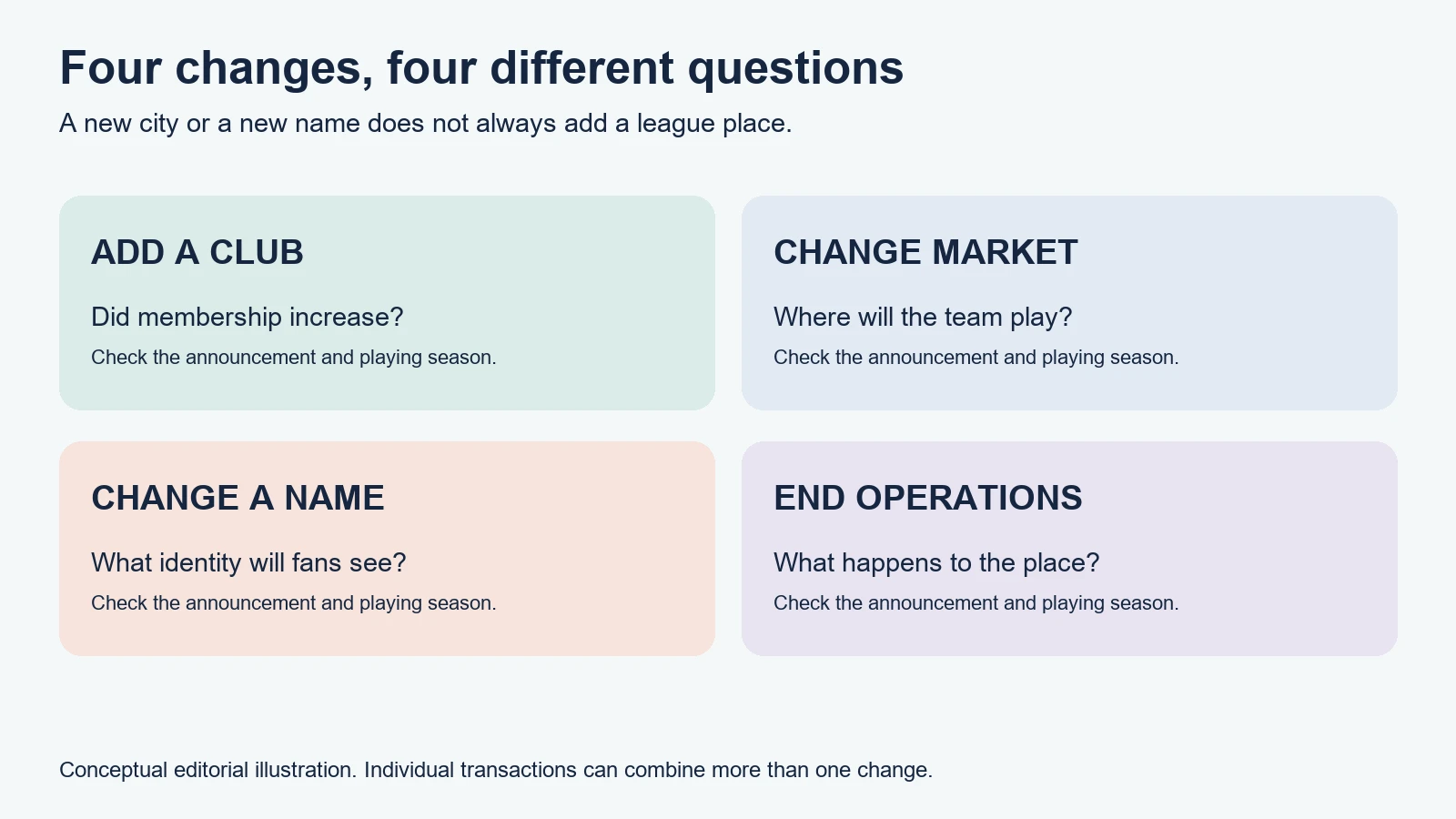
For a supporter, the distinctions explain more than bookkeeping. A market can gain a team while another loses one; players can continue their careers elsewhere while a local fan community loses its club. A different badge on a familiar group of players therefore does not answer every question about what survived the transition.
Read the announcement for the particular thing being transferred. A statement about player contracts does not, on its own, settle the treatment of historic trophies or records. Likewise, the return of a familiar city or brand does not establish that the previous operating organization has resumed unchanged. The next Kansas City and Utah chapters make that caution especially useful.
What a 2021 NWSL map should show
The 2021 field contained ten clubs: Chicago Red Stars, Houston Dash, Kansas City NWSL, NJ/NY Gotham FC, North Carolina Courage, Orlando Pride, OL Reign, Portland Thorns FC, Racing Louisville FC and Washington Spirit. A map of that season needs those ten identities, rather than the current list with a few recent additions removed.
Racing Louisville was a genuinely new market in the playing field. Kansas City also returned to NWSL competition, but the original Utah Royals operations had ended and player assets had moved to the new Kansas City club. The combined effect was a rise from nine league members to ten. Counting two arrivals while ignoring Utah's departure would produce the wrong total.
Kansas City's label needs a date within the year. Contemporary early-season material calls the team Kansas City NWSL. The club unveiled the Kansas City Current name on October 30, 2021, as it closed its inaugural season. Both labels can therefore appear in legitimate records of that year. They do not identify two different Kansas City entries in the same competition.
Two other labels are particularly useful for checking an old graphic. Sky Blue became NJ/NY Gotham FC in April 2021, so a regular-season snapshot should recognize that change. OL Reign was the identity used by the club now known as Seattle Reign. In 2021 its home schedule was based at Cheney Stadium in Tacoma, which makes a present-day Seattle label insufficient for a historical venue map.
This is why a club's regional identity, current name and actual home ground should occupy different columns in careful research. A regional team can play outside the city implied by its familiar name, and the venue can change without the league adding another club. For a specific historical match, retain the stadium named in that match's own record.
California's two later entrants were absent from this field. So were Bay FC and the returning Utah club, and the new Boston and Denver teams. Their absence is the defining difference between this ten-club snapshot and the progressively larger fields that followed.
California changed the 2022 and 2023 maps
Angel City and San Diego were new entries
Angel City FC and San Diego Wave FC began their NWSL playing histories in 2022. Their arrival increased the field to twelve and gave California two clubs in the competition. A 2022 map should therefore include Los Angeles and San Diego alongside the ten markets represented the previous season.
The two entries also created a different West Coast pattern. Portland and the Reign were no longer the only clubs in the Pacific states. California supporters had local NWSL teams, and the league had new pairings between those entrants and the established Northwest clubs. That geographical change came from additional members, rather than simply changing an existing team's mailing address.
The 2023 league still had twelve clubs. Bay FC and Utah were announced during that year for later entry; they did not take places in the 2023 playing field. This is an important correction when a map has been labeled using the year of an expansion announcement instead of the year matches actually began.
A new name does not always mean a new team
Several labels can make this period appear more crowded than it was. Kansas City Current was the name unveiled at the end of 2021, not another newcomer joining the Kansas City team in 2022. NJ/NY Gotham FC was already the identity used in 2021. Chicago's historical results in these seasons still appear under Red Stars.
The Reign supply an especially clear location example. The club announced that Lumen Field would become its home beginning in 2022, returning its home schedule to Seattle. It nevertheless competed as OL Reign in both 2022 and 2023. Moving the pin from Tacoma to Seattle did not require adding a thirteenth league club.
When comparing graphics from the two seasons, preserve both kinds of information: the actual twelve-club field and the labels appropriate to that year. Modern shorthand can help explain a familiar team, but it should not erase the period identity or suggest an expansion that never took place.
Two expansion waves took the field to sixteen
Bay FC and Utah Royals FC joined the playing field in 2024, taking membership from twelve to fourteen. Boston Legacy FC and Denver Summit FC followed in 2026, taking it to sixteen. The gap between those waves matters: there was no new playing entrant in the 2025 NWSL season.
The 2024 and 2026 pairs belong to different seasons
Utah's 2024 arrival brought back a familiar brand and market, but it followed an absence from the intervening league fields. A 2021, 2022 or 2023 map should not include Utah merely because a Royals team had played before and another would play afterward. The newer club's expansion season belongs to 2024.
Bay FC added another California market to the two already introduced in 2022. Its arrival did not turn the Angel City and San Diego debuts into a three-club expansion wave. The distinction is especially useful when a modern California graphic places all three together: that contemporary regional grouping does not describe their shared entry year.
Boston supplies another example of a city returning through a new club. Boston Legacy's 2026 debut came after the Breakers' operations had ended in 2018. Supporters can recognize a regional connection without treating the missing seasons as if the original club had continued playing. The current Boston name and the old Breakers name belong on different season lists.
Denver's award announcement was made in January 2025, but its first playing season was 2026. Someone searching for new NWSL teams in 2025 can therefore encounter a genuine Denver announcement without finding a genuine Denver league fixture from that season. The article's publication year and the club's debut year answer different questions.
Together, these waves explain the progression from the twelve-club 2022–23 field to the sixteen-club league of 2026. They also show why additions are best grouped by first playing season. This keeps current regional identities, future plans and historical competition membership from collapsing into one undated map.
Atlanta and Columbus are the planned 2028 step
As of November 11, 2026, Atlanta and Columbus are the next confirmed playing additions, with inaugural seasons planned for 2028. Atlanta's official identity is Atlanta City FC, unveiled in September 2026. Columbus's official club material also identifies 2028 as its first season. Their anticipated arrival would take the league from sixteen clubs to eighteen.
An award date is different from a first match
The latest example is the October 2026 expansion roster-building announcement. It provides mechanisms beginning in January 2027 as the clubs prepare for their 2028 debuts. Preparation in 2027 is not the same as playing an NWSL league schedule in 2027.
This gap is a normal part of the chronology, rather than a reason to move a future club into an earlier field. A team can recruit staff, develop its identity, sell a membership product and prepare to acquire players before it has an inaugural league opponent. Those activities describe how an organization is being built; they do not establish a completed match.
Read a future expansion story for the commitment it actually makes. The club's entry season may be confirmed while its first opponent, match dates or other competition details remain unannounced. An eighteen-club projection does not supply those missing details, and an attractive map of possible future cities is not evidence that each place has been awarded a franchise.
For historical comparisons, stop the current playing list at the current season. For future comparisons, label both the intended entry year and the status of the plan. That preserves the difference between sixteen clubs actually competing in 2026 and the eighteen expected when Atlanta and Columbus begin. The same discipline that makes an old 2021 map accurate makes a future 2028 graphic honest.
Use the history without mixing club records
A reliable historical comparison starts with a playing season, then keeps four details visible: the period club name, its market, the relevant venue and the event being discussed. Each answers a different question. A current stadium cannot explain where every old home match took place, just as a current badge cannot identify every name under which the club once appeared.
Records introduce another question. If your goal is to identify a past champion, begin with the club named in that competition's result. Our NWSL Championship history follows that sporting record. A description of transferred player contracts or a returning market does not, by itself, authorize combining every earlier trophy into one modern club total.
The Kansas City and Utah sequence is a good reason to be precise. There are historical FC Kansas City results, original Utah Royals seasons, the new Kansas City club's 2021 inaugural campaign and the later Utah expansion era. Familiar players, markets or branding can connect parts of those stories while leaving important differences between the organizations and playing fields.
Old match reports can also use a former stadium sponsor name. Preserve the period reference when describing that match, then add a present-day explanation only when it helps the reader locate the building. Silently replacing every old venue name with its latest commercial name can create a history that nobody watching at the time would recognize.
For a present-day visit, switch back to the current NWSL schedule and the actual fixture's venue. For a historical map, stay with that season's membership and locations. For a future map, state the intended debut year. These habits let the same fan follow the league's growth, recognize a returning city and read an old result without confusing three different versions of the NWSL.
Loading comments…