Start with the current report, then confirm the lineup
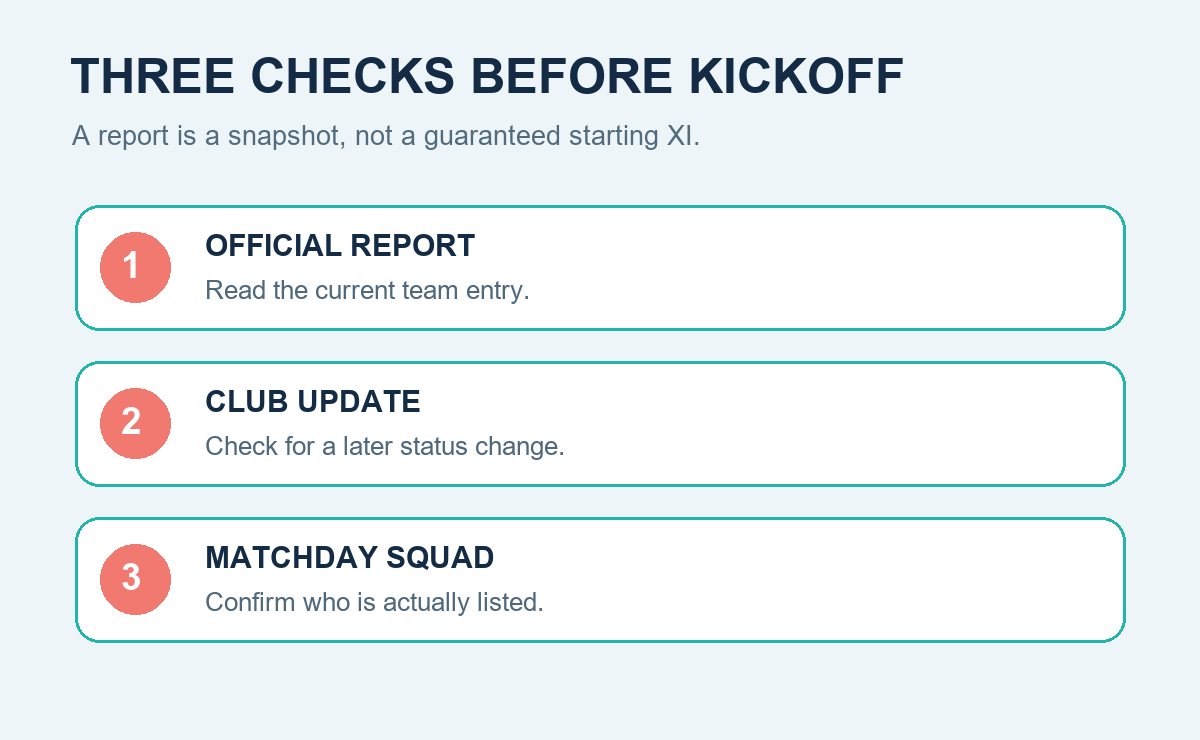
If you want to know whether an NWSL player is likely to be available for a match, begin with the league's official Availability Report. Find the club and the specific game you are following. Then look for a newer club update and, closest to kickoff, the actual matchday squad. This sequence matters because an availability list is a dated status snapshot; it is not a guarantee that every unlisted player will start or that every uncertain player will miss the game.
The difference is easy to overlook when a favorite player is involved. A report may label someone “out” or “questionable,” which answers a pregame availability question at that moment. A coach still chooses a starting XI from the players who can take part. A player can be eligible but remain on the bench, enter as a substitute, or be left off a particular squad for reasons the public report does not explain. Conversely, an earlier “questionable” entry calls for a later check rather than an automatic conclusion about the lineup.
Use the fixture as an anchor. Check the opponent, date and kickoff on the games today page or full schedule, especially on a weekend with many games. A report for one match should not be reused for the next. The official Kansas City Current preview for its September 11 meeting with Orlando, for example, printed a team-specific availability block inside a match preview. That block was useful for that game, not a permanent status page for every player named in it.
This guide explains the public labels and a careful way to read them. It does not maintain a live roster of injured players or predict medical return dates. Those details can change quickly, and a source may choose not to disclose them. If you are making travel or viewing plans because you hope to see one player, the safest promise a schedule can make is when and where the team is due to play. Player availability should be rechecked close to kickoff, and the final squad remains the decisive public evidence of selection for that particular match.
Read the labels without overreading them
An availability list becomes much easier to use when you read its headings as status for one upcoming match. The September 11 Kansas City Current preview, for example, separated players into Out, Questionable and International Duty. It also attached short reason labels to some names. Those headings give fans a starting point, but they do not replace a later club update or the final lineup. A player who is not on the list has not been promised a starting place, and a short reason is not a complete explanation of a player's health or private circumstances.
Out, questionable and international duty
| Label | How to read it | What it does not prove |
|---|---|---|
| Out | The report does not expect that player to participate in the listed game. | A return date for later games. |
| Questionable | Availability is unresolved in that pregame report. | A numerical chance of playing or a guaranteed bench role. |
| International Duty | The player is away with a national-team commitment in that report. | The exact date of club reintegration or next start. |
These are practical interpretations of the public headings, not hidden league probabilities. Kansas City's dated example included Katie Scott on international duty and other players in the out and questionable groups. A fan should read that as a September 11 match note, not as Scott's status for every subsequent Current fixture. Likewise, if the report says “Questionable: None,” it means that published group has no names at that check. It does not mean the coach has committed to fielding every other player.
Injury and illness descriptions
A reason next to a name may be as general as “knee,” “hip,” “thigh” or “illness.” Kansas City's official preview used several of those terms. They help distinguish a reported health-related absence from international duty or a broader excused category. They do not tell readers the diagnosis, clinical severity or medical plan. Two players with the same body-part label may have completely different timelines, and the public list does not justify treating them as comparable cases.
The same caution applies to a status change between reports. If a player moves from out to questionable, that signals a different published assessment for that match; it does not prove a full recovery or guarantee minutes. A club may publish a more detailed statement about a significant injury, but that statement should be read directly and dated. For ordinary game planning, the short label is enough to flag uncertainty. For a medical conclusion, it is deliberately too thin.
SEI, D-45 and longer absences
Some lists add roster codes. The league's historical roster key expands SEI as season-ending injury and D-45 as the 45-day disabled-list designation; both codes also appear in Kansas City's 2026 match preview. Those designations signal a different administrative context from a simple “questionable” entry. They are not a diagnosis. Current roster rules, activation steps and any exception should be checked in current league or club material rather than assumed from the abbreviation alone.
There is one broad distinction fans can safely make. A club announcement placing a player on a season-ending injury list means that club does not expect the player to appear again in that season; San Diego Wave said this explicitly in its September 2026 announcement about Catarina Macario. A D-45 entry does not by itself promise a return exactly 45 days after the report was posted. The code describes a designation, while rehabilitation and roster decisions follow their own course. The practical response to either label is to look for the next official club update, not to calculate a medical timetable from a shorthand code.
What an excused absence does and does not tell you
“Excused absence” is a category that can answer a narrow match question while leaving the underlying reason private. In the Current's September 11 club preview, one player appeared under Out with that reason label and no further explanation. The supported conclusion for a reader of that report is that the club listed the player as unavailable for that game. The entry does not identify an injury, a transfer, a family event, a disciplinary matter or a date when the player will return.
Why the public label can be broad
The same Kansas City list used more specific words for some other players, such as body parts, illness and maternity leave. That difference can feel inconsistent to fans, but it does not give a reader access to what the club and player know privately. A broad category may keep a personal matter out of public view. It can also frustrate supporters trying to understand why an important player is missing. Both reactions appear in current NWSL fan discussion; neither reaction turns the public label into a detailed medical or personnel report.
The September supporter discussion illustrates the disagreement. Some people want more predictable information about injuries and possible return windows. Others argue that an excused absence should be enough, particularly where a reason may be personal. Those comments are useful for understanding what fans are asking, but they are opinions, not an official definition of the reporting category or evidence about a named player's private life.
How to avoid turning uncertainty into a rumor
The safe reading is simple: report the label, the club, the date and the match. If a player is marked out with an excused absence, say exactly that. If a club later confirms a transaction or gives a more detailed statement, use that later official information and its date. Until then, avoid building a story around the possibilities. A player can be absent for reasons that are no one else's business, and even a plausible theory can be wrong.
That discipline is especially useful when a team is in a playoff race or a fan has bought a ticket hoping to see a star. The temptation is to treat a single line as a clue to an impending move or a serious injury. But an availability report's purpose is narrower: it helps explain whether someone is expected to be available for a particular fixture. It is not a transfer-wire notice, a disciplinary ruling or a clinical update. Check the next game and the next official team communication before drawing a conclusion about anything beyond the match at hand.
A practical matchday check for fans
The most reliable routine is short enough to use while planning a trip or opening a stream: identify the exact fixture, read the newest official availability information for the two teams, and check the official squad near kickoff. Add a quick schedule check if there has been a weather issue or a late change. This sequence keeps a useful pregame report in its proper place and prevents an old screenshot from becoming the answer to a new question.
Find the right team and fixture
Begin with the today page or complete schedule. Confirm both clubs, date, kickoff time and time zone. An NWSL weekend may include games spread across Friday, Saturday and Sunday, and a matchweek recap may publish several team lists at once. The headline can look current while the particular club entry belongs to a game that has already ended. Kansas City's September 11 club preview, for example, printed its availability list alongside that game's Orlando opponent and kickoff. The context is part of the information.
Next, open the league's availability hub or an official club preview and check the publication date. Search within the page for the specific club rather than assuming the first visible list is the one you need. If a third-party page reproduces the report, compare it with the league or club version before relying on it; a copied list can be accurate at publication and still be stale by matchday. The site's schedule helps you locate the fixture, while the league and club sources tell you what they have publicly reported about players.
Recheck the game-day squad and kickoff status
Closer to the game, look for an official club or league lineup announcement. A pregame availability label can tell you that a player was out or questionable when the report was prepared, but the eventual squad tells you who has actually been selected for that match. If a player is on the bench, they are in the matchday group even though they might never enter. If they start, the uncertainty has been resolved for that game. If they are omitted, do not manufacture a reason when no new explanation has been given.
Also recheck the fixture itself. The kickoff and broadcaster in a club preview are helpful planning details, but late changes can occur independently of any player's status. The TV schedule and the relevant team or league match page should be refreshed before watching. No fixed hour for report publication or lineup release is promised in this guide because an accessible current official rule establishing one was not found during the research check. The habit to keep is to ask “What is the latest dated official information for this game?” rather than “What did the report say earlier this week?”
Why fans are asking for clearer updates
The league already publishes an availability destination, and clubs sometimes place their own status list inside a match preview. The debate is about how much those public labels should explain and how early fans should receive them. September discussion among NWSL supporters shows a real split: some want more usable injury information, while others think a broad category is appropriate when a player's circumstances are personal. An accurate guide should make room for both concerns instead of portraying every missing detail as a cover-up or every question as intrusive.
The case for more timely information
Supporters arrange travel, buy tickets, plan watch parties and decide which game to stream. Knowing that a player is out can change expectations before they leave home. It can also help explain why a coach's lineup differs from the one seen in the previous match. These are reasonable uses of a match-specific report. The Current's September 11 preview shows how a club can put opponent, kickoff and availability in one place so readers do not have to piece together separate rumors.
At the same time, a ticket is for a team match, not a guarantee that an individual player will appear. A rostered player could be rested, substituted later or unavailable after a new development. Some fans in the public discussion asked for longer-term injury outlooks so they could understand whether an absence might last beyond one match. That is a different request from knowing who is currently out. It may be helpful when a club chooses to provide it, but an estimated return can change and should not be treated as a deadline. We did not find an accessible current official rule that guarantees a precise publication time for every availability update.
The privacy and accuracy trade-off
A public list can say that someone is unavailable without publishing the details of their health or home life. That distinction matters even when a fan is disappointed. The Current's report used both relatively specific body-part labels and the broad phrase “excused absence.” The Wave, in a separate official statement, provided a season-level update about one player. The existence of that detailed announcement does not mean every player must have the same level of disclosure for every absence.
Supporters also raised the concern that repeatedly demanding a firm recovery date could place pressure on a player or medical staff, especially when recovery is uncertain. Others believe regular, clearly dated status updates would reduce speculation. Both ideas can be true: it is useful to know whether someone can play today, and it is appropriate to leave private matters private. Our editorial standard is to identify the latest verified match status, quote the club's chosen level of detail accurately and avoid presenting an unconfirmed prognosis as fact. That makes a schedule guide more useful without turning a player into a mystery for the crowd to solve.
Common questions about player availability
If a player is not listed, will they start? No. The report is about stated availability, while the coach chooses the starting XI and substitutes. Look for the official matchday squad before concluding they have been selected, and remember that being on the bench is different from appearing in the game.
Does “questionable” mean a 50 percent chance? The public category in the club example gives no numerical probability. Treat it as unresolved at that check. A later club update or final squad is more useful than assigning your own percentage from the word alone.
Can I use last week's report for the next match? No. Opponent, travel, training and recovery can all change between games. Start again with the current league report or a fresh club preview and verify that its date matches the fixture on the schedule.
Does a body-part label tell me when someone returns? No. “Knee” or “thigh” is a short public reason, not a recovery estimate. A separately confirmed club statement may give a broader timeline, but even then it should be read with its date and wording intact.
Is an excused absence a transfer hint? The category does not say that. Report the absence for the named game and wait for an official player or club announcement before describing any transaction or personal circumstance.
For fans, the best habit is a two-minute refresh before kickoff: confirm the game time, read the newest official availability information, and check the final squad when posted. That approach answers the question a public report is built to answer—who is expected to be available for this match—while leaving uncertain and private details where they belong.
Loading comments…