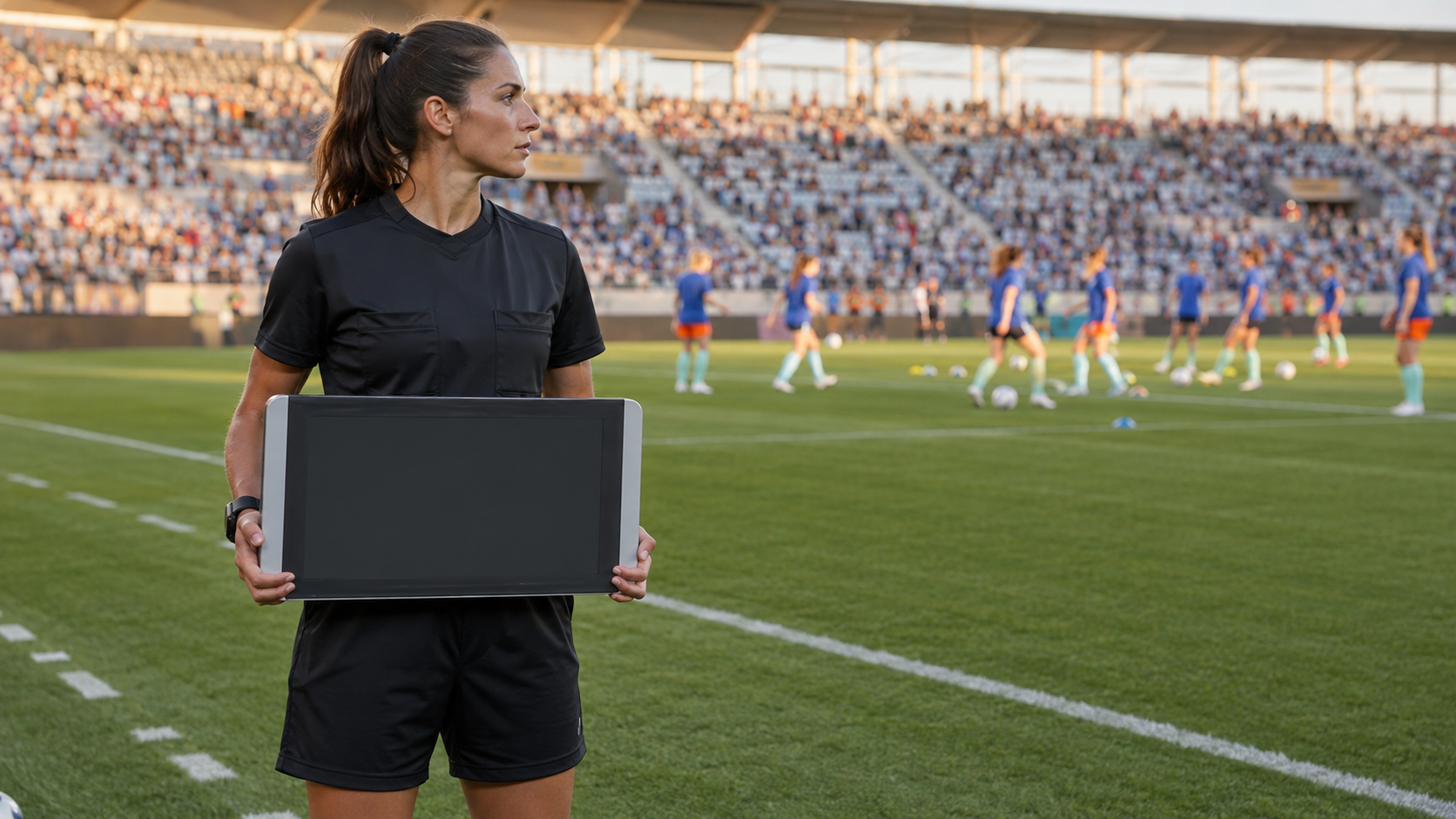
What changed in the NWSL on June 26, 2026
The NWSL introduced three visible matchday changes beginning with the June 26 Challenge Cup: a one-minute off-field treatment period in qualifying injury situations, a ten-second limit for substituted players to leave, and a simpler duration for mandatory hydration and cooling breaks. The league announced the package on June 24 after consultation with the NWSL Players Association, clubs, medical and competition staff, and PRO.
The three matchday changes
Treatment
A player treated on the field may have to remain off for one minute after play restarts.
Substitutions
A departing player normally has ten seconds to leave or the replacement's entry is delayed.
Heat breaks
Mandatory breaks now last 150 to 180 seconds under one consistent duration band.
All three rules affect what viewers can see. A team may restart temporarily with one fewer player after treatment. A replacement can be held at the touchline after a slow exit. A hot-weather break lasts long enough for structured cooling but no longer expands into the old five-minute upper tier. The mechanics are specific, however, and none should be reduced to a slogan.
What did not change
The June update did not replace every substitution or heat rule. Teams still have five normal substitutions across three opportunities, subject to the competition's existing details. The heat policy still uses Wet Bulb Globe Temperature, not the ordinary temperature displayed by a phone app, and retains the established 82.3°F and 92.1°F WBGT action points.
The change to heat breaks is duration, not a cancellation of monitoring or delay authority. The NWSL can still delay a match at the high WBGT threshold, and officials can still authorize a short break below the mandatory band when appropriate. The official June 24 announcement and current rules PDF should be read together.
For a specific fixture, use the NWSL schedule. The rules explain possible procedures; they do not predict that any given match will contain a treatment exclusion, delayed substitute or mandatory cooling break.
How the off-field treatment clock works
The treatment rule applies when play stops for a possible injury, the player says medical help is needed, and the referee calls team medical staff onto the field. Barring an exception, that player is removed for assessment or treatment. Play restarts, and the team may temporarily continue with ten players while the one-minute off-field period runs.
When the one-minute period starts
The minute does not start when the player first goes down, when the trainer enters, or when the player crosses the touchline. The current NWSL protocol says it starts once the ball is back in play. The fourth official notes when the player becomes eligible, and the referee controls permission to re-enter.
That sequence matters for viewers. Medical assessment can take longer than a minute, and the player cannot return simply because sixty seconds have passed if treatment is still continuing or the referee has not signaled. Conversely, the team is not guaranteed to play short for exactly sixty seconds of wall-clock time from the original stoppage. The running period is tied to the restart.
The rule is intended to reduce unnecessary stoppages while moving assessment away from active play when safely possible. It should not be described as punishment for being injured. The trigger is the defined on-field treatment sequence, and the exceptions show that welfare can override the ordinary process.
The exceptions protect genuine emergencies
A player does not serve the ordinary one-minute period in several situations. The list includes an injury from a challenge that produces a yellow or red card; a penalty incident when the injured player will take the kick; a goalkeeper injury; a collision between two teammates; and a collision between a goalkeeper and opponent when both need attention.
Potential head injuries, cardiac arrest and other life-threatening events are also exceptions. Bleeding has its own practical treatment: a player with blood on the uniform must leave to clean or change it, but may return with permission once the issue is resolved. A player who voluntarily leaves is treated differently from someone whose assessment brings medical staff onto the field.
Safety comes first
The exceptions prevent a flow rule from pressuring medical staff to rush serious care. A player returning before an expected minute may fit an exception that the broadcast has not yet explained.
When following a live match on the today schedule, treat the temporary player count as a procedure, not proof of simulation or misconduct.
How the timed substitution rule works
The time-limited substitution protocol gives a departing player a maximum of ten seconds to leave the field after the fourth official raises the board. The expected exit is normally at the nearest boundary line unless the referee directs otherwise. The rule targets restart delay; it does not reduce a team's normal substitution allotment.
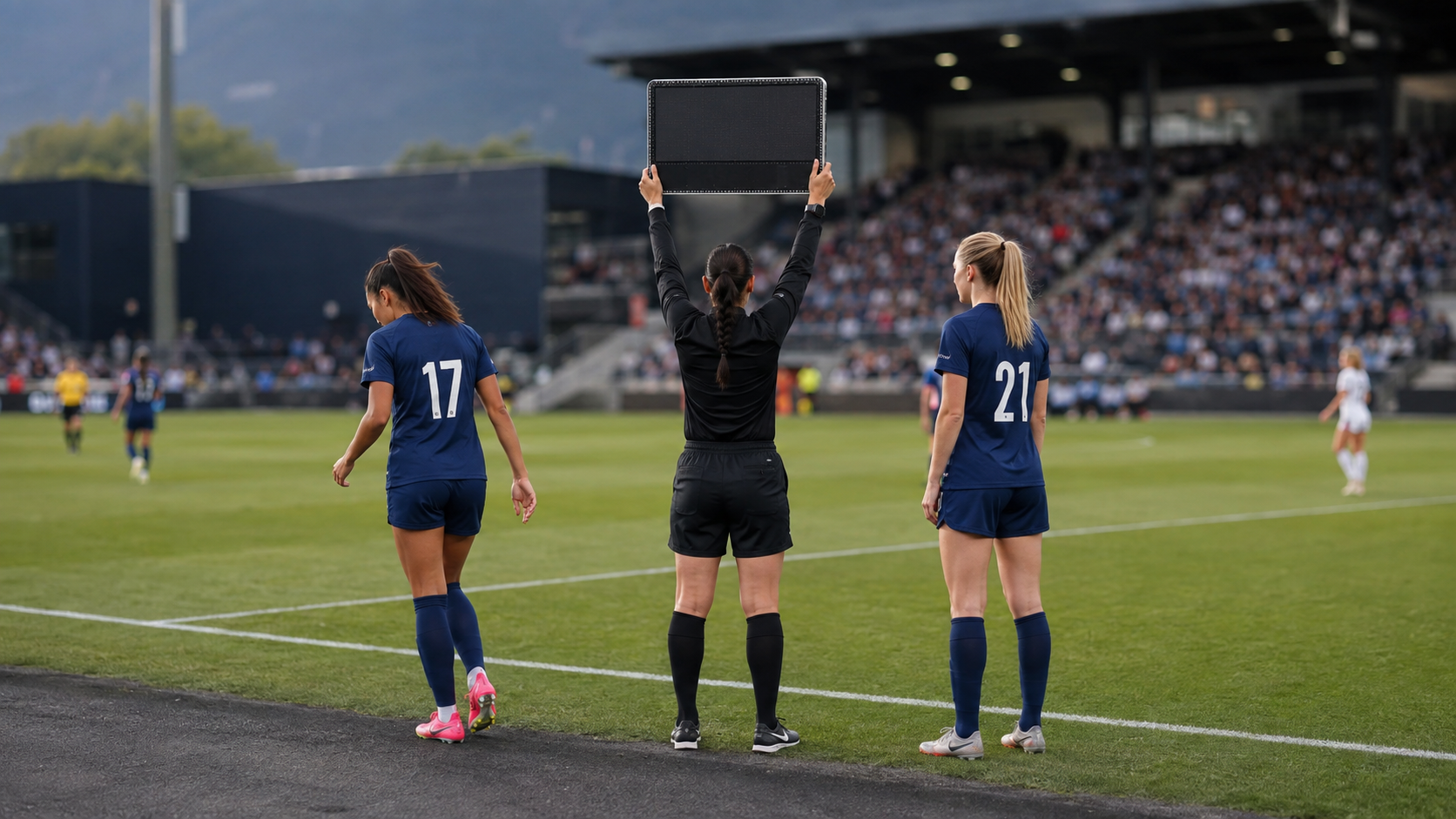
Ten seconds to leave, then a delayed entry
If the player has not left within ten seconds, that player must still exit, but the substitute is held out. Play restarts and the team operates with one fewer player. The sixty-second count begins when the ball is back in play, not when the substitution board first appears.
The replacement may enter only with permission at the first stoppage after one minute has elapsed. That can make the practical absence longer than sixty seconds: if the ball remains in play after the minute ends, the substitute must wait. The change cannot be canceled and a different replacement cannot be selected just because the entry has been delayed.
A slow exit does not automatically mean the departing player receives a yellow card. Under the protocol, a caution is tied to excessive delay beyond the ten-second failure. The immediate competitive consequence is the postponed entry and temporary numerical disadvantage.
Multiple changes and practical exceptions
For multiple substitutions at one stoppage, every departing player must be off within ten seconds of the board or signal for the final change. Officials should not create extra time by delaying the boards between changes. The referee may visually count the final five seconds, helping players and spectators understand the deadline.
The NWSL rules identify exceptions for goalkeeper substitutions, injured players, concussion substitutions, security or safety concerns, and situations approved by the league. IFAB guidance also recognizes that a player already very close to crossing the line at the end of the count can be allowed to complete the exit without defeating the rule's purpose.
Context is therefore essential. A player moving slowly because of an injury is not the same as a player ignoring the nearest exit to consume time. Referees manage those facts, while viewers see the resulting entry signal and restart.
The full schedule provides the match context; replay and commentary may explain why an exception applied.
What the updated heat policy actually says
The June 24 heat update simplified the length of mandatory in-match cooling breaks while retaining the policy's core thresholds and monitoring system. The current official source is the 17-page Competition Rules and Regulations PDF labeled “June 24 Update.” Older versions can mislead readers because they still contain a two-tier break structure that the league expressly removed.
WBGT thresholds and measurements
NWSL decisions use Wet Bulb Globe Temperature, or WBGT. It estimates heat stress in direct sunlight by considering air temperature, humidity, wind, sun angle and cloud cover. An ordinary forecast temperature is therefore not interchangeable with an on-field WBGT reading.
If ambient air temperatures are forecast to reach at least 72.0°F between two hours before kickoff and two hours after the probable finish, the required WBGT measurement process is activated. A National Weather Service or local extreme heat warning, watch or advisory also activates the process. Officials administer the measurements with approved, equilibrated devices, while the home team coordinates timely execution and reporting.
| WBGT result | Current action |
|---|---|
| Below 82.3°F / 28°C | Official may authorize a break of no more than 60 seconds |
| 82.3°F to below 92.1°F | Mandatory 150–180-second cooling break |
| 92.1°F / 33.4°C or higher | Qualifying measurement triggers or continues a delay |
The third measurement, immediately after warmups, governs the first-half break around the 30th minute. A halftime measurement governs the second-half break around the 75th minute. Both occur at the official's discretion during a natural stoppage rather than at an automatic second on the scoreboard.
Mandatory breaks are now 2.5 to 3 minutes
Every mandatory hydration or cooling break now lasts between 150 and 180 seconds—two and a half to three minutes—based on the referee's discretion. The league's announcement says this eliminates the former two-tier system, including the five-minute break that had applied when WBGT exceeded 87.1°F.
That old five-minute description is no longer current. The 87.1°F breakpoint does not appear as a separate break-duration tier in the June 24 Update. Mandatory breaks within the active band use the same 150-to-180-second range, while the 92.1°F threshold remains the relevant delay line.
Below 82.3°F WBGT, an official may still authorize a cooling break when appropriate, but that discretionary break may not exceed 60 seconds. This is different from a mandatory break and should not be reported as evidence that the threshold was crossed.
When heat can delay a match
A cooling break and a heat delay are different interventions. The mandatory break band allows the match to proceed with planned pauses. A qualifying reading at 92.1°F WBGT or higher can stop warmups or keep play from starting or continuing until conditions fall below the delay threshold.
The 92.1°F WBGT delay line
The policy schedules an initial measurement 60 minutes before kickoff. A reading at or above 92.1°F must be reported immediately. At the second measurement, 45 minutes before kickoff, a reading at or above that level places the match into an official delay. The same threshold immediately after pre-match warmups also triggers a delay.
The halftime measurement can place an ongoing match into a delay before the second half, as can a required fifth reading at the end of halftime when shade at the fourth official's table would make the prior measurement unrepresentative of the sunny center mark. The procedure is designed around measured on-field heat stress rather than a generic forecast headline.
The league retains the authority to delay, postpone, suspend or abandon a game. Teams, spectators and broadcasters may provide information, but an app reading or fan calculation is not the official decision. The Heat Policy Contact, officials and NWSL representative follow the communication chain defined by the policy.
Rechecks, restart and stoppage time
Once a match enters a heat delay, subsequent WBGT measurements are normally taken every 15 minutes. The league may lengthen that interval after consultation if forecasts justify it. If readings remain at or above 92.1°F, the delay continues. When a reading drops below the line, warmups may begin, with officials determining the appropriate length after consulting both teams and the NWSL.
During a hydration or cooling break, the match clock keeps running and the allotted time is added to stoppage time. Players stay on the field; coaches remain in their technical areas; only medical staff or personnel distributing fluids and necessities should enter. The referee waits for the ball to go out or another natural stoppage before beginning the break.
Break is not delay
A 150–180-second cooling break is planned inside running match time. A heat delay is a separate official status governed by qualifying WBGT readings and new measurements.
That combination explains why a hot-weather game may show a long pause near minute 30 and additional time later. It does not mean the official forgot to stop the stadium clock. The rules intentionally preserve running match time and recover the interruption at the end of the half.
If a listed kickoff is affected, check the today page and official club or league channels for a confirmed status rather than inferring one from local temperature alone.
What fans, teams and broadcasters should expect
The common thread across the June rules package is visible match management. Treatment that can safely continue off the field no longer holds the restart indefinitely. A deliberately slow substitution can leave a team temporarily short. Heat breaks have a consistent mandatory duration, while dangerous measured conditions can still delay play.
How the rules change the viewing rhythm
Viewers may see more short-handed phases without a red card. After treatment, the player is waiting through the defined off-field period. After a slow substitution, the replacement is waiting for both the running minute and the next stoppage. Broadcast graphics should distinguish those situations because their triggers and exceptions are different.
Hot matches may include a 150-to-180-second break around minutes 30 and 75, followed by visible added time. That rhythm is planned, not an improvised timeout. Players remain on the field and the clock runs. A full heat delay is a different status and can shift the kickoff or second-half start while officials take new readings.
None of these moments proves bad faith by a player. Injuries and safety exceptions require judgment, and WBGT is measured at the venue. Commentary is most useful when it explains the controlling trigger instead of guessing from body language or the temperature on a phone.
A source-check checklist for future updates
- Open the league's Rules and Policies directory and confirm the version label.
- Use the June 24 Update PDF, whose current asset ID ends `hxoaampu8dszzp4ysbss.pdf`.
- Separate mandatory cooling breaks from heat delays and optional short breaks.
- Confirm a match's scheduled, live, delayed, postponed or final status through official channels.
This version check matters most for heat coverage. A page that still assigns five minutes above 87.1°F is describing the superseded two-tier model. The active mandatory duration is two and a half to three minutes; the high delay threshold remains 92.1°F WBGT.
Before watching, use the TV schedule for platform information and the match page for status. The rulebook explains what officials may do, while the live event tells you whether a procedure has actually been activated.
Loading comments…