Which NWSL teams actually have their own stadium?
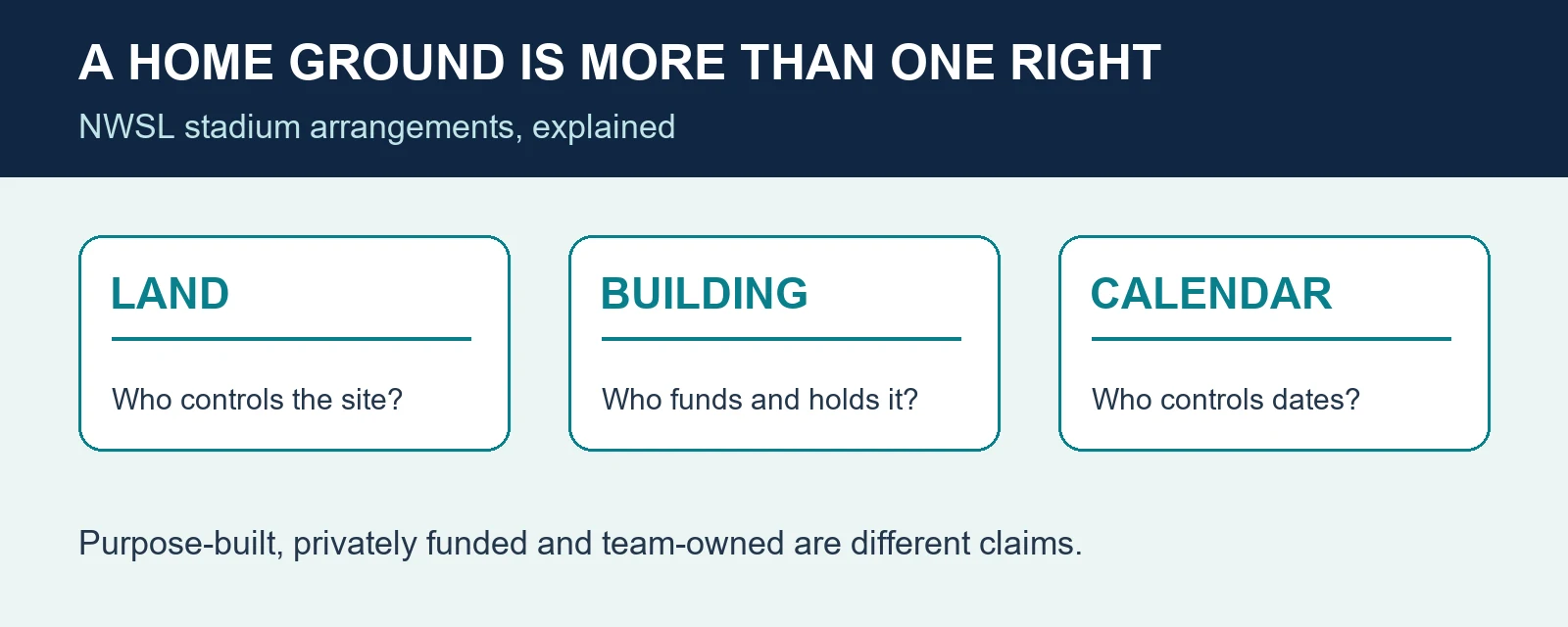
Kansas City Current's CPKC Stadium is the clearest example of an NWSL home built specifically around its women's team. That does not make every other club a simple opposite, or establish a reliable count of teams owning both their stadium and the land beneath it. In stadium discussions, a permanent home, a purpose-built building and ownership are different claims.
CPKC opened in 2024 through a project funded by the Current's ownership group. The club also describes a long-term lease with Port KC. Boston provides another useful distinction: the Legacy's planned permanent home at White Stadium will remain a public asset owned by Boston Public Schools. A club can have a lasting home without the public land or building becoming its private property.
This guide examines those arrangements as of November 11, 2026. It separates where teams played from who funded a project, what a public announcement establishes about ownership, and how much practical control a club has over the venue. Future projects are treated as future projects, with their own construction and occupancy milestones.
For the complete geographical directory, use our NWSL teams, cities and stadiums guide. A fixture list can tell you which team is at home and where its match is staged. It cannot, by itself, tell you who holds the property, whose organization runs the building or who gets the first choice of dates.
The useful question is therefore more precise than whether a team has somewhere to play. Ask which part of the venue arrangement belongs to the club and what that changes for players and supporters. That approach recognizes the importance of new women's soccer infrastructure while avoiding the assumption that every new address represents the same kind of investment or control.
Four questions separate a home ground from ownership
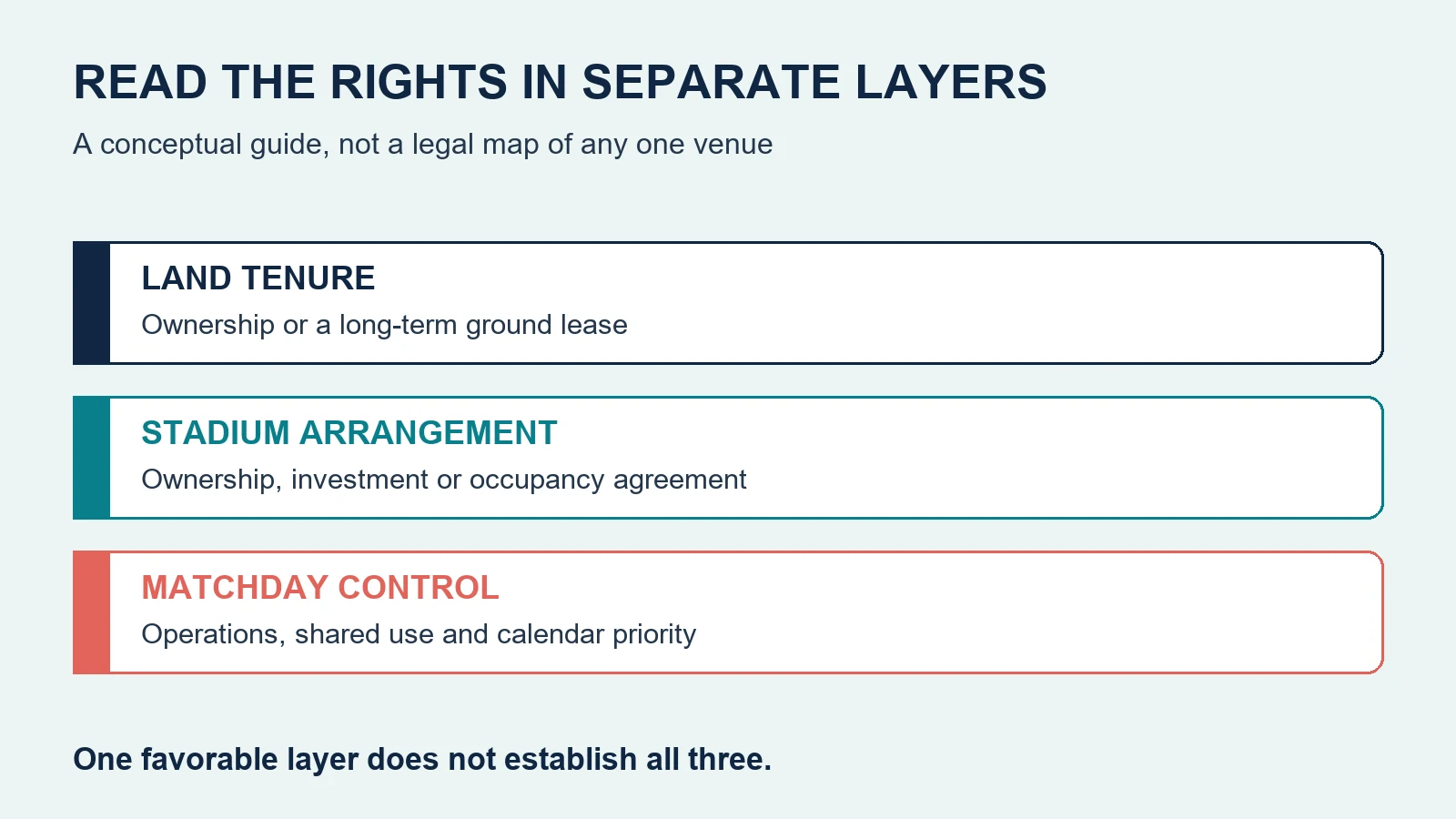
Read a venue announcement through four questions: who holds the land, who funds and holds the stadium investment, who operates the venue, and how its dates are allocated. Those questions describe different parts of the arrangement. An announcement may answer one very clearly while leaving another to a separate agreement.
Land and building ownership can be different
A long-term ground lease can support a substantial stadium project without requiring the investor to purchase the underlying land. Conversely, describing a facility as a public asset does not mean a professional club cannot make it a lasting home. The terms of that particular partnership determine the relationship; a photograph of the stands does not.
Keep funding separate from both questions. A statement identifying who financed construction is evidence about that investment. It should not be silently enlarged into a claim about every property right, future renovation bill or operating obligation. The same care applies to a naming sponsor: the name on the building establishes a commercial identity, rather than proving the sponsor owns the team or the site.
Control of dates is a separate asset
A club can improve its matchday identity through dedicated rooms, signage and hospitality without becoming the venue's only user. Gotham's announced Etihad Park arrangement is a useful example: its future home is New York City FC's stadium, with features intended specifically for Gotham. Sharing a soccer ground and having a recognizable home environment can exist together.
Calendar control requires a different question. Which competitions use the building, how far ahead can dates be reserved, and what happens when a knockout match becomes possible at short notice? A release celebrating a permanent home does not necessarily publish those details. Dedicated facilities and an attractive location do not, on their own, answer which event receives a particular weekend.
For supporters, this makes a more useful comparison than assigning every club a single owned-or-rented label. One arrangement may offer a clear identity and excellent player spaces; another may provide a longer planning horizon or a different operating role. Compare the rights actually described before deciding that two clubs have solved the same problem.
Where the 16 clubs played in 2026
The league's 16 clubs each had 15 regular-season home matches in 2026. That does not produce 16 equivalent stadium arrangements. The table identifies main homes or important multi-venue examples from that completed regular season. It is a venue-use comparison, rather than a register of property owners or an exhaustive list of every special fixture.
| Club | 2026 main home or venue-use example |
|---|---|
| Angel City FC | BMO Stadium |
| Bay FC | PayPal Park |
| Boston Legacy FC | Gillette Stadium and Centreville Bank Stadium |
| Chicago Stars FC | Northwestern Medicine Field at Martin Stadium |
| Denver Summit FC | Centennial Stadium, plus matches at Empower Field and Dick's Sporting Goods Park |
| Gotham FC | Sports Illustrated Stadium; selected matches elsewhere |
| Houston Dash | Shell Energy Stadium |
| Kansas City Current | CPKC Stadium |
| North Carolina Courage | First Horizon Stadium at WakeMed Soccer Park |
| Orlando Pride | Inter&Co Stadium |
| Portland Thorns FC | Providence Park |
| Racing Louisville FC | Lynn Family Stadium |
| San Diego Wave FC | Snapdragon Stadium |
| Seattle Reign FC | Lumen Field; selected matches elsewhere |
| Utah Royals FC | America First Field |
| Washington Spirit | Audi Field |
Boston and Denver make the limits of a single-address list especially clear. Boston divided its home program between Massachusetts and Rhode Island. Denver used a temporary purpose-built home alongside matches in other Colorado venues. Neither club's 2026 match address should be mistaken for the address of its planned permanent project.
Naming also creates apparent differences that are not new buildings. Gotham fixtures may appear in older data under Red Bull Arena, while the current name of the Harrison venue is Sports Illustrated Stadium. North Carolina's stadium sits within WakeMed Soccer Park; the club uses the fuller First Horizon Stadium name. A changed label does not automatically indicate a sale, a move or a new ownership agreement.
Nor does the phrase soccer-specific settle the ownership question. It describes the kind of venue and the sport around which it is configured. A soccer-focused building can still serve more than one professional club. A large multipurpose venue can be a genuine home without having been designed for the women's team that uses it.
Use this comparison to identify the next question, rather than to award points for the type of building. At Chicago, ask how the university venue fits the club's plans. At Denver, distinguish the temporary home from the future project. At Boston, separate the present venue from the public stadium planned for its return to the city. For a particular trip, the current NWSL match schedule remains the place to confirm the actual ground.
What Kansas City's model does and does not prove
Purpose-built for the Current
CPKC matters because the women's team was the reason for the project. The Current began playing there in March 2024, making the stadium an existing example of investment rather than another proposed rendering. Its significance is the shift from finding space in an established building to creating a venue around the club's own sporting and matchday needs.
That is a stronger and more specific claim than saying that every NWSL club needs an identical building. A club entering a well-suited shared venue faces different choices from one pursuing a new ground. The useful comparison asks what each arrangement delivers for the team and its supporters, rather than assuming the same construction model is available in every market.
Purpose-built also does not mean closed to other events. The club announced NCAA championship hosting awards for CPKC, including the 2025 Division I Women's College Cup and 2026 Division II competitions. Those announcements show that a stadium designed around a women's professional club can still have a wider soccer role. Hosting another competition does not erase why the building was created.
A long lease beneath a club-funded project
Port KC's project account describes a $140 million stadium financed by the ownership group. The Current's own facility description identifies a 50-year lease with Port KC. Read together, those statements describe substantial club-led investment alongside a long-term land partnership.
A ground lease of that duration should not be casually compared with arranging a stadium for one afternoon. Equally, the funding statement should not be enlarged into an assertion that there is no public relationship or that the club owns every underlying asset. Port KC's role is part of the published account, rather than a contradiction that needs to be hidden to preserve the project's significance.
This is why the most informative description retains both pieces. Kansas City created a purpose-built home through an ownership-group-funded project on a long-term leased site. The example supports the importance of durable infrastructure for women's soccer. It does not supply a universal template for every stadium agreement, a full accounting of project economics or a guarantee about every future event date.
The next homes are different kinds of projects
A future stadium announcement can describe a land purchase, a construction project, a partnership or the right to stage matches. Those are meaningful advances, but they are not interchangeable milestones. The distinction becomes especially useful when several clubs describe their next ground as a permanent home.
Denver, Boston and Gotham have different arrangements
Denver's Santa Fe Yards development includes a club-announced land acquisition and a purpose-built stadium project. That is a different undertaking from continuing to use Centennial Stadium, its temporary home. The contractor's project description establishes the construction role and the intended women's soccer venue; it does not make an unfinished stadium a place where supporters can attend a match today.
The club's published plans place its permanent move in 2028. Treat that as a project horizon, rather than turning it into a guaranteed opening match or travel date. A land closing, construction progress and a confirmed fixture each answer a different question. Until an actual event is attached to the new address, the temporary venue remains a separate practical planning issue. Our Centennial Stadium guide deals with that existing matchday setting.
Boston's announced path is different. Its August 2026 release places the Legacy at Centreville Bank Stadium in 2027 and White Stadium in 2028, while stating that the renovated White Stadium will remain a public asset owned by Boston Public Schools. The project combines a professional home with school and community use. Calling it the club's permanent home should preserve that public ownership distinction.
For fans, a continuing relationship with the city can be part of what makes a home durable. Permanence need not mean that the professional team becomes the only user or property owner. The Boston Legacy venue timeline explains the announced transition without treating the Pawtucket season and the Boston project as one address.
Gotham's planned 2028 move to Etihad Park is another model: an agreement to play at New York City FC's new stadium. The joint announcement describes Gotham-specific player and matchday features within that shared home. Those commitments can improve the club's identity without establishing that Gotham owns the stadium or has removed every other event from its calendar.
These examples should therefore be compared through the actual arrangement. Denver's land milestone, Boston's public renovation and Gotham's shared new ground are not three copies of the same ownership transaction. Each can represent progress for a club, while leaving different questions about completion, use and the final matchday experience to be answered.
Why venue control matters during the playoffs
The NWSL's 2026 competition rules make venue availability part of the postseason hosting question. The higher seed normally hosts a quarterfinal or semifinal, but the rules allow the lower seed to host if the higher seed's venue is unavailable. A sporting advantage and a usable stadium date are therefore separate parts of the calculation.
This is a different planning problem from arranging a regular-season calendar. Every club begins with a known allocation of home matches to place on a schedule. A knockout round creates an additional possibility: a club must earn the right to keep playing, and the relevant date may become a confirmed need only after another result.
The value of practical venue control becomes clearer in that setting. Supporters want a reliable address and a normal home environment when the stakes are highest. Players and staff need somewhere suitable to stage the match. The club must connect the competition's requirements with a building's actual availability, rather than assuming a seed number has already booked the ground.
Ownership alone should not be presented as a guarantee that this task disappears. A club-centered stadium can have other competitions on its published program, as CPKC's NCAA hosting announcements illustrate. A shared venue can also work well when its arrangements accommodate both clubs. The decisive questions concern the agreement and calendar, rather than the number of logos associated with the building.
For fans following a playoff race, separate three steps: qualification, the right to host and the final event listing. A team can be in contention for a home match before the precise venue is confirmed. Once the organizer publishes the event, compare that listing with the ticket in your account. A prediction about hosting is not yet a travel instruction, even when the club normally plays at a familiar stadium.
Read the next stadium announcement more carefully
Start with the milestone in the announcement. An approved project, a completed land purchase, a construction update and an agreement to play matches describe different progress. Keep the season and location beside that milestone. A club can be advancing its long-term home while continuing to play its immediate matches somewhere else.
Then identify the actual claim about control. Does the announcement say who owns the public asset, who financed the building or which organization will operate it? Does it describe a permanent occupancy agreement without publishing property terms? It is reasonable to leave an unanswered question unanswered. A confident ownership label adds little if the underlying announcement establishes something narrower.
What to confirm before buying a ticket
A supporter does not need to resolve every property question before buying a match seat. The immediate requirements are the correct season, event, venue and ticket product. Compare the official listing with the account or checkout you are about to use, particularly when a team is moving between grounds.
Current sales pages illustrate the distinction. Chicago's ticket hub says 2027 single-match tickets will go on sale after the schedule is announced, while also providing membership information. Gotham's Etihad Park page collects deposits for its future move. Neither type of advance offer should automatically be read as a dated match ticket for a newly completed stadium.
For an actual event, confirm which address is attached to the opponent and date, then inspect the specific seating and entry information. A club's long-term home announcement may explain the direction of travel without deciding that particular afternoon's arrangements. This matters most during transitions, showcase fixtures and postseason rounds whose final details arrive later.
The stronger stadium story is consequently about what each arrangement makes possible. Purpose-built spaces, durable partnerships and clear matchday control can all contribute to a better home for women's soccer. Recognizing those differences gives supporters a fairer way to assess progress than assuming that a privately owned building is the only meaningful development, or that calling somewhere home proves ownership.
Loading comments…