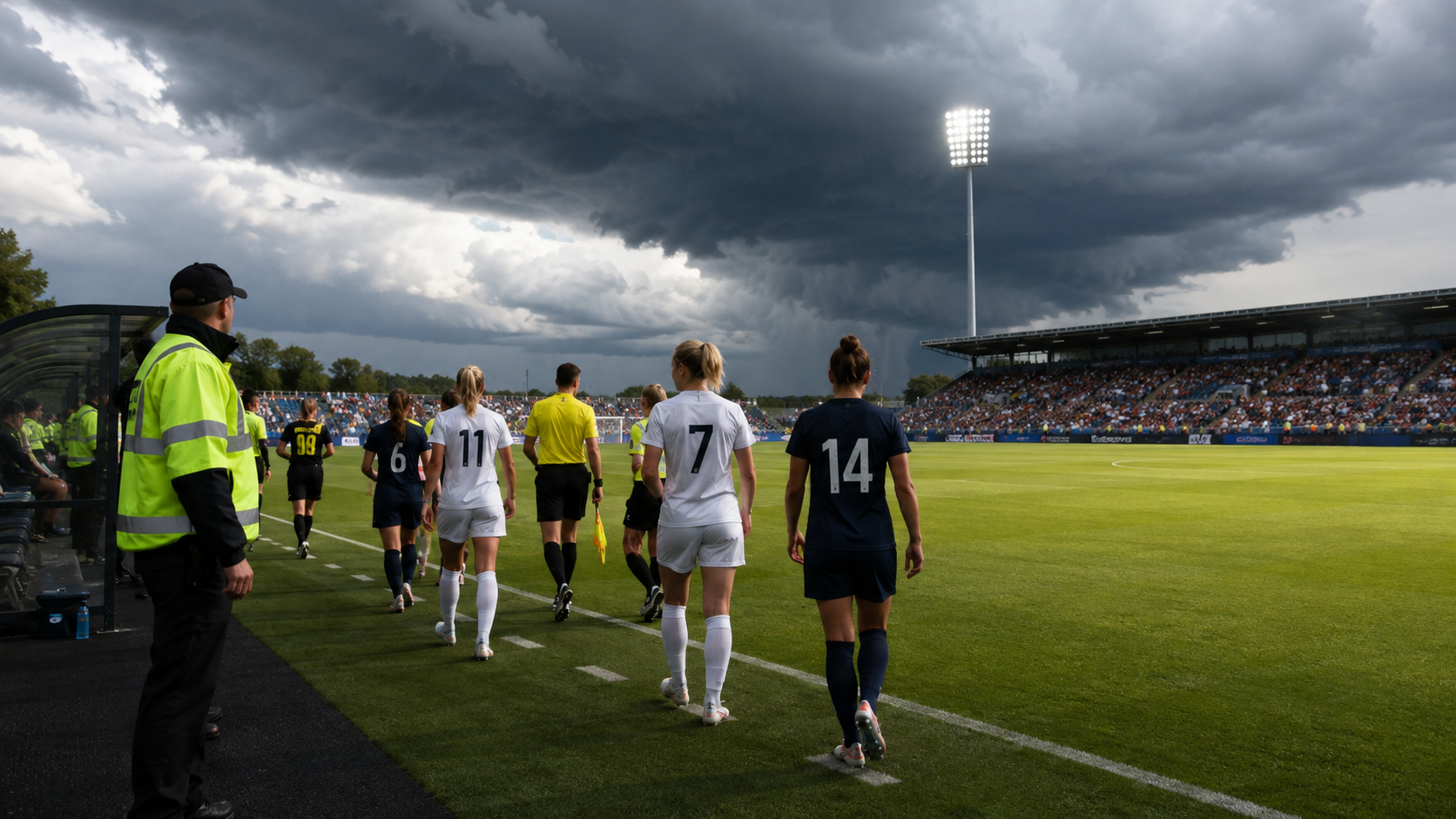
Does rain automatically postpone an NWSL match?
No. Rain by itself does not automatically postpone an NWSL match. The current competition rules say unfavorable weather or other adverse conditions trigger league evaluation when playing would be impractical or dangerous for players, other participants or spectators. Officials and event staff therefore consider the actual safety and feasibility of the event, not only the icon in a weather app.
A wet match can proceed if the field, visibility, wind, lightning, heat and venue operations remain acceptable. A different storm can require a delay even before heavy rain arrives because lightning or another hazard has crossed the applicable safety threshold. Use the NWSL games-today page for the listed status, then follow a dated league, club or venue instruction.
The quick decision test
Safe?
Could lightning, heat, wind or another condition endanger people?
Playable?
Can the field and visibility support a fair, practical game?
Operational?
Can the venue shelter, communicate with and safely serve the crowd?
Those three questions are a plain-language way to read the rule, not a new official formula. The league's current PDF contains specific lightning and heat procedures in addition to the general adverse-conditions standard. A television image cannot show every field measurement, weather track, emergency instruction or venue limitation being considered.
Who has authority to postpone
The rules define postponement as not starting a game, or stopping its progression, so it can be completed on a subsequent date. No game may be postponed without permission from the commissioner or a league-designated representative unless law enforcement mandates the postponement.
The referee, teams, stadium and weather personnel supply essential information, but seeing the referee inspect the field does not by itself announce a rescheduled date. Wait for the official competition decision and then check the complete schedule. Until that notice arrives, label the situation delayed or under evaluation rather than declaring a postponement from social media.
Delay, postponement and cancellation explained
Weather language matters because each status changes what a fan can safely assume. The current rules formally define postponement around completion on a subsequent date. A delay is a pause while same-event continuation remains possible. Cancellation or abandonment requires an explicit official decision; it should not be inferred simply because a restart time is missing.
| Status | What a fan can conclude | What remains open |
|---|---|---|
| Delayed | The scheduled event is paused. | Restart time and eventual outcome. |
| Postponed | The game will be completed on a subsequent date under the rule. | New date, ticket instructions and coverage. |
| Canceled/abandoned | Only trust a league or club notice using that outcome. | Competition, ticket and rescheduling consequences. |
Why restart time can remain TBA
The rules publish no single maximum that covers every weather delay. Lightning is measured from the last qualifying strike, so a new strike can move the reference point. During a heat delay, official WBGT readings normally repeat every 15 minutes. The home team's severe-weather plan also includes a venue curfew, and teams may require a warm-up when the hazard clears.
That means “conditions improving” is not an official restart time. Weather personnel, the referee, teams, venue and league still need to confirm that activities can resume safely and operationally. Keep the current match status open rather than adding a guessed warm-up interval to a fan-posted countdown.
Which official status fans should trust
A severe-weather plan must include contact with the league, prepared spectator and media updates through public address and video when available, and designated shelter or evacuation procedures. Inside the venue, follow those movement instructions immediately. They are more important than refreshing a social feed from an exposed seat.
Source order: venue instruction for immediate safety; league or club notice for match status; the TV schedule for coverage. A broadcaster listing cannot overrule a safety decision.
NWSL lightning and severe-weather rules
Every NWSL home team must maintain a detailed weather-delay plan coordinated with its venue. The plan is broader than one radar screen: it identifies decision-makers, weather and Doppler-radar contact, a tracking system, league communication, spectator updates, shelter or evacuation locations, venue curfew and standing procedures.
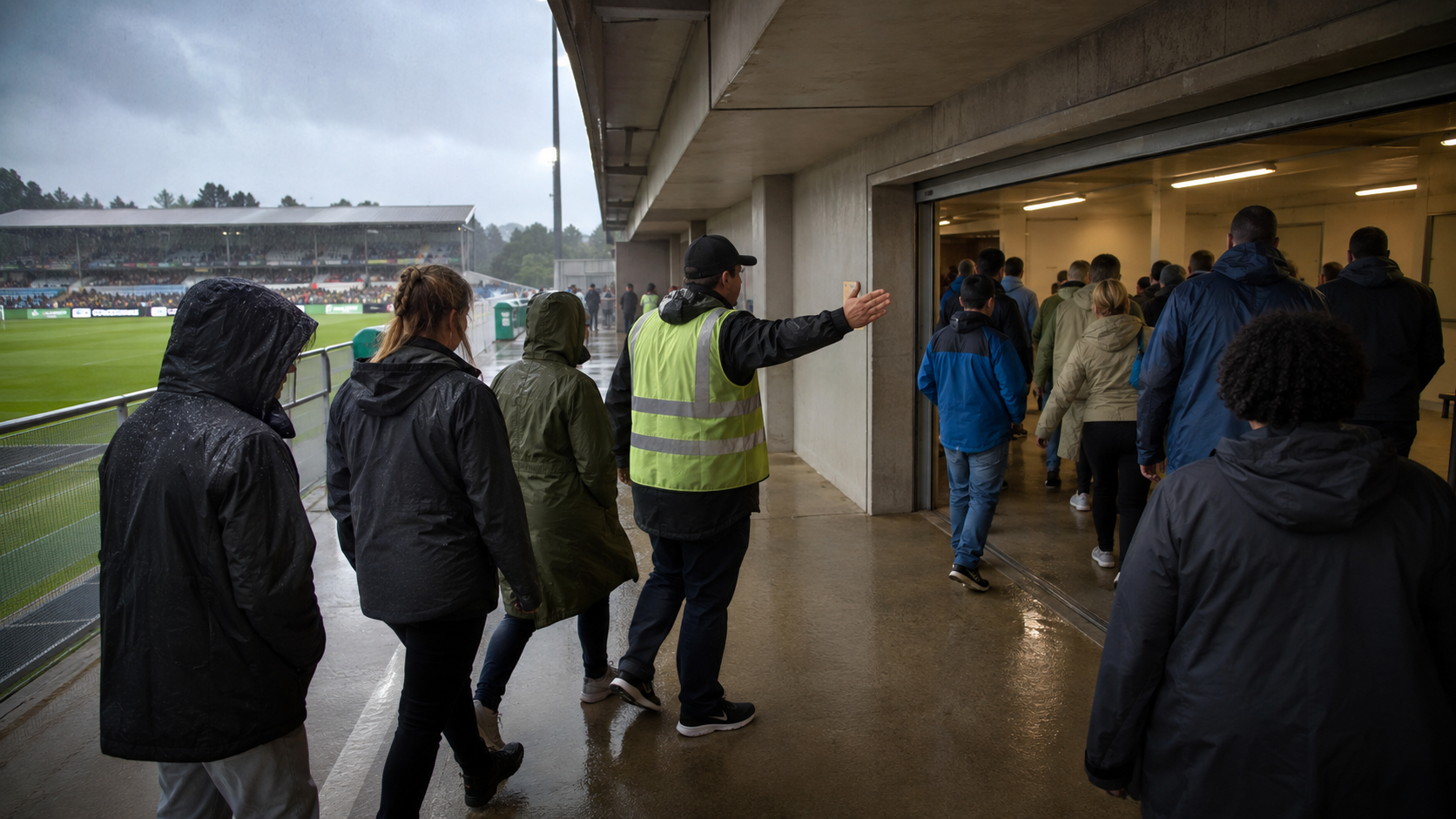
How the 30-minute lightning clock works
When lightning causes a delay, the current rule requires a 30-minute waiting period from the last lightning strike inside the controlling distance. That distance is whichever is greater: the league-prescribed threshold or the venue-prescribed threshold. The public rule does not give fans one universal number of miles to apply at every stadium.
The word “last” explains why a delay can grow. If a new strike occurs inside the controlling area, that newer strike becomes the relevant reference point. Rain can weaken over the field while the safety wait continues because the procedure is about lightning within the defined area, not the appearance of the nearest cloud.
After the wait, activities may resume. That phrasing does not promise a kickoff at exactly 30:00. Teams may need a warm-up, officials must confirm the field and venue are ready, and spectators or staff may need to return from shelter. Use the schedule for status, but follow on-site instructions for movement.
Shelter, local thresholds and communication
The home plan must designate shelter locations or an evacuation process and prepare public-address updates, with video updates when available. It also identifies specific management, home-team and law-enforcement decision participants and a weather-delay committee. Those requirements explain why an announcement can take time even when viewers already see a radar image.
- Do not remain in an exposed seat to watch the sky.
- Do not estimate an unpublished radius from thunder or a phone map.
- Use the venue announcement for shelter and evacuation.
- Use the official match listing for competition status.
Current NWSL heat-delay and cooling-break rules
The NWSL uses Wet Bulb Globe Temperature, or WBGT, rather than the ordinary air temperature as its operational heat measure. The procedure is activated when the ambient forecast reaches 72°F during the defined window—from two hours before scheduled kickoff through two hours after the game is expected to end—or when a qualifying local heat advisory, watch or warning applies. Activation means officials take the required WBGT readings; it does not mean the match is automatically delayed at 72°F.
| Official WBGT | Current match procedure | Fan takeaway |
|---|---|---|
| Below 82.3°F | An authorized break may last up to 60 seconds. | A break is discretionary, not guaranteed. |
| 82.3°F to below 92.1°F | A mandatory break lasts 150–180 seconds. | Expect the longer current break, not an obsolete duration. |
| 92.1°F or higher | A qualifying scheduled reading triggers or continues a heat delay. | Wait for the next official update rather than using a phone reading. |
WBGT triggers and measurements
WBGT combines air temperature, humidity, wind, sun angle and solar radiation or cloud cover. That is why two venues showing the same temperature can produce different official values. Officials use approved devices, allow the sensor to equilibrate and calculate the official value from a five-minute average. Most measurements are taken at the field’s center mark; the rules specify an exception for the fourth measurement.
The scheduled checks occur 60 minutes before kickoff, 45 minutes before kickoff, after warm-up and at halftime, with a conditional fifth reading under the procedure. A reading above 91.1°F but below 92.1°F can lead to closer monitoring or a delayed warm-up when the threshold is expected to be crossed. The precise official value therefore belongs to the match process, not to a weather app. Check the NWSL schedule this week for affected fixtures, then rely on match-specific notices.
Heat delay versus a 150–180-second break
A heat delay stops the pregame or match process because a qualifying official reading is at least 92.1°F. During that delay, readings normally repeat every 15 minutes. A cooling or hydration break happens within play at a natural stoppage, approximately around the 30th and 75th minutes, when the applicable band requires or permits it.
Current timing: the mandatory mid-match break in the 82.3°F-to-below-92.1°F band lasts 150–180 seconds. The match clock continues and the time is added. The break is therefore not a timeout that removes minutes from the game, and the TV schedule cannot guarantee an exact return-to-play minute.
How delayed and incomplete matches resume
Once the hazard clears, a match does not simply jump from “delayed” to a whistle. The current competition rules connect the length of the interruption to a maximum warm-up, then preserve the match state at the moment play stopped. For a game that cannot be completed, the 75-minute threshold determines whether the existing score counts or whether the contest ordinarily must resume.
Warm-up time and the exact restart
| Length of delay | Maximum warm-up | What “maximum” means |
|---|---|---|
| Up to 10 minutes | 5 minutes | It may be shorter. |
| 11–30 minutes | 10 minutes | It may be shorter. |
| 31–60 minutes | 15 minutes | It may be shorter. |
| More than 60 minutes | 20 minutes | It may be shorter. |
The referee and both head coaches can mutually agree to shorten the applicable warm-up. Fans should not add the table’s maximum to an announced clearance time and treat the result as a guaranteed restart. Field inspection, team movement and the final operational instruction still matter.
Play resumes at the precise match time at which it was stopped. If the ball was already out, the appropriate throw-in, goal kick, corner, free kick or other awarded restart remains applicable. If play was stopped while the ball was in play, the rule calls for a dropped ball at the location where the ball was when the match stopped, subject to the normal location provision. The games-today listing can show the status, but not every restart detail.
The 75-minute rule and roster changes
If a game cannot be finished after 75:00 has been played—excluding stoppage time—it is considered complete and the score at stoppage stands. If the stoppage occurs before that line, the game ordinarily resumes in the same minute rather than starting again at 0:00. The league says every effort must be made to resume within 24 hours.
When the resumed portion is more than 24 hours later, each team may make up to three changes to its official game roster. NWSL also retains discretion to order a full replay. These are competition rules, not a universal ticket promise: re-entry, rain-check, refund and replacement-ticket instructions must come from the league, club or venue for that specific match. Track the confirmed continuation on the NWSL calendar.
Fan checklist for a weather-affected match
The most useful weather plan separates safety information from competition status and commercial details. The venue tells people where to move. The league or its designated authority determines whether the match is postponed. The club, venue or original ticket seller explains how a match-specific ticket will be handled. Keeping those lanes separate helps fans act quickly without treating a forecast, a television grid or an unofficial post as a final ruling.
Before leaving home or opening the stream
24 hours before
Check the forecast for travel planning, but keep the match on your itinerary unless an official notice changes it. Save the venue’s event page and review permitted rain gear, bag rules and transportation alerts.
Before departure
Open the NWSL games-today page, then compare it with a dated club or venue message. Charge your phone and identify the venue’s official alert channel.
Near kickoff
Confirm the listed start and the TV schedule. A normal listing means no announced change; it does not override a later stadium safety direction.
If the forecast is hot, remember that the public air temperature cannot reproduce an on-field WBGT value. If lightning appears on a consumer map, remember that the controlling league-or-venue distance is not published as one universal mileage radius. Both tools are useful for personal preparation, but neither lets a spectator declare an official delay.
- Bring only weather gear allowed by the specific venue.
- Plan an alternate route in case local transit or parking operations change.
- Keep the ticket seller’s original confirmation accessible offline.
- Use a timestamped official message when sharing an update with other supporters.
During a delay and after postponement
At the stadium, follow public-address, screen and staff instructions immediately. Move to the designated shelter or evacuation location even if the rain looks light or the sky appears clearer in another direction. The home plan is built around tracked conditions and named decision-makers; remaining in an exposed seat to wait for a social update defeats its safety purpose.
- Safety first: follow the venue instruction and do not leave shelter merely because 30 minutes have passed on your own clock.
- Status second: distinguish delayed from postponed. A missing restart estimate is not proof that the match has moved to another date.
- Logistics third: wait for specific guidance on re-entry, parking, transit and concessions rather than assuming every venue uses the same policy.
- Commercial details fourth: retain the original ticket and receipt while the club, venue or seller publishes match-specific instructions.
For a postponed game, use the full NWSL schedule and calendar to verify the subsequent date once announced. Then recheck the broadcaster, because the competition rules do not guarantee that the original channel or stream remains unchanged. The same caution applies to refunds, exchanges, ticket reuse and re-entry: none is universally promised by the weather provisions summarized here.
Fast answer: rain alone does not automatically postpone an NWSL match; lightning uses a 30-minute wait from the last qualifying strike; current mandatory heat breaks last 150–180 seconds in the applicable WBGT band; and a match that cannot continue counts as complete after 75:00 excluding stoppage time. Every live decision still belongs to the officials, league and venue handling that event.
Loading comments…