Portland reached the playoffs before a quarterfinal exit
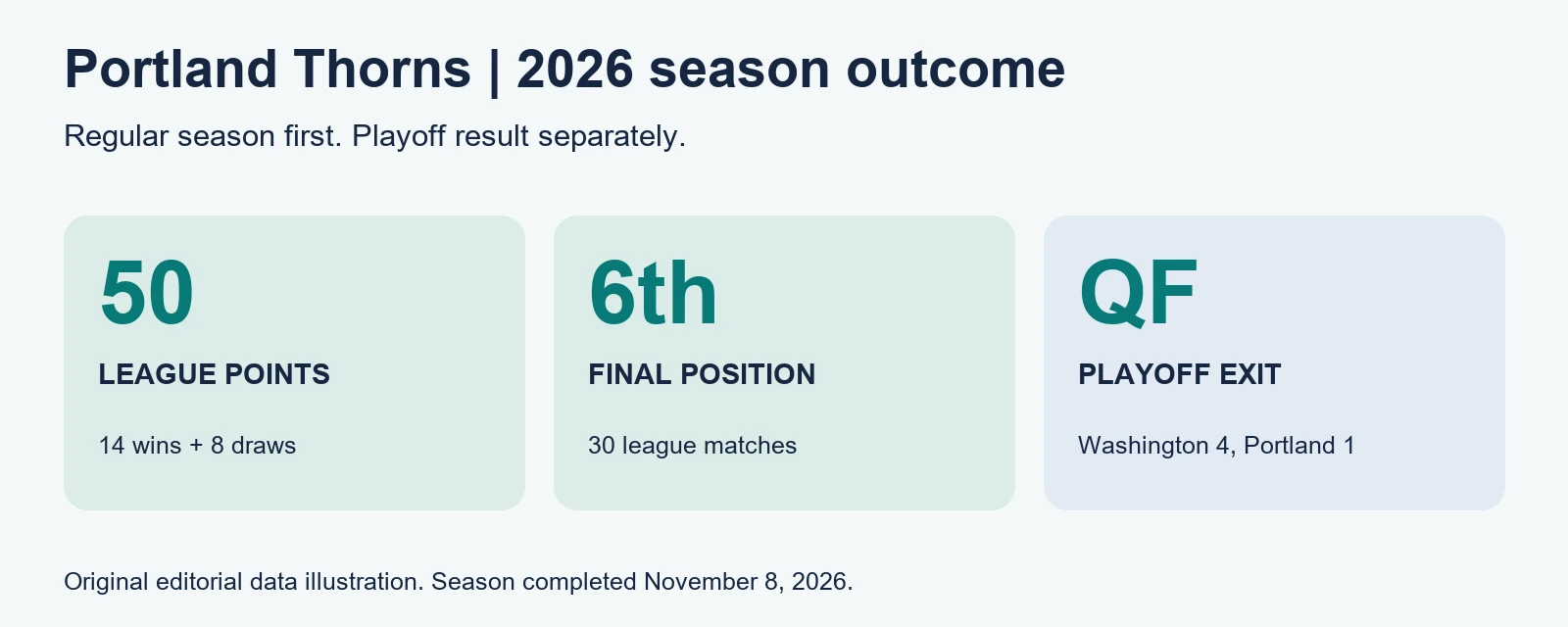
Portland Thorns FC finished sixth in the 2026 NWSL regular season with fifty points from thirty games: fourteen wins, eight draws and eight defeats. The Thorns scored fifty league goals and conceded forty-one. Their season then ended on November 8, when Washington Spirit won the playoff quarterfinal 4-1 at Audi Field.
Those two outcomes need to be read together. Portland earned a postseason place over a full league schedule, then lost the single match that determined whether it would advance. The quarterfinal does not change the fifty-point league total, and the regular-season position does not diminish the importance of the defeat. A complete review has to explain both the route into the playoffs and the way the campaign ended.
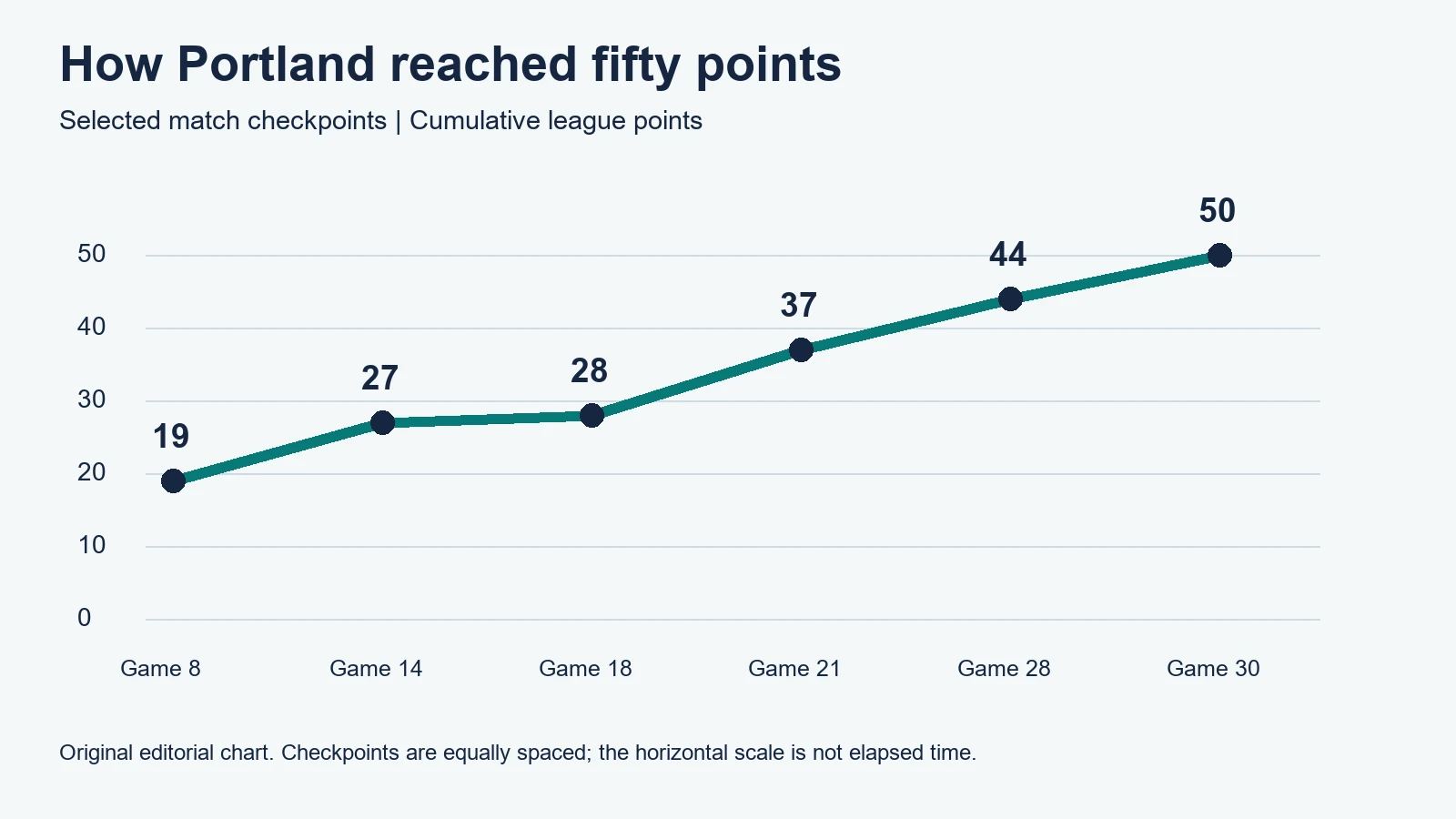
The regular season had several distinct phases. Portland collected nineteen points from its opening eight fixtures, recovered from a difficult summer sequence with three successive August wins, and finished the league campaign with consecutive clean-sheet victories. Between those stronger stretches came dropped points, including draws at home and heavy defeats on the road. The final table reflects that uneven progression rather than one uninterrupted trend.
The attacking story also extended beyond one player or one match. Olivia Moultrie and Reilyn Turner helped establish the early platform, Sophia Wilson scored important goals across the campaign, and Pietra Tordin supplied a hat trick in the August win at Boston. Later contributions from other players helped Portland secure the points it needed. The playoff starting side was a specific selection for November 8, not a permanent answer to a search for the Thorns lineup today.
For the complete match list, use the Portland Thorns schedule and results page. The NWSL standings provide the league context around the sixth-place finish. This review follows the completed 2026 campaign, keeping league results, friendly matches and the postseason in their proper places.
The opening stretch established a strong platform
Six wins from the first eight matches put Portland on nineteen points by May 3. The Thorns scored fourteen goals and conceded six across that opening stretch, keeping five clean sheets. A 3-1 defeat at San Diego and a 2-2 draw at North Carolina were the only interruptions to a sequence that immediately gave the team a strong position.
Moultrie and Turner delivered against Kansas City
The March 28 home win over Kansas City was one clear example of how that platform was built. Wilson drew a penalty, Moultrie converted it, and Turner added a header from Jayden Perry's long delivery. The 2-0 result was Portland's third win and third clean sheet in four games, following opening victories against Washington and Seattle.
Moultrie's penalty also carried an individual milestone: she became the youngest player to reach twenty NWSL regular-season goals. That was a career total, not her goal count for 2026. Turner's contribution showed another route to goal, with a defender's delivery turned into a headed finish. Portland had useful contributions from several parts of the team while also preventing Kansas City from scoring.
A late win in Los Angeles began another sequence
The April 26 trip to Angel City ended dramatically. Tordin headed Portland ahead in the second half from Carolyn Calzada's delivery, and Wilson added another in stoppage time. Angel City scored afterwards, leaving a 2-1 Thorns win. Calzada recorded an assist on her professional debut, while Mackenzie Arnold made seven saves.
That result is a reminder that even a successful early run contained different kinds of matches. The clean sheet against Kansas City and the late finish in Los Angeles were both wins, but they required different contributions. The goalkeeping work in the Angel City match mattered alongside the two forwards' goals.
Portland followed the away victory with 2-0 wins at home to San Diego on April 29 and away to Chicago on May 3. Three successive wins across that sequence supplied nine points and returned the defensive record to consecutive clean sheets. The opening nineteen points would remain a significant part of the final fifty. Later inconsistency should not erase how much the Thorns had already earned in the campaign's first eight fixtures.
Summer combined setbacks with a three-win response
Portland restarted league play with a 4-0 home win over Racing Louisville on July 5. It was the team's largest winning margin of the regular season, but the following four fixtures brought only one point. Defeats at Seattle and Denver were followed by a home draw against Gotham, then a 5-1 loss away to Utah on August 2.
The contrast was substantial. After fourteen games, Portland had twenty-seven points; four matches later, the total had advanced only to twenty-eight. A high-scoring win at the start of July had not established a reliable run. The Utah result was particularly costly in goals conceded, but the whole four-match sequence mattered to the points total.
The response began at Boston on August 9. Tordin scored a first-half hat trick and Wilson added another as Portland built a four-goal return. Boston narrowed the gap, but the Thorns held on to win 4-3. The official match report confirms the road victory and Tordin's first career hat trick. It was a very different kind of win from the clean sheets of the opening weeks.
Two home victories followed. Against Orlando on August 15, Deyna Castellanos scored first and Caiya Hanks supplied the stoppage-time winner after the Pride had equalized. Hanks had come on late for her first appearance since June 2025. Portland then beat Denver 1-0 on August 22, completing a three-match winning sequence and reaching thirty-seven points.
The nine points restored progress after the earlier slowdown. They also came through varied contributions: Tordin's repeated finishing, Wilson's goal at Boston, Castellanos opening the Orlando match and Hanks supplying its decisive finish. Those events support a concrete account of the recovery without requiring a claim about dressing-room belief or a single tactical change. The results demonstrate that Portland could recover from a difficult stretch, while the preceding defeats show why that recovery was necessary.
Providence Park provided the steadier results
Portland earned twenty-nine points at home and twenty-one away. Its fifteen league matches at Providence Park produced eight wins, five draws and two defeats. The road record was six wins, three draws and six losses. The home schedule therefore supplied the more dependable points return, even though the Thorns also won significant matches away from Portland.
The first ten home league fixtures of 2026 ended without a defeat. That sequence included wins against Seattle, Kansas City and San Diego early on, the 4-0 result against Louisville, and the August victories over Orlando and Denver. Washington finally won at Providence Park on September 6, recovering from Wilson's first-half penalty to take the match 2-1.
Boston supplied the other home defeat, winning 4-2 on October 3. Those two losses should be kept in perspective alongside the five home draws. Avoiding defeat helped Portland build its total, but sharing points with Angel City, Utah, Gotham, Chicago and Houston also limited how much the home schedule could contribute. The difference between a draw and a win remained important even in the team's stronger setting.
Equal scoring totals hid a defensive split
The Thorns scored twenty-five league goals at home and twenty-five away. Looking only at attacking output would therefore suggest similar returns in both settings. Goals conceded reveal a different picture: thirteen at home and twenty-eight away. That produced a home goal difference of plus twelve, compared with minus three on the road.
These numbers describe the results; they do not isolate a stadium effect or establish why particular goals were conceded. Opponents and match circumstances varied. They do, however, identify a useful question for evaluating the season: how could Portland retain its ability to score away while allowing fewer goals at the other end?
The quarterfinal at Washington belongs outside those league splits. Adding its four goals conceded to the road total would mix two competitions and obscure the record that earned Portland its playoff place. The distinction matters when comparing the steady home campaign with the much sharper disappointment of the final away match.
The league finish restored momentum before the trip to Washington
After the August winning sequence, Portland's progress became uneven again. A draw at Gotham was followed by the home defeat to Washington and a draw against Chicago. The Thorns then won 4-1 away to Orlando on September 19, but the next three fixtures brought draws with Houston and Bay around the home loss to Boston.
Portland entered its final two league matches with forty-four points. The team had continued to score, including four at Orlando, but it had not converted every scoring performance into a win. The 1-1 home draw with Chicago was particularly frustrating in its timing: the visitors equalized in stoppage time. These dropped points form part of the explanation for the sixth-place finish alongside the more memorable victories.
Two clean sheets completed the regular season
The October 23 home match against North Carolina brought the result Portland needed to secure a playoff berth. Marie Müller scored the only goal in the second half, striking after a deflected attempt reached her. The Thorns kept the Courage out and won 1-0. Qualification was therefore secured before Decision Day, rather than depending on the final match at Houston.
That finale still mattered to the league finish. Wilson scored twice in the 2-0 away win on November 1, with Turner supplying the pass for the first goal. The victory took Portland from forty-seven to fifty points and completed consecutive clean sheets. It also gave the Thorns a successful road result immediately before another away assignment in the playoffs.
The two wins supplied six points without a goal conceded. That is a concrete measure of a stronger league ending; it does not guarantee that the next opponent will allow the same game to develop. Washington presented a different contest at a different stage of the competition, and the quarterfinal outcome would be much harsher.
Keeping both finishes in view prevents an incomplete reading of the season. Portland did not stumble into the postseason on consecutive defeats. It qualified through a narrow home win and then improved its league total with a clear away victory. The subsequent elimination belongs alongside that finish, rather than replacing it in the account of the year.
The quarterfinal changed the ending in one afternoon
Portland returned to Audi Field for the November 8 quarterfinal, the same venue where it had won its opening league match in March. This time Washington scored early and built a three-goal halftime lead. The final 4-1 result ended the Thorns' campaign at the first playoff hurdle.
The starting eleven belongs to November 8
The official Thorns match report listed a 4-4-2 starting formation. Jessie Fleming captained the side, with Tordin and Wilson among the starting forwards. The table records that actual selection. It should not be treated as a forecast for another match or a permanent description of the squad.
| Group | Players |
|---|---|
| Goalkeeper | Mackenzie Arnold |
| Defensive line | Reyna Reyes, Jayden Perry, Isabella Obaze, Carolyn Calzada |
| Midfield | Jessie Fleming, Nina Nijstad, Marie Müller, Caiya Hanks |
| Forwards | Pietra Tordin, Sophia Wilson |
Calzada, Hanks and Nijstad made their NWSL playoff debuts. Reilyn Turner and Morgan Weaver were among the players introduced during the match. Those details describe the personnel involved in the actual contest without speculating about the coaching staff's private reasoning for each choice.
Three first-half goals created the decisive gap
Washington's opening goal came through Melissa Bethi in the sixth minute. Clara Luvanga added the second in the thirty-fourth, and Rodman scored a minute later. The rapid pair of goals before the break turned a one-goal deficit into a much more demanding position. Washington's report identifies turnovers and quick attacking actions within that sequence; the damage was already substantial before halftime.
Fleming then assisted Tordin for Portland's goal early in the second half. It was Tordin's first career playoff goal and reduced the deficit to 3-1. Rodman scored again seven minutes later, restoring the three-goal margin. Portland had briefly narrowed the contest, but Washington answered before a longer recovery could develop.
Perry's dismissal came late, after the score had already reached 4-1. It therefore cannot explain the earlier goals or be presented as the moment that created the decisive deficit. The sequence matters more than simply attaching every negative event to the final score: Portland's most damaging period was the first half, followed by Washington's quick response to Tordin's goal.
How to assess the season beyond its final score
Three measures give a useful account of Portland's year: the points earned over thirty league games, the contributions that produced those points, and the performance in the match that ended the season. They answer different questions. Fifty points established a playoff place; individual milestones explain part of how Portland got there; the quarterfinal exposed a deficit the team could not overcome that afternoon.
Wilson finished the regular season with fifteen goals and five assists. Fleming started all thirty league matches and played all 2,700 minutes. Those are substantial records of attacking production and availability respectively. They belong alongside the specific contributions seen throughout the campaign, from the early Moultrie and Turner goals to Tordin's Boston hat trick and Hanks' late winner against Orlando.
The team's scoring was sufficiently broad to reach fifty league goals, yet the distribution of results remained uneven. Portland could follow a four-goal win with a difficult sequence, then recover with three successive victories. That variation explains why one good or bad match is an unreliable guide to the whole campaign. The final record contains both the early nineteen-point platform and the later periods when progress slowed.
The home and away comparison identifies another clear area for assessment. Portland scored equally in both settings but conceded fifteen more goals on the road. Preserving the ability to create and finish away while reducing that concession total would address an observable difference in the completed results. It is a more precise question than assuming the final playoff score describes every away performance.
At the same time, a season review should retain the significance of the elimination. Washington's three first-half goals and its response after Tordin scored determined the end of Portland's campaign. The Thorns had earned the right to play that match through a substantial league total and a strong final pair of results. Advancing required another performance, and on November 8 they could not produce the result they needed.
Loading comments…