Chicago's player directory at the end of 2026
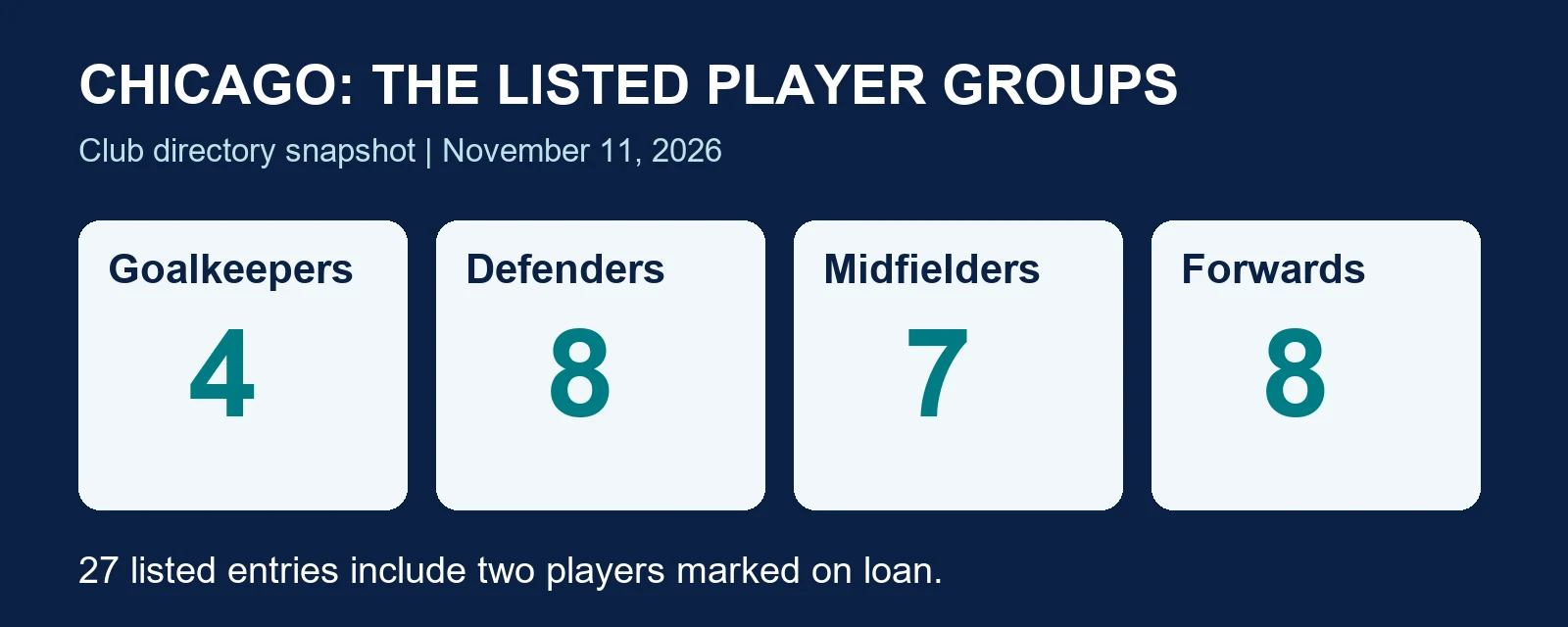
Chicago Stars FC's club directory listed 27 players on November 11, 2026, including two marked as on loan. The groups below follow the club's own position labels. This is a dated guide to the players associated with the team, rather than a claim that all 27 are available for selection or already form the final 2027 squad.
| Club position group | Listed players |
|---|---|
| Goalkeepers | Katie Atkinson, Halle Mackiewicz, Alyssa Naeher; Mackenzie Wood (on loan) |
| Defenders | Michelle Alozie, Sam Angel (on loan), Elise Evans, Aaliyah Farmer, Natalia Kuikka, Sam Staab, Oihane Valdezate, Taylor Wood |
| Midfielders | Tessa Dellarose, Emma Egizii, Bea Franklin, Anna Gasper, Julia Grosso, Maitane, Brianna Pinto |
| Forwards | Jenna Bike, Simone Charley, Ryan Connaughton, Nádia Gomes, Jordyn Huitema, Micayla Johnson, Racheal Kundananji, Mallory Swanson |
The date matters because Chicago's opening announcement described a different stage of the year. On March 12, the club reported 28 players under contract and 25 on its active roster. Those opening figures describe that announcement, not a permanent head count. Arrivals, departures, loans and changes in availability mean that a season can contain several equally authentic lists that answer different questions.
Start with the official Chicago roster when identifying the club's players. Then keep the intended question in view. Finding a player in the directory establishes a connection to the club; checking whether she can play in the next match requires a more specific announcement. A player who is on loan also needs a different interpretation from somebody preparing with the first team.
Position labels are an organizing aid. They help a supporter locate goalkeepers or compare the midfield group without prescribing a formation, a depth chart or a particular starting eleven. A midfielder can have responsibilities that change with the opponent and the selected teammates. The directory supplies a useful starting point for understanding those choices, while the actual match selection shows what the coach chose on one occasion.
Use the Chicago Stars schedule and results alongside this guide. A result or lineup belongs to its own date. Keeping that date attached prevents a memorable performance, an old transfer announcement or an earlier season's team sheet from silently becoming a statement about the next game.
Goalkeepers and defenders: reading the back line
The goalkeeping group includes a separate loan case
Alyssa Naeher, Katie Atkinson and Halle Mackiewicz are listed in the goalkeeping group, with Mackenzie Wood separately marked as on loan. Naeher returned for her eleventh Chicago season in 2026, giving the group a familiar name for longtime supporters. That season-specific return does not itself announce the terms of a subsequent season.
Wood illustrates why the extra label matters. Chicago's opening roster announcement identified her 2026 loan to Portland Thorns FC. A parent club can retain a player in its directory while she plays elsewhere. Counting every goalkeeper associated with Chicago as an option on its bench would therefore give a misleading picture of the competition for a particular match.
The same caution applies to temporary cover. Chicago announced Taylor Rath on a roster-relief contract in March after Mackiewicz entered the injury list. Rath is absent from the current listed group above. The historical signing remains part of the season, but it is not enough to add an extra goalkeeper to a November directory or make a fresh statement about Mackiewicz's health.
For a match, identify the named goalkeeper and the available substitute from that game's team sheet. The season directory explains the wider group; it does not select the starter. A familiar first-choice name, an earlier injury announcement and a recent appearance each provide different information. Their dates determine whether they help answer the current selection question.
Defenders have different routes into this squad
Sam Staab provides a concrete measure of continuity. Chicago's report on the November 1 finale credits her with 29 starts in 30 appearances during the 2026 season. Those are season participation figures, rather than a promise about who will start after the offseason. They explain why she is an important name when a new supporter begins reading the defensive group.
Other defenders arrived through different professional backgrounds. Michelle Alozie's club profile identifies Houston Dash as her previous team, while Oihane Valdezate's identifies AS Roma. Alongside the rest of the group, those histories help distinguish the players without reducing each to a nationality, a transfer headline or an assumed place in a fixed formation.
The club labels Taylor Wood as a defender. Use that designation consistently here, even if another sports directory groups her differently. Sam Angel also appears among the defenders with a loan flag, which needs the same separate treatment as Mackenzie Wood's. A list of eight defenders consequently cannot be read as eight currently interchangeable matchday options.
When comparing two lineups, look at the selected combination as well as the names. Replacing one player can change the responsibilities of the others, and a directory's broad position label will not describe every task in a match. The useful progression is to identify the player accurately, attach the correct appearance date and then assess the role shown in that game.
The midfield and attacking options
The midfield group brings together Tessa Dellarose, Emma Egizii, Bea Franklin, Anna Gasper, Julia Grosso, Maitane and Brianna Pinto. Read the club's broad label as a way to find the player, rather than a claim that all seven perform the same job. A lineup and the movement within a match provide the more detailed picture.
Several of those names connect Chicago to different professional environments. Grosso's official profile identifies Juventus as her previous club. Pinto's identifies North Carolina Courage, while Gasper's identifies Benfica. These are useful starting points for a supporter following a player into Chicago: the same midfield directory contains established NWSL experience and arrivals whose previous clubs were abroad.
Dellarose's profile lists North Carolina as her college. That background belongs beside, rather than underneath, the professional histories of her teammates. The directory describes who is in the group; it does not rank their readiness or make a college background a fixed limit on a player's role. Their individual match records are the place to assess the opportunities they received.
A change in a midfield combination can matter without changing the directory's position labels. The selected players may distribute responsibility differently, and substitutions can alter that combination later in the game. For a useful comparison, keep the opponent and the stage of the match alongside the names. Simply counting how many listed midfielders started leaves much of that context out.
The forwards include late-season reinforcements
Chicago's attacking group includes players who entered the year with the club and additions who arrived later. Jordyn Huitema's official profile identifies Seattle Reign FC as her previous club. Racheal Kundananji joined from Bay FC in October. Simone Charley is another name that a supporter relying on the opening announcement would miss.
Charley's contribution in the finale supplies a specific example of why the bench belongs in a roster guide. The club reported that she entered the November 1 match in the 61st minute and finished with five shots, the most for Chicago in that game. Those details describe a substitute's involvement on one evening; they do not establish a future starting place or a season-long shooting ranking.
The remaining listed forwards are Jenna Bike, Ryan Connaughton, Nádia Gomes, Micayla Johnson and Mallory Swanson. Keeping the full group visible avoids treating the attack as a single famous player's responsibility. It also makes subsequent announcements easier to interpret: a new forward joins an existing set of players, with selection and availability still to be settled separately.
Swanson's presence in the club directory should be read with particular care when moving from roster identification to match planning. The opening announcement recorded a leave status at that earlier date. A historical leave notice and a present directory entry cannot, on their own, tell a supporter whether she will appear in a particular future game. The current availability announcement and the eventual team sheet answer that narrower question.
Why the squad differs from the opening roster
Summer additions changed more than one position
Anna Gasper's July 9 arrival from Benfica added a midfielder after the season had already begun. Chicago announced a deal through 2027 with a mutual option for 2028. That wording records both a firm stated term and a further possibility; the option year should not be silently treated as another guaranteed season.
Oihane Valdezate followed in August. The club's August 10 announcement described a free-agent signing from AS Roma through the end of 2026, pending international transfer clearance. The distinction between that announcement and Gasper's matters when a supporter begins discussing the next season. Two arrivals in the same summer can have different announced contract horizons.
These additions also show why a head count alone provides a limited account of change. A club can alter its midfield and defensive options without producing a dramatic increase in the total number of names. Looking at the position, arrival date and stated term explains more than comparing two squad totals and assuming the difference measures the scale of the work.
Kundananji became a late-season arrival
On October 8, Chicago announced Racheal Kundananji's acquisition from Bay FC through the 2027 season. The club identified her as the first roster addition under Chief Soccer Officer Vlatko Andonovski. The transaction therefore belongs to the late-season player story as well as the wider change in sporting leadership.
It is still important to keep the jobs separate. A leadership appointment describes who is responsible for sporting decisions; an acquisition identifies an actual player entering the group. Neither announcement alone sets a starting lineup. The existing Andonovski appointment guide explains the organizational role, while this roster guide follows the resulting named player changes.
For a new arrival, compare the announcement with subsequent match involvement before describing her impact. The signing date is a clear milestone, but it does not establish how many minutes she will play, which teammates she will partner or how the team will perform. Those conclusions need evidence from the matches that follow.
Departures remain visible in old search results
Several familiar names require the opposite update. Ludmila left for San Diego Wave FC in January. Kathrin Hendrich's transfer to FC Köln was announced on August 6, and Jameese Joseph's move to Utah Royals FC followed on September 7. Their Chicago history remains real even though they do not belong in the current listed group above.
Joseph is an especially useful example because her earlier extension had announced a Chicago commitment through 2028, with a mutual option for 2029. A reader finding only that release could reasonably miss the later transfer. The correct response is to preserve both dates: the extension describes the agreement at that time, and the subsequent transaction explains why the current club list changed.
Search engines can continue to surface the older release or an archived player profile. Those pages are valuable for following a career, but their continued existence is not a fresh membership announcement. Reading the date and then checking later club news prevents an accurate historical page from producing an inaccurate present-day roster.
Contracts, loans and matchday availability answer different questions
A contract announcement is a dated commitment
Chicago's announcements give supporters useful planning information when their wording is kept intact. Gasper's stated term runs through 2027, with a mutual option for 2028. Valdezate's arrival announcement described the remainder of 2026. Kundananji's announcement identified the 2027 season. These are different commitments, even though all three players appear in the same November directory.
An option is a condition to follow, rather than a completed extension to assume. Likewise, an earlier agreement can be followed by another transaction, as Joseph's move demonstrated. The latest relevant club announcement should sit alongside the original deal when assessing a player's current connection to Chicago.
The distinction also makes free-agency reporting easier to read. An eligibility list concerns a stage of contract planning; it is not a newly announced starting squad. Our 2027 NWSL free-agent guide explains that league-wide subject. Use the relevant dated club signing or departure to establish what happened to an individual player.
The match squad is a separate selection
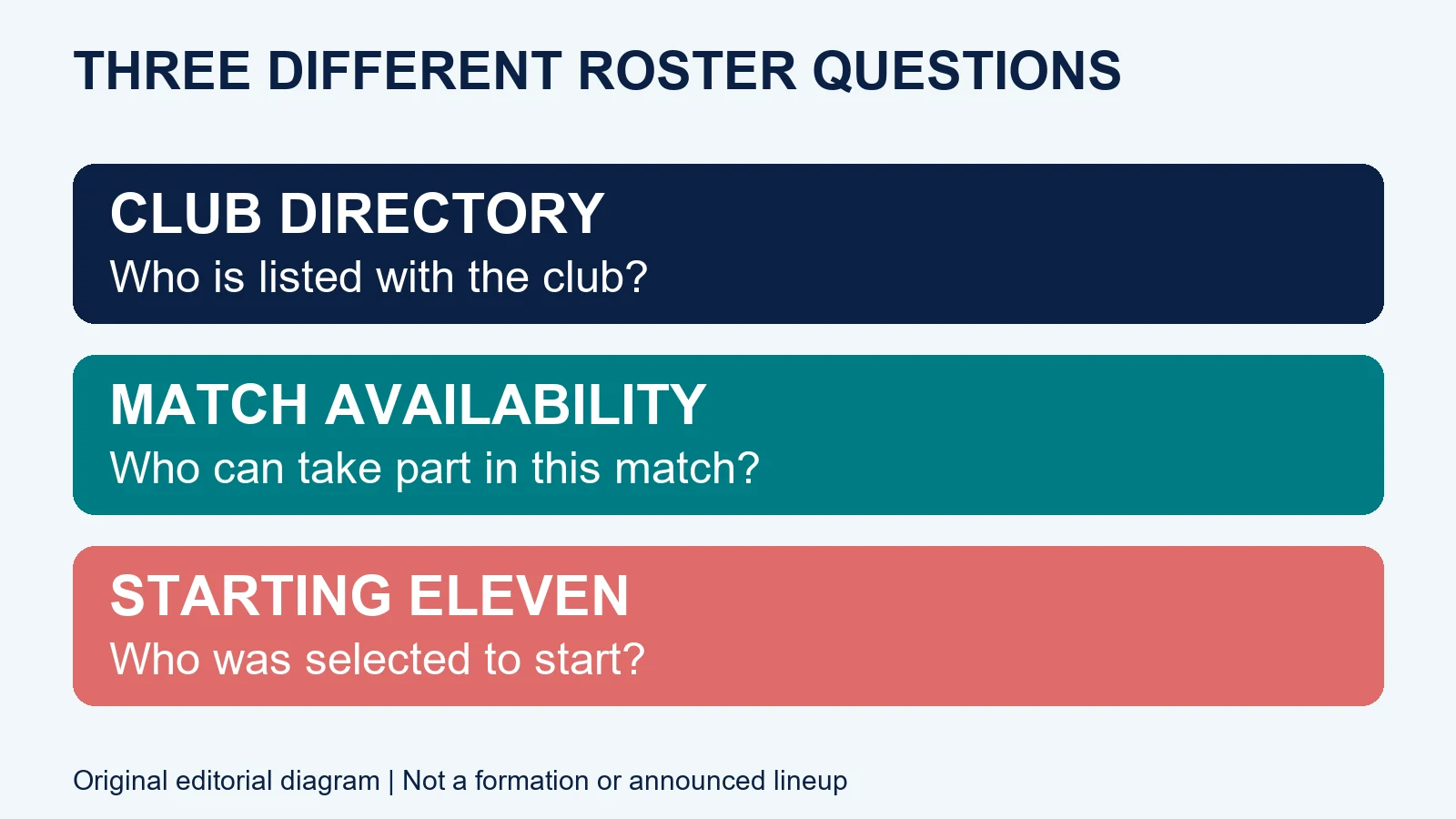
Match availability asks whether a player can take part in one particular contest. The starting eleven then records a selection within the available group. A loan annotation asks a different question again, because a player can remain associated with the parent club while her playing arrangement is elsewhere. None of those labels can safely stand in for all the others.
Chicago's finale offers a straightforward illustration. Charley appeared as a substitute, which was a real role in that game even though she was not on the field at kickoff. A supporter looking only for the first eleven names would miss part of the selected team's contribution. Conversely, a player absent from one team sheet has not thereby been announced as leaving the club.
For future matches, use the specific fixture and the newest official club or league information. The availability-report guide explains the public labels without predicting medical return dates. A player's directory portrait should help you identify her; it should not be treated as evidence that a leave, injury or other absence has ended.
Follow the next confirmed Chicago roster update
Chicago's 2026 campaign ended on November 1, so the next roster story needs to be read as an offseason development rather than an automatic continuation of a remaining league schedule. An arrival, departure, extension or new loan can change one part of the directory without answering every question about the next season.
Use the club's dated news announcements to identify the actual change. Keep the player, the action and the stated term together. A completed signing and an expression of interest should not produce the same update. A mutual option should remain conditional until there is an announcement establishing what happened to it.
Preserve the historical record when the current list changes. Joseph's Chicago appearances do not disappear because she moved to Utah, and a player's earlier club remains part of the explanation of how she reached this squad. The useful distinction is between recalling what happened in a Chicago shirt and identifying who belongs in the present directory.
For the next published fixture, pair the team information with the match itself: opponent, competition, venue and date. Then seek the applicable player announcement or match selection. A calendar reminder helps you find the team; it cannot promise an appearance by the player whose name first drew your attention.
A good next-season roster update will name the players, show the date it describes and distinguish confirmed membership from unresolved arrangements. Until those details are announced, this November guide provides a clear baseline: a club-listed group spanning four positions, two explicit loan cases and several meaningful changes since opening day. It makes the next announcement easier to understand without pretending that the offseason has already settled every role.
Loading comments…