What changes on January 1, 2027?
The clearest answer to the latest Rodman Rule debate is about eligibility. Under the October 23 settlement between the NWSL and its players association, the sporting and commercial tests that restricted High Impact Player designations are being removed for 2027. The change begins January 1, after the current season. It opens the mechanism to players who would have missed the old qualifying lists; it does not promise every player a raise or replace the team salary cap with unlimited spending.
That distinction matters when a headline says that every player can now receive HIP money. It describes who can be considered, rather than what every club must pay. A player still needs a negotiated contract, a club willing to fund it and a transaction that fits the applicable financial rules. A designation is a route through the accounting system, not a prize automatically deposited after a particular performance.
The old eligibility tests are being removed
The league's March 2026 competition announcement linked HIP access to specified achievements or visibility: international player rankings, marketability lists, national-team minutes and certain NWSL honors. Those tests could make two otherwise similar contract negotiations subject to different spending options. Removing the tests changes that gate even if the rest of a club's roster budget remains constrained.
Consider a hypothetical midfielder who becomes crucial to her club without appearing on a qualifying media list. Under a list-based system, the club's evaluation of her sporting value might not be enough to unlock the exception. Broader eligibility removes that particular obstacle. Whether the player receives an offer, accepts it or prefers another club remains a separate question. This example illustrates the effect of an eligibility gate; it does not identify an actual contract or a league-approved cap calculation.
Readers following the run-in should also keep the season boundary in view. A future eligibility expansion does not establish that a club's 2026 roster was compliant or noncompliant. Nor does it rewrite a signed deal in public merely because the rules will change. For the surrounding season framework, use our 2026 NWSL rules guide and check the date attached to each announcement.
How HIP money differs from the ordinary salary cap
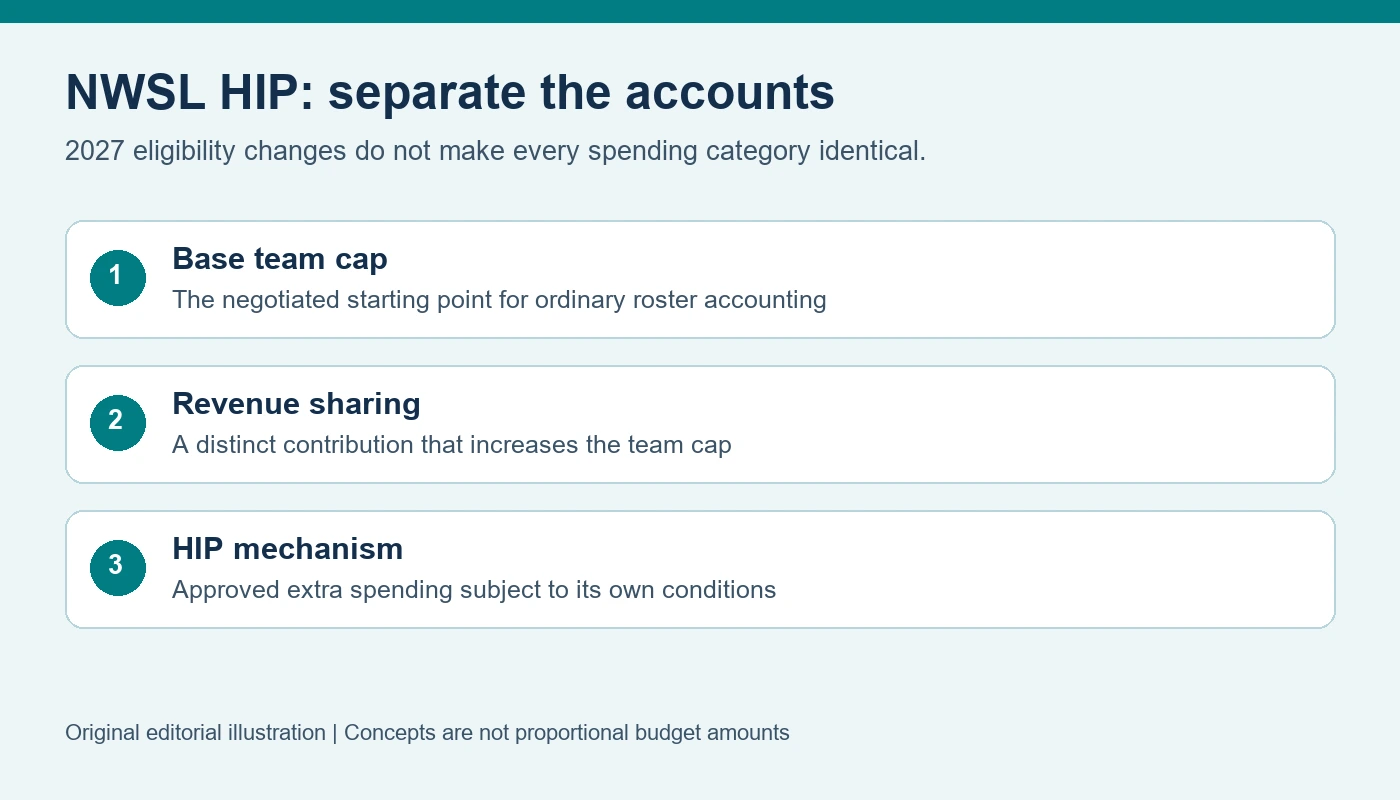
A useful way to follow an NWSL contract story is to separate three accounts: the ordinary team budget, the revenue-sharing contribution that enlarges it and any approved special mechanism. The league's published 2026 figures were a $3.5 million base salary cap, increased to $3.7 million through revenue sharing, with a distinct HIP allowance permitting additional qualifying expenditure. These are descriptions of different spending layers, rather than three labels for one player's wage.
Salary, cap charge and extra spending are different numbers
Salary answers what a contract pays. Cap charge answers how an agreement is counted under the rules. The latter can depend on the treatment of bonuses, fees and benefits as well as any permitted relief. Neither a reported annual wage nor a headline value for an entire multiyear deal is enough to reconstruct a club's accounting. Dividing a total reported contract value by the number of years can be useful arithmetic, but it does not reveal payment timing or the league's cap assessment.
Imagine two hypothetical offers with the same headline value. One could guarantee more money immediately while the other ties part of the package to future conditions. Without those terms, supporters cannot know that the offers have identical sporting or financial effects. An announcement that confirms HIP use adds a helpful piece of information; it still does not publish the complete cap ledger.
Why a higher general cap would distribute flexibility differently
The union's preference for a general increase, rather than restricted star funding, helps explain why the original dispute was about distribution as well as total dollars. If an equal sum is available anywhere on a roster, a club can choose between one major signing and several smaller improvements. If that sum sits behind an eligibility gate, some of those combinations may be unavailable. This is a comparison of incentives, not a prediction that every club would choose the same strategy.
Broader HIP eligibility narrows one difference between those models, but it does not make their administration identical. A separate mechanism still needs conditions and accounting. Fans evaluating offseason plans should therefore ask both how much flexibility exists and where it may be used. Our 2027 free-agent guide identifies the player-movement context; free agency itself should not be mistaken for confirmation that a particular club can fund every available player.
What the 12 percent requirement actually means
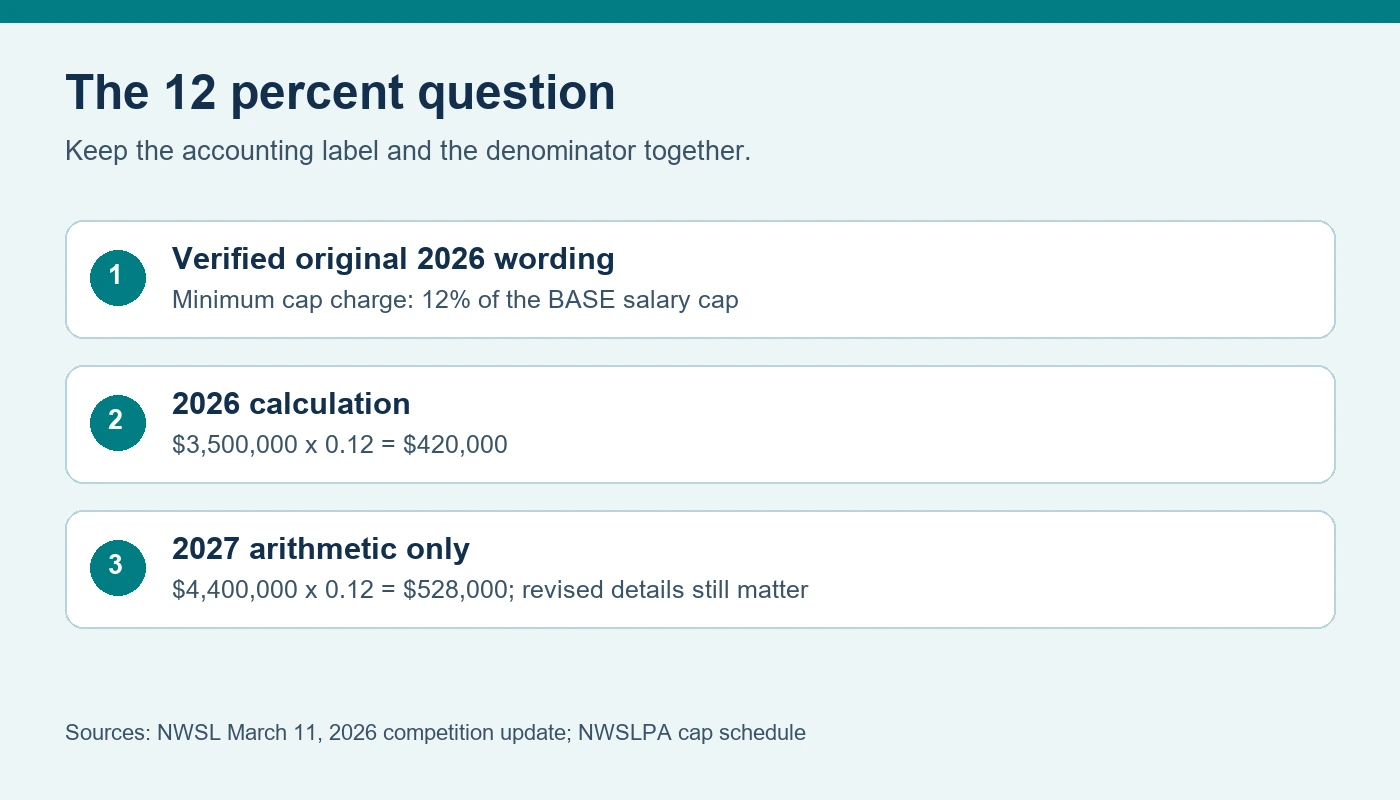
The most confusing number in this debate needs both a denominator and an accounting label. The original official rule did not say that a player could earn only 12 percent of the team's cap. It set a minimum cap charge measured against the base salary cap. Nor did it say that only 12 percent of the player's own wage had to count. Those sentences produce very different results, even though each contains the same percentage.
The verified 2026 calculation
Using the published 2026 base, $3,500,000 multiplied by 0.12 equals $420,000. That is the floor implied by the original cap-charge wording. Using the $3.7 million revenue-adjusted figure instead would produce $444,000, but it would change the denominator from the base to a different account. The arithmetic can be correct while the rule application is wrong.
For a hypothetical $1 million salary, 12 percent of the salary would be $120,000. That is a third number, based on a third calculation. It should not be substituted for the original $420,000 floor. None of these examples determines the complete treatment of bonuses or other contract terms; their purpose is to show why a short social post can mislead without actually containing an arithmetic error.
What can and cannot be inferred for 2027
The players association's cap schedule lists a $4.4 million base for 2027. Twelve percent of that is $528,000. Reporter Jeff Kassouf clarified on October 23 that $528,000 is the minimum salary required for HIP eligibility in 2027. That directly attributed explanation is more useful than the earlier, conflicting social summaries. It still does not publish the complete revised cap-accounting instructions for every contract.
As of October 29, distinguish that reported minimum-salary explanation from the original official cap-charge wording and the treatment of an individual future contract. The revised agreement itself was not available in the material reviewed for this guide, so a precise accounting ruling on a specific offer remains beyond the evidence. The verified change is the removal of the old sporting and marketing criteria. Before judging an offer by the new percentage, look for the revised official wording and distinguish any announced limit on HIP designations from the league's ability to introduce one later. A permission to set a limit is not itself a published number of slots.
Why the players union challenged the Rodman Rule
Opposing the original HIP policy did not mean opposing higher pay for Trinity Rodman or other prominent players. The dispute concerned who could change compensation rules, how consultation should work and whether a separate eligibility system was consistent with the collective bargaining agreement. The union could favor larger salaries while disagreeing with the league's chosen mechanism for delivering them.
In January interviews with The Philadelphia Inquirer, commissioner Jessica Berman defended the league's authority to create the classification after consultation. Union executive director Meghann Burke disputed both the characterization of the process and the justification for the selection tests. Those attributed positions are useful context; neither should be converted into a judicial finding that the other side broke the law.
Think of the difference between agreeing that a workplace should pay more and agreeing on who controls the pay structure. Employees may object if a new benefit depends on categories they did not negotiate, especially when those categories can exclude colleagues whose work is valued highly inside the organization. An employer may argue that a targeted program helps attract talent in a competitive market. Both propositions can explain the dispute without establishing which interpretation would have prevailed in a formal proceeding.
For supporters, the sporting implication is that labor rules shape the market before a coach chooses a formation. A contract that a wealthy owner wants to offer still has to fit the system under which the league and players operate. Conversely, settling a grievance can expand future options without producing a new transfer on the same day. A labor agreement and a signing announcement answer different questions.
The October settlement should therefore be read as a negotiated resolution with practical consequences, rather than a declaration that every earlier complaint was proven. It removes a disputed eligibility barrier and addresses other issues, while leaving clubs to construct actual offers. When a discussion frames the outcome as either unrestricted spending or opposition to stars getting paid, it loses the central question: how compensation opportunities are governed and distributed across the membership.
The settlement covers more than star contracts
The HIP headline is only part of a resolution covering six grievances. Other terms affect how contracts are reviewed, which incentives can be negotiated and how existing commercial agreements and benefits are treated. These details matter to players who may never become the subject of a multimillion-dollar transfer story. A wage mechanism and protections surrounding an ordinary contract both influence the practical value of employment.
Contract rejection notices and negotiated bonuses
The Equalizer's settlement report, syndicated by Yardbarker, explains that the league must notify the union and explain a contract rejection within 72 hours. That requirement improves the information available after a decision. It should not be read as a promise that every submitted offer will be approved or as a deadline after which an otherwise prohibited contract automatically becomes valid.
The agreement also widens the categories of performance incentives that clubs and players may negotiate. Appearance and minutes milestones are examples discussed in the reporting. A permitted category is not an automatic payment to every player who reaches the milestone: the actual agreement must provide the entitlement. For a supporter comparing two announcements, guaranteed salary and conditional incentives should remain separate even when a headline combines them into one potential value.
Footwear and existing benefits need their own context
The settlement addresses existing footwear endorsement arrangements and previously issued fines. That is a sponsorship-policy issue, not another pot of salary-cap room. Seeing a player in a different boot brand does not by itself establish either defiance or a new exemption; an existing deal and the applicable supplier arrangements can matter. Photos alone do not disclose those contractual relationships.
Reporting also describes protection for qualifying housing and automobile benefits already specified in existing agreements. This is why a larger future base cap should not be interpreted as a simple measure of every player's improvement in disposable income. What is included in compensation, what remains a benefit and what a player must pay personally all affect the comparison. The practical question is whether the same person's full package has changed, rather than whether one published league number has increased. Without the contract, a precise individual before-and-after calculation would be speculation.
How to read a 2027 signing announcement without getting misled
Start with the thing that is actually confirmed. A club statement may confirm a contract term and a HIP designation while leaving salary undisclosed. A reporter may add a sourced estimate. A fan calculation may then infer the club's remaining room. Those are three different levels of information. Keeping them separate is more useful than treating the most detailed-looking spreadsheet as the most authoritative account.
Next, identify the season. A report published in October can describe a deal beginning in January, an extension of a current agreement or a negotiation that has not produced a signature. The removal of the old tests does not erase contract dates. Likewise, a player being available to negotiate does not tell supporters when she would arrive, how long her agreement runs or which competition she can immediately enter.
Questions a contract headline should answer
- Is the agreement signed, officially announced or only reported as a negotiation?
- Does the quoted amount describe one season, the entire contract or the maximum after conditional bonuses?
- Is HIP use confirmed, and does the story distinguish salary from the charge retained against the ordinary cap?
- Does a percentage use the base cap, the revenue-adjusted cap or the player's own salary?
- Are any restrictions being described as current rules, future changes or possibilities the league may adopt?
These questions also improve discussion about competitive balance. A club assembling several well-known players is a reason to ask how the mechanisms work; it is not evidence that it has exceeded its budget. Public salary information is incomplete, and permitted relief can make an outside estimate inaccurate. Equally, the existence of a special mechanism does not excuse a genuinely undisclosed or prohibited arrangement. Evidence about the actual transaction is needed in either direction.
For offseason planning, follow official club announcements alongside the free-agent list and contract updates. The important result of the settlement is a wider pool of players who can enter HIP negotiations in 2027. The next useful developments will be precise implementation language and confirmed contracts showing how clubs use that opportunity. Until then, separating eligibility, pay and accounting gives supporters a firmer basis for judging each headline.
Loading comments…