What the reported Player Development Rule is designed to do
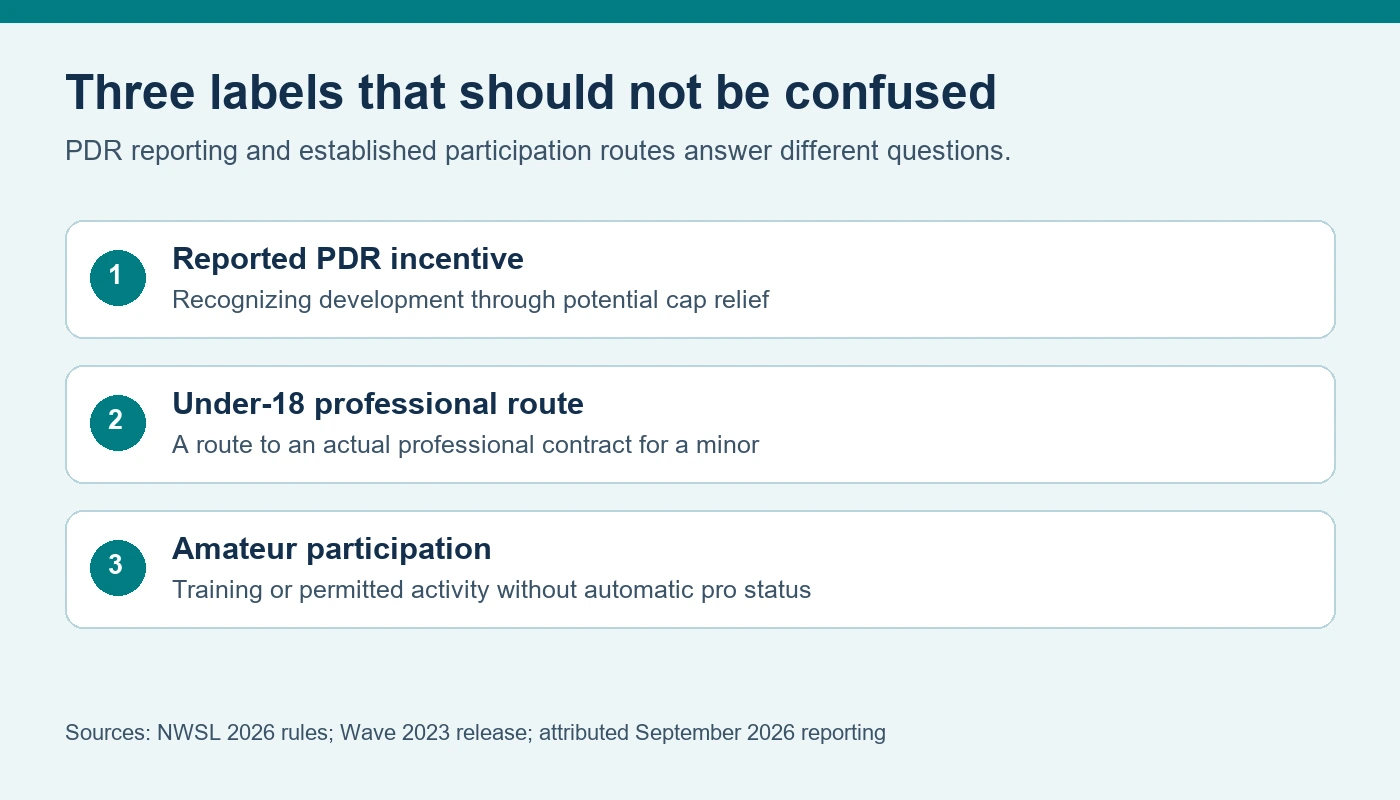
The reported NWSL Player Development Rule, usually shortened to PDR, is an incentive for clubs to invest in developing young players before a professional contract is signed. Its central idea is financial recognition of development work through salary-cap relief. It should not be confused with a new draft, an automatic professional contract for every registered prospect or permission to select an amateur in a league match.
Just Women's Sports reported on September 23, citing ESPN's source-based story, that clubs could register prospects, fund their development and qualify for relief after a period of documented oversight. Its summary describes two years and 200 hours. Those are reported conditions, rather than a complete set of requirements independently confirmed here from a published league manual.
A reported mechanism is not a complete public rulebook
That distinction is important because a development program needs more than a headline percentage. It needs definitions of eligible work, registration, compensation treatment, player choice and what happens when circumstances change. The publicly reviewed material for this guide does not establish every one of those details. A short news summary cannot safely be used as a calculator for a particular club's future cap room.
The useful answer for supporters is therefore specific but limited: the reported mechanism aims to make developing talent financially attractive to NWSL clubs. It is part of the conversation about how teams find and prepare players after the draft's removal. Whether a particular prospect is registered, whether a specific contract qualifies and exactly how much relief applies require additional documentation.
Readers who have seen social posts calling this an immediate new route for U-15 signings should pause at the word signing. Registration for development and signing a professional agreement are distinct events. Our 2026 rules guide provides the wider season context; the following distinctions explain why the reported incentive cannot replace existing participation and employment requirements.
How development rewards could affect salary-cap accounting
Cap relief changes the amount charged to a club's roster budget. It does not mean that the player receives only the amount that counts, and it does not necessarily mean the league sends a cash reward to the player. The reported PDR concept concerns how developing talent can become more attractive within a spending system. Compensation owed under an actual contract remains a separate matter.
Consider a purely hypothetical club deciding between paying for structured youth coaching now and spending all its resources on immediate first-team recruitment. If documented development can later reduce the accounting cost of a qualifying signing, the club may have an additional reason to invest early. That is the incentive being discussed. The example does not establish that development guarantees a successful professional or that any particular expenditure qualifies.
This distinction also helps explain why a relief percentage cannot tell the whole story. A reader would need to know the eligible compensation, the duration, the conditions and whether relief survives a change of club or contract. A percentage attached to the wrong base can produce a precise-looking but meaningless figure. For this guide, no universal PDR relief percentage or club-specific saving is asserted.
The public CBA already anticipates the possibility of a homegrown or other development classification. That provision shows that developmental categories were contemplated in the negotiated framework. It should not be stretched into proof of every term in the September reporting. A general provision about potential roster treatment is not the same document as an implemented registration process or a calculation schedule.
For fans evaluating a club's long-term plan, the better sporting question is whether the investment creates a coherent route from coaching to appropriate competition and, eventually, a credible professional opportunity. Financial recognition could support that route. It cannot substitute for it. A club that registers many prospects has not automatically produced many first-team players, just as a club that announces a youth partnership has not necessarily confirmed a PDR-qualified signing.
PDR is different from the Under18 signing pathway
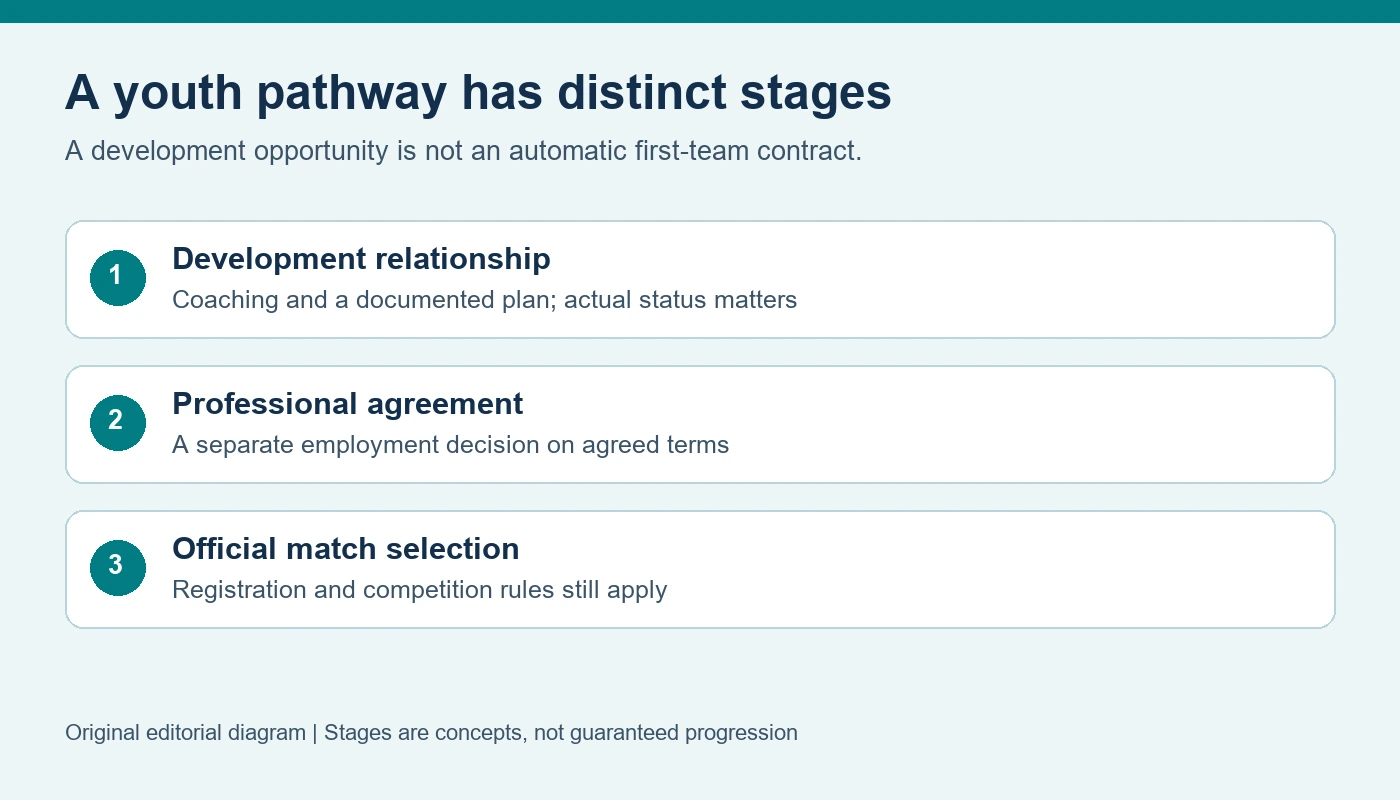
Three events can appear in the same young player's story without being interchangeable: working with a professional club, entering a development arrangement and signing a professional contract. A report about one event does not automatically confirm the other two. A fourth question, selection for an official match, depends on the relevant competition and registration requirements as well.
Training or registration does not make someone a professional
The league's published amateur framework allows certain participation without turning the participant into a contracted first-team player. Its 2026 competition announcement distinguishes training and permitted exhibition activity from NWSL match participation. Seeing a prospect in a training photograph therefore does not establish a professional signing or availability for the next league match.
The same caution applies to a development registration. Even if a club confirms that a young player is involved in a program, supporters still need to know what status the announcement actually establishes. A development plan can describe future work; a professional contract establishes employment on agreed terms. Neither guarantees that a coach will select the player ahead of more experienced teammates.
Melanie Barcenas illustrates the older signing route
San Diego's March 21, 2023 announcement about Melanie Barcenas provides a dated example. The club announced a professional contract for the then 15-year-old and explicitly identified the Under18 Entry Mechanism. It described an actual agreement, rather than only an invitation to train.
That historical example predates the September 2026 PDR reporting. It demonstrates that young players could sign professionally through an existing pathway; it does not establish that Barcenas was a PDR signing or disclose her present accounting status. Descriptions such as local talent or homegrown can also be ordinary descriptions of a player's background. Readers should look for the actual mechanism named by the club before treating a familiar word as a formal rule classification.
Can a developed player choose another NWSL club?
This is one of the most important questions in the PDR discussion, and it cannot be answered by importing rules from a different league. Rewarding a club for development work and granting that club an exclusive right to employ a player are different policy choices. The reviewed primary material does not establish a PDR territorial claim or automatic exclusive signing right, so neither is asserted here.
Imagine a player who receives useful coaching from one organization but later finds a better professional opportunity elsewhere. A system could recognize the original development work without requiring the player to accept the original club's offer. Whether and how a particular mechanism does that depends on its actual terms. The example explains the policy question; it does not certify an unverified compensation split or a specific player's contractual freedom.
Why the draft's removal matters to this debate
The players association's published CBA summary confirms the removal of entry and expansion drafts, free agency when current contracts expire and consent requirements for trades. Those protections make player choice central to the current NWSL framework. They do not mean a signed professional contract can be ignored or that every player may leave for any team at any moment.
For the same reason, a development relationship should be read on its actual terms rather than assumed to function as an old-style draft selection. Supporters should ask what the young player agrees to, which organization is responsible for her support and what happens if either side changes its plans. A familiar homegrown label is insufficient to answer those questions.
Our 2027 free-agent guide follows a different stage of the pathway: players approaching the end of professional agreements. PDR discussion concerns investment before or around entry into that professional market. Keeping those stages separate prevents a development incentive from being mistaken for either a guaranteed signing or an unrestricted right to end an existing contract.
What a young player's development plan needs beyond cap relief
The accounting incentive is only one reason to care about a youth pathway. A prospect needs an environment in which the training, education and daily support fit together. The public CBA already requires safeguarding plans for under18 trialists and amateurs, addressing living arrangements, transportation, schooling, supervision, health and development. That is an existing protection for those statuses, not a claim that the complete PDR framework has been published.
In practical football terms, development also needs an appropriate balance between training and competition. Working beside experienced professionals can offer useful learning, while suitable match opportunities provide another kind of experience. A strong announcement should explain where the prospect will play and who is responsible for feedback. A photograph with the first team says little about those ordinary but important details.
Consider a hypothetical player attending school while commuting to additional training sessions. More hours with professional coaches may sound attractive, but the value depends on how those sessions fit her wider program and recovery time. Counting attendance is easier than explaining progress. Supporters evaluating a club initiative should therefore look for a coherent plan rather than assume that the largest number of logged hours guarantees the best outcome.
The same care applies to college pathways. A news report about development registration does not determine an individual's amateur status or future college eligibility. Agreements, benefits and participation need to be considered under the applicable rules. For this article, no promise is made that every arrangement described as PDR preserves every college option.
A player-centered measure of success is broader than whether the club earns a future cap advantage. The pathway should leave the young person better prepared for the next appropriate stage, with clear responsibilities and realistic expectations. Some prospects will progress quickly, others will need a different route. Treating development as a longer process allows supporters to judge the work without turning every youth announcement into a prediction of immediate first-team stardom.
What the league has officially confirmed about its wider pathway work
There is confirmed youth-development news beyond the reported PDR mechanism. On September 29, the NWSL announced a dedicated pathways leadership appointment and plans for its 2026 Youth Combine. Those announcements provide a firmer basis for describing the league's broader direction. They do not, by themselves, publish all the financial conditions of the separate mechanism discussed in September reporting.
Meghan Frey's role is broader than one spending mechanism
The official announcement names Meghan Frey Senior Director of Pathways and Development. Her remit includes connections among clubs, youth and collegiate soccer and the preparation of future sporting staff. That broader scope matters: developing players requires coaches, evaluation and opportunities across organizations, not only a cap exception when a contract is eventually signed.
For a supporter, a useful way to follow this work is to look for operational changes. Are clubs explaining their youth partnerships? Are emerging players getting appropriate competition? Are coaches supported in preparing players for the next level? These are questions for assessing progress, rather than a claim that every club already runs the same academy structure. One league appointment cannot establish uniform local programs.
The Youth Combine is an evaluation opportunity
The league also announced a December 2026 event in Florida for players ages 13 to 17. Its purpose is evaluation in front of NWSL clubs. That is different from a promise of professional employment, PDR registration or a place on a particular team's roster. Event participation and the eventual terms of a football opportunity should be read separately.
The distinction is useful even for fans who will never attend the event. A combine can broaden the set of players clubs observe, while a development arrangement concerns what happens after identification. A professional contract is another decision again. If later news says a player was discovered at a combine, supporters should still look for confirmation of the contract and mechanism instead of assuming a single uninterrupted administrative route.
For anyone evaluating actual participation, the current organizer information is the place to check eligibility, scheduling and application conditions. This article does not infer those details from the general announcement or present the event as a guaranteed route into the league.
How to judge the next reported PDR signing
Start by asking what the announcement actually confirms. Does the club describe a youth partnership, a player training with the team, a development registration or a signed professional agreement? These can all be positive developments, but they answer different questions. A detailed headline about a prospect does not automatically confirm her cap treatment or eligibility for an upcoming match.
Next, check whether the specific mechanism is named. A young player's age, hometown or previous training relationship does not establish that PDR was used. Nor does a club's general interest in youth development prove that every young signing earns the same accounting benefit. The most useful future announcements will identify the relevant route and explain enough of its conditions for supporters to understand what has changed.
The implementation details still worth asking for
- What activity qualifies as documented development, and who verifies the record?
- How do registration timing, age and the eventual contract affect eligibility?
- Which compensation enters the relief calculation, and for how long?
- What happens if a player chooses a different club or changes her development plans?
- How does the arrangement interact with amateur training, professional employment and match registration?
- Which requirements are confirmed league terms, and which remain source-based reporting?
These questions are not reasons to dismiss the initiative. They identify the information needed to evaluate whether the incentive rewards useful development while respecting the player's next decision. A financial benefit can help clubs invest in the pathway; clear terms make it possible to assess that investment without guessing.
As of October 29, the supported picture is a reported development incentive alongside established professional and amateur pathways and newly confirmed league-wide pathway work. A complete public PDR specification was not located in the reviewed material. Supporters can still follow the story intelligently by separating those layers and judging each new contract on what is actually announced, rather than treating every young player as evidence of an identical, fully disclosed formula.
Loading comments…