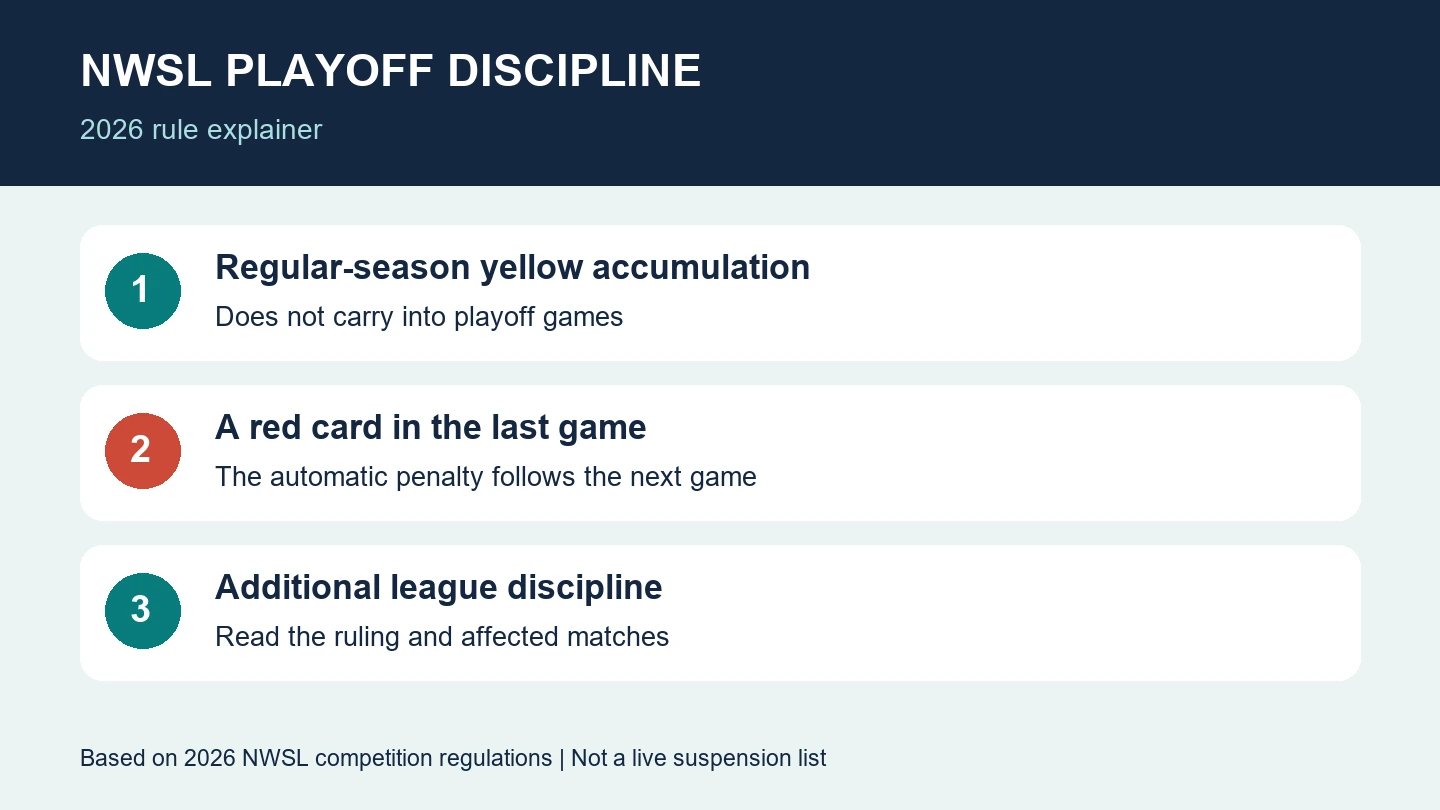
The short answer: the yellow-card ledger and red-card penalties separate
Regular-season yellow-card accumulation does not carry into NWSL playoff games. A red card in a team's final regular-season match can still produce a suspension for its next game. Those two statements belong together: hearing that yellow cards reset does not mean that every player becomes available when the postseason begins.
The distinction is supported by Angel City's 2026 playoff explainer and the league's 2026 competition regulations. The relevant question is why a player faces discipline. A caution total, a dismissal during one match and a separate disciplinary decision are different routes to an absence. A score app's yellow or red icon rarely explains all three.
For a playoff availability check, start with the reason for the sanction, then identify the match named in the official notice. The word “suspended” alone is not enough.
Consider two hypothetical teammates on the final weekend. One receives an ordinary caution that reaches the regular-season accumulation threshold. The other is sent off. Their disciplinary histories may look equally worrying in a match recap, but the postseason consequences differ. Do not transfer the first player's reset explanation to the second player's dismissal.
A third teammate could receive additional league discipline after the match. That situation requires reading the announced penalty; the explanation for ordinary yellow-card accumulation cannot settle it. Likewise, being eligible under disciplinary rules does not establish that a player is fit, selected or guaranteed to start. Injury, international duty and coaching decisions require their own checks.
This guide explains the rules available on October 29, 2026. It is a framework for reading match reports and late-season team news, rather than a list of current absences. Pair it with the NWSL standings when assessing the playoff race, then return to the latest official notices when the next lineup matters.
What a yellow card means before the final regular-season game
A caution is a referee's disciplinary action within a match. Accumulation is the competition's accounting across matches. The first does not automatically establish the second: seeing a yellow card means a player has been cautioned, while knowing whether it triggers a suspension requires the adjusted league total.
The 2026 player ladder begins with a one-game regular-season suspension at five accumulated cautions, then additional intervals of three, three and two, followed by two thereafter. Team staff have a different ladder, starting at three and continuing in intervals of two. The distinction matters when a coach appears next to a player on the same warning list: their starting thresholds are different.
Before the final regular-season match, an accumulation suspension can change a team's available lineup for its next regular-season fixture. That is why a warning can matter deeply in the playoff race without becoming a playoff ban itself. Check the remaining schedule before deciding which match a suspension would affect.
Why a raw season total can be misleading
The good-behavior mechanism makes a simple count of yellow icons incomplete. Players can earn a one-card deduction after five consecutive qualifying appearances without another caution, red card or supplemental discipline. A qualifying appearance requires at least ten minutes excluding stoppage time. The regulations also limit deductions and prevent a negative balance; staff follow their own separate process.
Spotrac's July good-behavior analysis illustrates why deductions became a prominent part of the discussion. Its season snapshot is historical, not a current warning list. The useful lesson for a late-October reader is methodological: a cumulative match-log statistic may describe all cautions received rather than the balance used for discipline.
For example, imagine a fictional player's profile showing five yellow cards across the season. It would be premature to announce a new suspension from that number alone. The chronology of a deduction, an earlier suspension and any second-yellow dismissal can change what the count represents. Use the league's current disciplinary notice rather than rebuilding a case from an incomplete app display.
This also prevents an unfair interpretation of a missing player. A player absent from the lineup has not necessarily accumulated too many cautions, and a player present despite a high raw total has not necessarily received an exception. The official accounting and the team's selection decision answer separate questions.
A red card on Decision Day can cost a playoff appearance
The last-game exception for a red card is the key postseason risk. The league's regulations send the automatic one-match suspension to the next game, expressly including a playoff match, the Championship or the next regular-season game in the following season. Qualification does not erase the dismissal.
Picture a hypothetical midfielder sent off late in the regular-season finale. If her team qualifies, the next game is its quarterfinal. Treat that as a potential quarterfinal absence unless an official decision changes the sanction. If the team does not qualify, there is no playoff game in which to serve it; the following season becomes relevant instead. A fixture disappearing from this year's calendar does not establish that the penalty disappears.
Two yellows in one match are a dismissal
A second caution in the same match is a sending-off offense under IFAB Law 12. It belongs in the dismissal branch of an availability check. Calling it “only yellow cards” obscures the decisive event: the referee has sent the player off.
NWSL's accumulation accounting also excludes both cautions involved in that second-caution sending-off. Do not add them as two ordinary season cautions and then independently announce an accumulation penalty. A match feed may display two yellow symbols and one red, but the disciplinary ledger is not a simple sum of the visible symbols.
This distinction is especially useful during a fast-moving finale. Read the match report's description, not just a cropped graphic. Was there one caution, a second-caution dismissal or a direct red? Those are different inputs before anyone starts calculating the next available match.
A semifinal red can affect the Championship
The same next-game principle makes a playoff dismissal significant beyond the match in progress. Imagine a fictional defender sent off in a semifinal her team wins. The Championship is next, so the automatic penalty can affect the final. If her team loses, its next relevant game lies beyond the tournament.
The three-round, single-elimination format gives teams few opportunities to absorb an absence. That is a sporting consequence of the bracket, not a separate disciplinary multiplier. Avoid importing a different tournament's two-yellow rule or assuming that a new playoff round automatically clears everything. For a real player, the latest official ruling remains the decisive evidence.
The league can add discipline after the referee's decision
The referee's decision determines the immediate match situation, but a league disciplinary announcement can establish additional consequences. When reading a report, distinguish the automatic suspension attached to a dismissal from any further match the league adds. The announced total, rather than the color of the original card alone, is what a lineup forecast needs.
The timing can also confuse fans. A player may already have served the automatic game when another sanction is announced. The league's March 27 Reyna Reyes notice described precisely that sequence: an automatic suspension had been served in Portland's March 25 match before the additional discipline. A reader who saw only the first absence could miss the later development.
That is why “the red-card match is over” and “the disciplinary case is complete” are not interchangeable. Similarly, the regular-season accumulation reset does not decide the treatment of a separately issued sanction. Read the league's stated matches and any subsequent decision rather than assuming a universal postseason exemption.
What Ana Tejada's September case actually shows
In its September 24 announcement, NWSL said Tejada received a red card following VAR review during Utah's September 20 match against Angel City. The automatic one-match penalty was followed by one additional match after the Disciplinary Committee's review. The notice specified September 27 against North Carolina and October 3 against Louisville as the two service dates.
This is a historical example of how a total was assembled, not a claim that Tejada remains suspended in late October. It also cannot tell us what penalty another player will receive for a different incident. Similar-looking clips may omit relevant evidence or fall under different findings.
A useful reading habit is to write the sequence in plain language: incident, on-field decision, automatic consequence, added decision, matches affected. If a report skips a step, look for the original league notice. For the separate question of which incidents video review can address during play, use our NWSL VAR guide. The two processes can relate to the same incident while doing different jobs.
VAR review and a suspension appeal answer different questions
Video review takes place within the officiating process of a match. A suspension appeal addresses a disciplinary outcome through a separate procedure. A coach disagreeing with a decision, a television replay revealing another angle and a club announcing an appeal are three developments; none, by itself, is an official ruling that restores a player's availability.
The IFAB VAR protocol restricts assistance to defined categories of incidents and leaves the final match decision with the referee. It is not a general invitation to reconsider every caution whenever a viewer dislikes the result. The relevant competition's adopted protocol matters, so a rule discussed for another tournament should not automatically be applied to NWSL.
NWSL's published 2026 appeal framework includes a preseason bond requirement and the player's written consent before a team appeal advances to the Independent Review Panel. Eligible teams can have up to two unsuccessful red-card appeals. That wording matters: it is not a blanket promise that every club has only two appeals of any outcome.
| Appeal outcome | Published consequence |
|---|---|
| Successful | Discipline is rescinded. |
| Unsuccessful, not frivolous | Discipline stays; one appeal is lost. |
| Unsuccessful, frivolous | Discipline doubles; appeal rights are lost for this season and the next. |
For fans, the practical distinction is between a challenge being lodged and a challenge being decided. If an article says a team intends to appeal, read that as news about the process. Wait for the decision before announcing that a player can return. Conversely, when discipline is officially rescinded, continuing to circulate the original suspension graphic can mislead other supporters.
A disagreement over officiating quality can remain reasonable after an appeal decision. Availability still needs a concrete answer from the responsible competition. Keep those discussions separate: one asks whether a call was convincing, while the other asks who can participate in the next match. Treat the latest official outcome as the anchor for the second question.
How to read an availability report without guessing
NWSL provides both an availability report and a disciplinary report. Use them for different parts of the same lineup question. One can help establish a player's reported availability; the other gives the disciplinary context that an injury update or a match recap may omit.
A useful note for yourself has three fields: the next fixture, the player's reported status and the reason stated by the source. This prevents “not starting,” “not in the squad” and “suspended” from becoming synonyms. A player may be on the bench without disciplinary restrictions, or unavailable for a reason unrelated to the caution ledger.
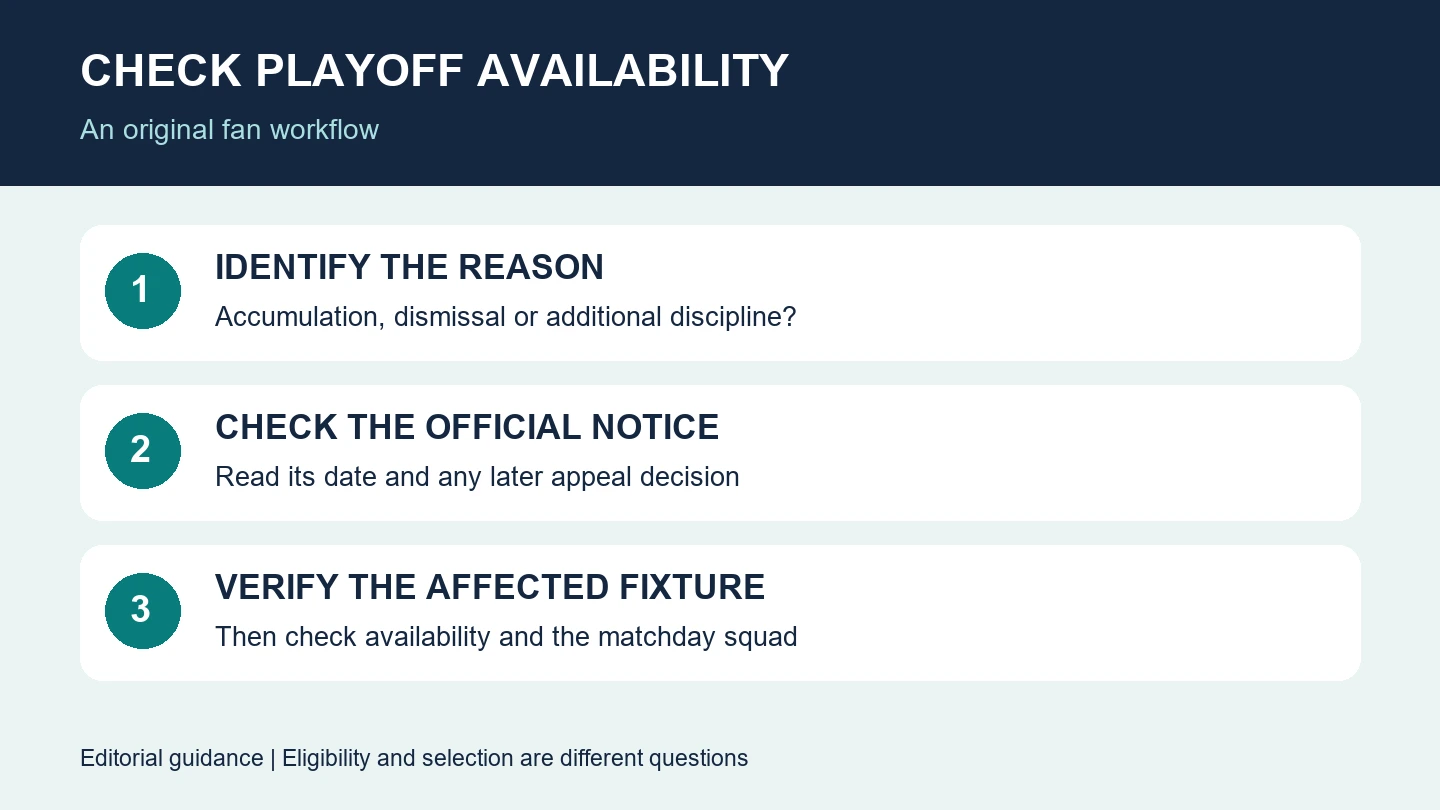
Check the date and the stated reason
Start with when the information was issued. A preview written before a disciplinary decision can be accurate at publication and incomplete later. A screenshot may omit its date entirely. When two sources disagree, compare their timestamps and whether either cites a later ruling before concluding that the league has changed the rules.
Then read the actual explanation. “Accumulation” describes a different mechanism from “additional discipline,” and an announced appeal outcome may supersede the first notice. If no reason is available, describe the absence without inventing one. That is more useful than turning a selection surprise into a confident accusation of a disciplinary problem.
For a hypothetical example, a Friday preview might say a midfielder is expected to return, while a Saturday league notice identifies an additional suspension. The newer official decision changes the availability assessment. The earlier writer's prediction does not create an exemption, and repeating the prediction after the ruling spreads avoidable confusion.
Separate an accumulation warning from a confirmed suspension
A warning list identifies players approaching a threshold. It is not a list of players already barred from the next match. Likewise, a caution in a match does not prove that every player previously on warning has reached the same consequence; deductions and the applicable ledger still matter.
Use cautious language while evidence is incomplete: “on accumulation warning” and “listed as suspended for the next match” communicate different facts. Once official lineups appear, check whether the player is in the matchday squad, but do not infer the reason for every omission. The games-today page helps locate the relevant fixture; the league and club notices supply the player-specific explanation.
A practical matchday checklist for playoff fans
When a disciplinary question appears in a group chat, resist starting with a remembered rule from another competition. First identify the event being discussed. An ordinary caution, a second-caution dismissal, a direct red and a later league sanction may all be described loosely as “card trouble,” but that phrase does not determine availability.
- Locate the next actual fixture. Establish whether the team has another regular-season game, a playoff match or no remaining match this season.
- Name the disciplinary route. Read the match report and notice to distinguish accumulation from a dismissal or additional discipline.
- Find the current ruling. Check the league's disciplinary report and any later appeal outcome, rather than relying on a screenshot of an earlier notice.
- Separate eligibility from selection. Use availability news and the matchday squad to understand fitness and selection; do not convert every missing name into a suspension.
For a hypothetical final-weekend conversation, compare these statements: “She was on accumulation warning,” “She was sent off,” and “The league announced an additional game.” Each gives a useful lead, but they require different follow-up evidence. Asking for the official reason and affected fixture is faster than debating a blanket reset that never described all three situations.
Be equally careful with timing. A fan who checks the correct page several days before the match may still need to revisit it after a new ruling. Keep the source date next to any player-specific note you share. If the available report does not settle the point, describe what it confirms and leave the unresolved part open.
The reliable 2026 distinction is clear: the regular-season yellow-card accumulation ledger does not move into playoff games, while a final-game red can follow a player into the next match. Additional discipline and appeal decisions need their own reading. Use that framework with the NWSL schedule and the latest official notices to make a grounded playoff availability check.
Loading comments…