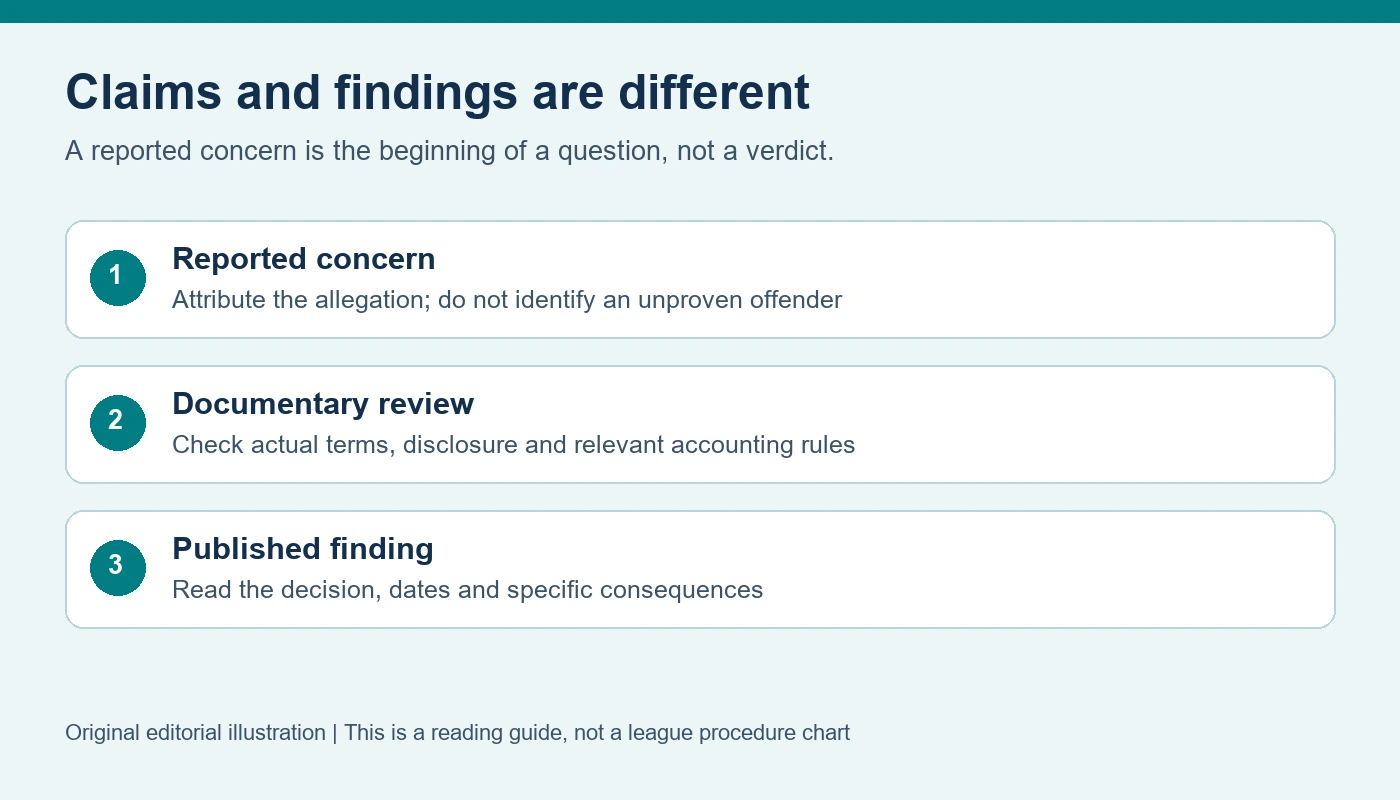
What the latest GM complaints do and do not establish
The latest salary-cap debate starts with an important distinction: anonymous executives describing suspected rule-breaking is news, but it is not a league finding that a particular club cheated. An official violation requires evidence about actual arrangements and an assessment under the relevant rules. A crowded roster of recognizable players, a large reported contract or a frustrated rival's comment cannot substitute for that work.
In its October 28 account of ESPN's anonymous GM survey, Just Women's Sports identified concerns involving marketing deals, transfer discounts and jobs for spouses. Those categories explain what respondents were worried about. They do not establish that every marketing contract, discounted transfer or spouse appointment is prohibited, and they do not identify a current club proven to have violated the cap.
This matters because the same public facts can support several possible explanations. A player might have an independent commercial opportunity, a club might be using an authorized spending exception, or an arrangement might deserve further investigation. An outsider who cannot inspect the paperwork cannot reliably choose among those explanations merely from an announcement photo. The right question is what the agreement provides, who pays and how the transaction was disclosed and counted.
The distinction also protects the quality of discussion about competitive balance. Supporters can ask whether the rules are fair, understandable and consistently enforced without alleging that a named person committed misconduct. Conversely, complexity should not become a blanket excuse for avoiding scrutiny. If a finding is published, its dates, reasoning and sanctions should be examined directly, rather than softened into a generic complaint about confusing rules.
This guide separates the spending system from the evidence needed to establish a breach, then uses the official 2024 Angel City decision as a documented example. It does not present that historical case as evidence against a different team in 2026. For the surrounding season framework, our NWSL rules guide provides context; financial compliance depends on the specific transaction and the rules in force when it occurred.
A large payroll is not automatically an illegal payroll
The figure a supporter calls the salary cap may be only one part of the permitted spending system. The NWSL's official competition updates describe ordinary cap accounting alongside mechanisms that can change how much a club may spend or how a particular expense is treated. Applying one headline limit to every dollar associated with a roster will therefore produce unreliable conclusions.
Approved mechanisms can change the accounting
HIP spending is the clearest current example: it is a defined way to pay eligible players beyond the ordinary cap, subject to conditions. Historical allocation money also has transition rules. A team using an authorized balance is not automatically evading the cap simply because an outside estimate exceeds a simplified ceiling. The source of the flexibility, its expiration date and the transaction's eligibility all matter.
Club circumstances can also differ. The league's published expansion roster-building provisions illustrate why one should check the applicable rules instead of assuming every team has identical assets at every moment. That does not mean every claimed exception is valid; it means the existence and conditions of the exception must be tested before making an accusation.
For a hypothetical comparison, one club could pay a substantial amount in permitted benefits while another directs more money into salary. The total cash outlay and the total cap charge need not match dollar for dollar. Supporters looking only at reported wages could underestimate the first club's investment or misunderstand the second club's remaining room. Neither conclusion can be resolved by reputation alone.
A transfer fee is not the same as a player salary
A fee paid to acquire a registration and compensation paid to the player are different transactions. The 2026 spending announcement describes net transfer-fee accounting with its own threshold and an excess-fee cap charge. It is therefore misleading to add a reported transfer fee to one year's salary and label the result the player's annual cap charge.
The reverse mistake is to assume a low publicly reported transfer fee proves a secret arrangement. A seller might accept different terms for sporting or contractual reasons; an actual undisclosed side payment would require evidence. Reports that say only that a fee is undisclosed leave a gap in public knowledge. They do not fill that gap with either proof of compliance or proof of misconduct.
When outside payments and benefits need closer examination
A payment's commercial label does not answer every compliance question. An endorsement can represent genuine work for an outside business. An arrangement described as marketing could also raise questions about whether it is connected to a player's employment and how it should be treated. The existence of the label proves neither conclusion. Reviewers need the underlying terms and the relevant policy, not just an invoice heading.
The public standard player agreement recognizes endorsement arrangements subject to conditions. That is why it would be wrong to describe all outside earnings as hidden salary. It would be equally wrong to assume that calling a payment a sponsorship settles whether it requires disclosure or affects league accounting. The current debate is about the relationship between transactions, not whether professional athletes can have commercial careers.
Useful questions include who arranged the opportunity, what services are actually required, who funds the payment and whether an agreement is contingent on joining or remaining with a club. These are investigative questions, not a substitute rulebook. None alone establishes the result under the league's policies. A spouse's job, for example, requires facts about the role and agreement before any conclusion can responsibly be drawn; a family connection is not proof of a fictitious appointment.
Why disclosure matters as much as the label
The documented Angel City case shows why undisclosed contractual benefits deserve attention. A benefit can be valuable compensation even when it is not described as base salary. If the people assessing compliance do not receive the complete agreement, they cannot assess the complete package. That is different from a supporter simply being unable to find private salary information online: public secrecy and nondisclosure to the league are not the same thing.
Even the phrase side letter needs care. The public collective bargaining materials themselves contain negotiated side letters. An additional written agreement is not inherently improper because of its name. The relevant questions are whether it is permitted, disclosed as required and treated correctly. In the historical enforcement case, the league described specific undisclosed player arrangements and a resulting cap breach. Those findings provide the substance; the phrase alone does not.
For fans, the safest practical distinction is between asking for transparent enforcement and asserting a verdict without the transaction. The first can improve accountability. The second can misidentify lawful player income as misconduct while overlooking the documentary questions that actually need answers.
What the Angel City ruling actually found
The October 3, 2024 NWSL decision is a concrete example because the league published findings and sanctions. It said Angel City entered five undisclosed side letters with players in 2023 and that undisclosed benefits produced an approximately $50,000 cap overage for four weeks in 2024. The distinction between agreement dates and the season of the cap breach is part of the finding, not a contradiction.
The league imposed a $200,000 fine and deducted three standings points. It also suspended Julie Uhrman and Angela Hucles Mangano from player-transaction duties for the remainder of the 2024 calendar year. Those were specified restrictions for a specified period. They should not be described as continuing suspensions in 2026, and the announcement should not be recycled as news of a fresh breach.
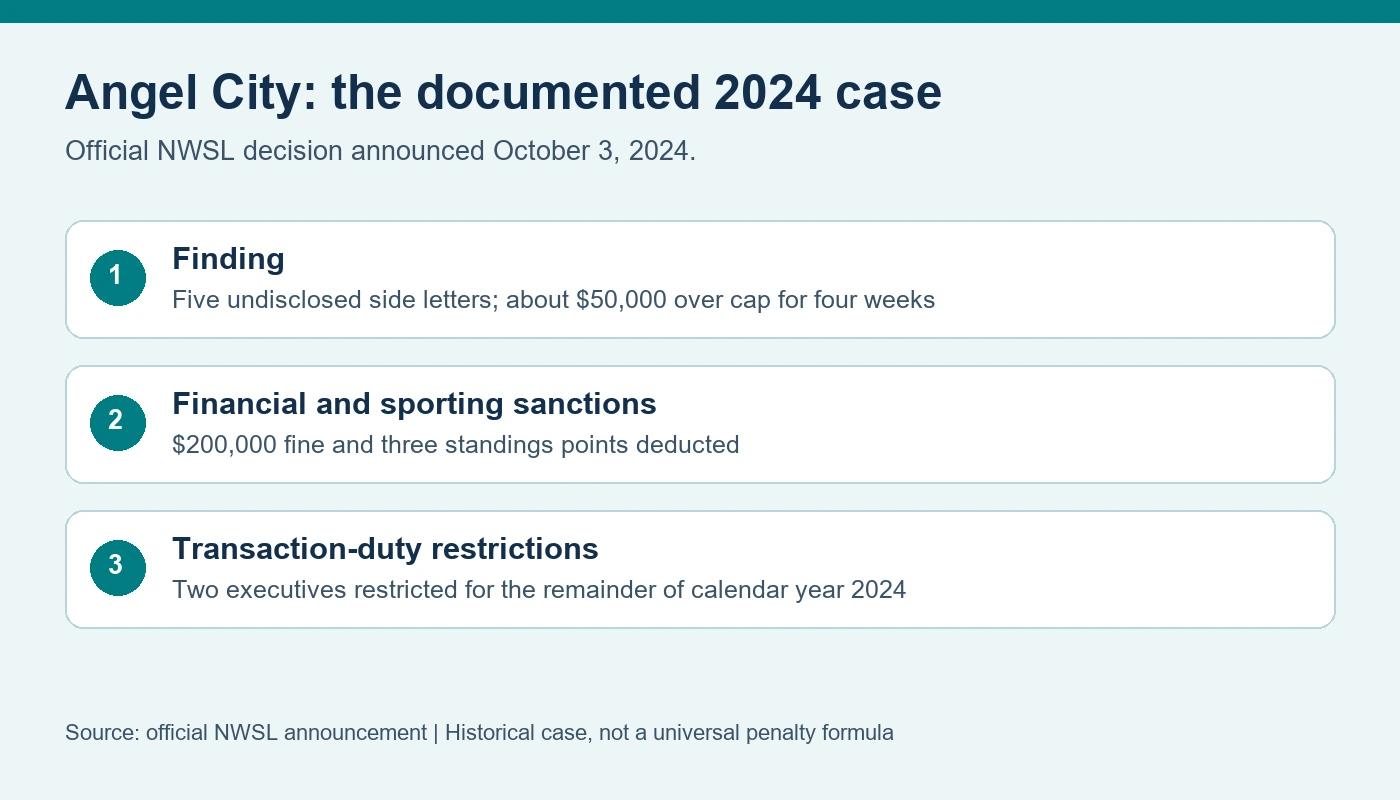
The $50,000 figure also should not be multiplied by four as if the league said a separate $50,000 breach occurred every week. The announcement describes an approximate overage over a period. Nor does the relationship between the fine and the overage create a general four-times formula for future penalties. A single decision is evidence of what happened in that case, not a complete sentencing table.
Sporting sanctions make financial enforcement immediately relevant to fans. A points deduction changes the competition's accounting as well as a club's expenses. It is different from losing a match on the field, and a historical table should preserve that distinction. When comparing seasons, readers need the adjusted official record rather than an informal points total reconstructed only from wins and draws.
The strongest lesson from this example is evidentiary. The league identified the arrangements, explained the cap effect, named the sanctions and specified their timing. A current rumor that lacks those elements is not equivalent. The historical finding supports scrutiny of disclosure and benefits, but it provides no basis for declaring a different club guilty because its roster looks expensive. Each allegation still needs its own evidence and current ruling.
How audits, cap reports and revenue checks differ
Discussion often uses the word audit for several different forms of oversight. A review of club spending asks whether transactions fit the rules. A cap report presents accounting information. An examination of league revenue addresses the money that feeds the collectively negotiated compensation system. Those activities can inform one another, but they do not ask exactly the same question or necessarily produce a public verdict.
Player-spending reviews examine club compliance
In announcing the Angel City sanctions, the league said it would conduct annual investigations and audits of player spending across clubs. That published commitment is more concrete than speculation that no one checks the paperwork. It is still not a public certificate that every transaction at every club has been reviewed and approved. The announcement does not provide a live audit dashboard or a complete schedule of later findings.
A useful hypothetical shows the distinction. A reviewer could find that a payment was correctly disclosed but assigned to the wrong accounting category. Another arrangement could involve a document that was never submitted. Those possibilities require different factual inquiries even if both eventually affect the cap total. Supporters cannot infer which occurred from the size of a reported contract, and an absence of a public sanction does not reveal the contents of confidential review work.
Union oversight protects the negotiated compensation system
The public CBA separately provides union access to audited financial statements and relevant supporting records, and requires monthly team cap reports to the union. These provisions give the player representative information rights; they do not promise that every private contract or financial record will become a public document.
That distinction helps explain why players and supporters may know different things about the market. Confidential oversight can exist without a publicly searchable salary database. Fans are entitled to ask for clear explanations of decisions, but incomplete public information is not proof that the union has no access to records or that the league has performed no review.
Revenue checking also protects a different interest from policing a particular club's upper spending limit. If compensation is linked to qualifying league revenue, the calculation of that revenue matters to the amount available to players. Compliance therefore includes both enforcing limits and honoring negotiated financial obligations. A debate framed solely around stopping wealthy teams can miss that second purpose.
How to assess the next salary-cap allegation
When a new story breaks, begin by identifying its claim rather than its tone. Does it report a suspicion, a request for investigation, an investigation in progress or a completed finding? Those are different stages. A forceful anonymous quotation can explain frustration without moving a matter from the first stage to the last. An official decision can establish a breach without revealing every confidential document behind it.
Then check the date of the arrangement and the date of the rule. A contract agreed under one framework may have financial effects in a later season, as the Angel City decision illustrates. Likewise, an announced future change should not be used to judge an earlier transaction as if it had already applied. Our 2027 free-agent coverage follows player availability; a player-movement update and a compliance ruling remain different kinds of information.
A practical evidence checklist for supporters
- Identify who is making the claim and whether the underlying information is public.
- Separate actual salary, potential bonuses, a transfer fee and the relevant cap charge.
- Check whether an approved mechanism or season-specific provision could explain the apparent difference.
- Look for evidence about disclosure and the terms of any connected arrangement.
- Read the actual finding and its scope before describing a named club as sanctioned.
- Keep historical penalties separate from current suspensions, standings and eligibility.
This approach still leaves room for strong criticism. Supporters can argue that a complicated system is hard to understand, that published decisions need clearer explanations or that the financial structure should change. Those are policy positions. They become stronger when they do not depend on treating an unproven allegation as an established fact.
The question raised by the latest survey is therefore worth pursuing: how does the league ensure that teams compete under the same enforceable framework? The answer requires both clear rules and credible scrutiny of actual transactions. For now, the documented lesson is that undisclosed arrangements and resulting cap effects can have sporting consequences. Whether another arrangement crosses that line must be established on its own evidence.
Loading comments…